1. Summary of Significant Accounting Policies
Principles of Consolidation
The consolidated financial statements include the accounts of the company and its majority-owned subsidiaries. All significant intercompany transactions are eliminated.
Use of Estimates
The preparation of financial statements in conformity with generally accepted accounting principles requires management to make estimates and assumptions that affect the amounts reported in the consolidated financial statements and accompanying notes. Actual results could differ from those estimates.
Cash and Short-term Investments
Short-term investments which have a maturity of ninety days or less at time of purchase are considered cash equivalents in the consolidated statement of cash flows. The carrying amount reported in the consolidated balance sheet for short-term investments approximates fair value.
Financial Instruments
The company uses various financial instruments, including derivative financial instruments, for purposes other than trading. The company does not use derivative financial instruments for speculative purposes. Derivatives used as part of the company's risk management strategy are designated at inception as hedges and measured for effectiveness both at inception and on an ongoing basis.
Inventories
Inventories are stated at the lower of cost or market. Cost is determined on the first-in, first-out (FIFO) method.
Property, Plant and Equipment
Property, plant and equipment are stated at cost. Depreciation is computed on the straight-line method for financial reporting purposes and on accelerated methods for tax reporting purposes. Leasehold improvements are amortized over the shorter of the term of the related lease or the life of the improvement. Long-lived assets are reviewed for impairment whenever changes in circumstances or events may indicate that the carrying amounts may not recoverable. If the fair value is less than the carrying amount of the asset, a loss is recognized for the difference.
Cost in Excess of Net Assets of Companies Acquired
The cost in excess of net assets of companies acquired is being amortized on a straight-line basis over periods of 20 to 40 years. Management reassesses the carrying value and remaining life of the excess cost over fair value of net assets of companies acquired on an ongoing basis. Whenever events indicate that the carrying values are impaired, the excess cost over fair value of those assets is adjusted appropriately. As of December 31, 2000, management believes there is no impairment with respect to these assets.
Foreign Currency Translation
The assets and liabilities of foreign operations are translated at the exchange rates in effect at the balance sheet date, with the related translation gains or losses reported as a separate component of shareholders' equity. The results of foreign operations are translated at the monthly weighted average exchange rates.
Income Taxes
Income taxes are accounted for under the liability method. Deferred taxes reflect the tax consequences on future years of differences between the tax bases of assets and liabilities and their financial reporting amounts.
Earnings Per Share ("EPS")
Basic EPS is computed by dividing income available to common shareholders by the weighted average number of common shares outstanding for the period. Diluted EPS reflects the potential dilution that would occur if securities or other contracts to issue common stock were exercised or converted into common stock.
Comprehensive Income
Comprehensive income is defined as the aggregate change in shareholders' equity excluding changes in ownership interests. The foreign currency translation adjustments included in comprehensive income have not been tax effected as investments in foreign affiliates are deemed to be permanent.
Segment Reporting
Operating segments are defined as components of an enterprise for which separate financial information is available that is evaluated regularly by the chief operating decision makers in deciding how to allocate resources and in assessing performance. The company's operations are classified into two reportable business segments, the distribution of electronic components and the distribution of computer products.
Revenue Recognition
The company recognizes revenue when customers' orders are shipped.
Software Development Costs
The company capitalizes certain costs incurred in connection with developing or obtaining software for internal use. The company capitalized $21,945,000 and $23,933,000 of computer software costs in 2000 and 1999, respectively. Capitalized software costs are amortized on a straight-line basis over the estimated useful life of the software, which is generally three years.
Reclassification
Certain prior year amounts have been reclassified to conform with current year presentation.
Impact of Recently Issued Accounting Standards
In June 1998, the Financial Accounting Standards Board issued Statement No. 133, "Accounting for Derivative Instruments and Hedging Activities." As its effective date was deferred, the company will adopt the new Statement as of January 1, 2001. The Statement will require the company to recognize all derivatives on the balance sheet at fair value. Gains and losses resulting from changes in the value of the derivatives would be accounted for depending on the intended use of the derivative and whether it qualifies for hedge accounting. Due to the company's limited use of derivative financial instruments, adoption of Statement No. 133 is not expected to have a significant effect on the company's consolidated results of operations or financial position.
2. Acquisitions
During 2000, the company acquired California-based Wyle Electronics and Wyle Systems (collectively, "Wyle"), part of the electronics distribution businesses of Germany-based E.ON AG (formerly VEBA AG), and the open computing alliance subsidiary of Merisel, Inc. ("MOCA"), one of the leading distributors of Sun Microsystems products in North America. In addition, the company acquired Tekelec Europe ("Tekelec"), one of Europe's leading distributors of high-tech components and systems, and Jakob Hatteland Electronic AS ("Hatteland"), one of the Nordic region's leading distributors of electronic components. The company also acquired a majority interest in the electronics distribution business of Rapac Electronics Ltd., one of the leading distribution groups in Israel, and Dicopel S.A. de C.V., one of the largest distributors in Mexico. The company increased its holdings in Silverstar Ltd. S.p.A. and Consan Incorporated to 100 percent, and acquired an additional 6 percent interest in Scientific and Business Minicomputers, Inc. ("SBM"). The aggregate cost of these acquisitions was $1,249,015,000, which includes 775,000 shares of the company's common stock valued at $27,754,000.
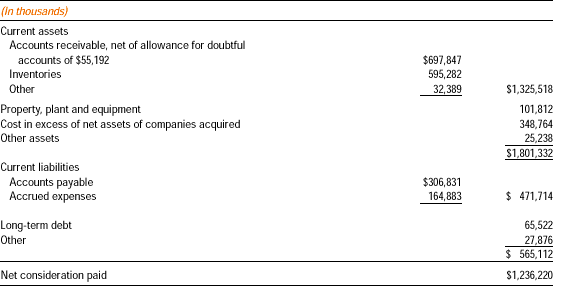
A summary of the allocation of the aggregate consideration paid for the aforementioned acquisitions, excluding amounts paid for increases in majority holdings, to the fair market value of assets acquired and liabilities assumed is as follows:
Set forth below is the unaudited pro forma combined summary of operations for the years ended December 31, 2000 and 1999 as though the acquisitions made during 1999 and 2000 occurred on January 1, 1999:
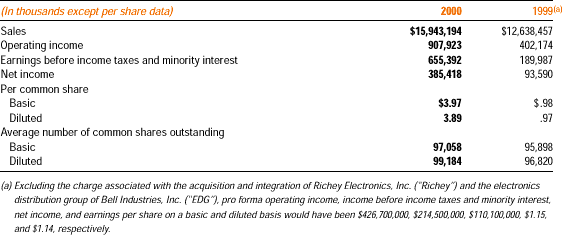
The unaudited pro forma combined summary of operations does not purport to be indicative of the results which actually would have been obtained if the acquisitions had been made at the beginning of 1999 or of those results which may be obtained in the future. The company has achieved cost savings from the acquisition of Richey and EDG and expects to achieve further substantial cost savings from the combination of its acquisitions. The anticipated cost savings have not been reflected in the unaudited pro forma combined summary of operations. In addition, the unaudited pro forma combined summary does not reflect any sales attrition which may result from the combinations.
The unaudited pro forma combined summary of operations includes the effects of the additional interest expense on debt incurred in connection with the acquisitions as if the debt had been outstanding from the beginning of the periods presented. In addition, the summary of operations includes amortization of the cost in excess of net assets of companies acquired in connection with the acquisitions as if they had been acquired from the beginning of the periods presented.
In 2000, the company recorded $31,354,000 as cost in excess of net assets of companies acquired to integrate Wyle into the company. Of the amount recorded, $9,770,000 represented costs associated with the closing of various office facilities and distribution and value-added centers, $7,390,000 represented costs associated with severance and other personnel costs, $7,890,000 represented professional fees principally related to investment banking and legal and accounting services, and $6,304,000 represented costs associated with outside services related to the conversion of systems and certain other costs of the integration of Wyle into the company. Of the total amount recorded, $9,109,000 has been spent to date. Approximately $6,900,000 of the remaining amount relates to severance and other personnel costs to be paid in 2001, $9,500,000 relates to vacated facilities leased with expiration dates through 2005, and the balance relates to various license and maintenance agreement obligations, with various expiration dates through 2003, and other costs associated with the integration of Wyle into the company. In the first quarter of 2001, the company expects to record a special charge of not more than $10,000,000 related to the integration of Wyle into the company.
In connection with certain acquisitions, the company may be required to make additional payments that are contingent upon the acquired businesses achieving certain operating goals. During 2000, the company made additional payments of $2,365,000, which have been capitalized as cost in excess of net assets of companies acquired.
During 1999, the company acquired Richey, a leading specialty distributor of interconnect, electromechanical, and passive electronic components and provider of related value-added services to customers throughout North America, and EDG, one of the ten largest distributors of electronic components in North America. In addition, during 1999 the company acquired a two-thirds interest in Panamericana Comercial Importadora, S.A., the largest distributor of electronic components in Brazil, and a 70 percent interest in the Elko Group, the largest distributor of electronic components in Argentina. The company also increased its holdings in Spoerle Electronic Handelsgesellschaft mbH ("Spoerle") and Support Net, Inc. to 100 percent and acquired an additional 4 percent interest in SBM. Also during 1999 Spoerle acquired Industrade AG, one of Switzerland's leading distributors of electronic components and related products. The aggregate cost of these acquisitions was $428,969,000.
In 1999, the company recorded a special charge of $24,560,000 related to the acquisition and integration of Richey and EDG The company also recorded an additional $38,241,000, as adjusted, as cost in excess of net assets of companies acquired. Of the total amount recorded, $30,301,000 represented costs associated with the closing of various office facilities and distribution and value-added centers, $12,442,000 represented costs associated with severance and other personnel costs, $14,662,000 represented costs associated with outside resources related to the conversion of systems, professional fees principally related to legal and accounting services, and certain other costs of the integration of these business into the company, and $5,396,000 represented the write-down of inventories to estimated fair value and supplier termination costs. Of the expected $54,700,000 to be spent in cash in connection with the acquisition and integration of Richey and EDG, $33,090,000 has been spent to date. The remaining $21,610,000 principally relates to vacated facilities leased with various expiration dates through 2010.
It is not anticipated that the integration-related items will have a significant impact upon cash flow in any one particular year.
The cost of each acquisition has been allocated among the net assets acquired on the basis of the respective fair values of the assets acquired and liabilities assumed. The preliminary purchase price allocations for the 2000 acquisitions are subject to adjustment in 2001 when finalized. For financial reporting purposes, the acquisitions are accounted for as purchase transactions in accordance with Accounting Principles Board Opinion No. 16, "Business Combinations." Accordingly, the consolidated results of the company in 2000 include these companies from their respective dates of acquisition. The aggregate consideration paid for all acquisitions exceeded the net assets acquired by $356,488,000 and $303,326,000 in 2000 and 1999, respectively.
3. Investments
During 2000, the company entered into three new e-commerce ventures. At December 31, 2000, the company held an interest in eConnections, which serves suppliers, distributors, OEMs, and other members of the electronics supply chain continuum by providing them with integrated, independent, and custom-tailored solutions, improving communications, cutting costs, and enhancing margins. In addition, the company acquired an interest in Viacore, Inc., an eBusiness service provider of a reliable and transparent eBusiness hub for business processes between trading partners in the information technology supply chain, and an interest in Buckaroo.com, an internet marketplace for the DRAM industry. These investments are accounted for using the cost method.
In October 2000, QuestLink Technology, Inc. and ChipCenter LLC, two e-commerce companies the company had previously invested in, agreed to be merged to form eChips, a sales and marketing channel that serves the global electronics engineering and purchasing communities. This investment will be accounted for using the equity method.
During 1999, the company acquired an interest in VCE Virtual Chip Exchange, Inc. ("VCE"), an Internet marketplace for electronic components. VCE matches buyers with sellers and provides its members with supporting services such as real-time market availability and pricing information by device type or technology. This investment is accounted for using the equity method. The company also acquired an interest in Questlink Technology, Inc., a technical design resource for engineers and an interest in Technologies Interactives Mediagrif Inc. These investments are accounted for using the cost method.
In addition, the company has a 50 percent interest in Marubun/Arrow, a joint venture with Marubun Corporation, Japan's largest independent components distributor and a 50 percent interest in Altech Industries (Pty) Ltd., a joint venture with Allied Technologies Limited, a South African electronics distributor. These investments are accounted for using the equity method.
4. Debt
During 2000, the company's revolving credit agreement (the "global multi-currency credit agreement"), as then amended, provided up to $650,000,000 of available credit with a maturity date of September 2001. The interest rate for loans under this facility was at the applicable eurocurrency rate (6.56125% for U.S. dollar denominated loans at December 31, 2000) plus a margin of .225%. The company pays the banks a facility fee of .125% per annum.
In March 2000, the company entered into a 364-day $550,000,000 credit facility which expires in March 2001. There were no outstanding borrowings under this facility at December 31, 2000.
In October 2000, the company issued the following series of senior debentures to finance the acquisition of Wyle, with the proceeds in excess of the applicable purchase price utilized for general corporate purposes:

The floating rate notes bear interest at LIBOR plus 1% with interest payable on a quarterly basis.
In December 2000, the company entered into a $400,000,000 short-term credit facility scheduled to mature on March 19, 2001 and which, under certain conditions, could be extended at the company's option to June 19, 2001.
In November 1999, the company established a commercial paper program, providing for the issuance of up to $1,000,000,000 in aggregate maturity value of commercial paper. Interest rates on outstanding commercial paper borrowings as of December 31, 2000, ranged from 6.96% to 7.65% with an effective average rate of 7.35%.
At December 31, short-term debt consists of the following:
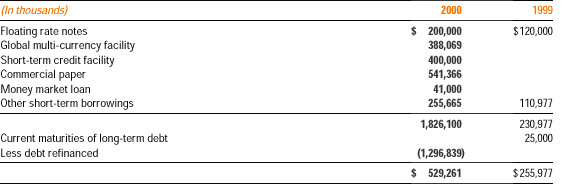
Other short-term borrowings are principally utilized to support the working capital requirements of certain foreign operations. The weighted average interest rates on these borrowings at December 31, 2000 and 1999 were 5.5% and 4.8%, respectively.
Long-term debt consisted of the following at December 31:
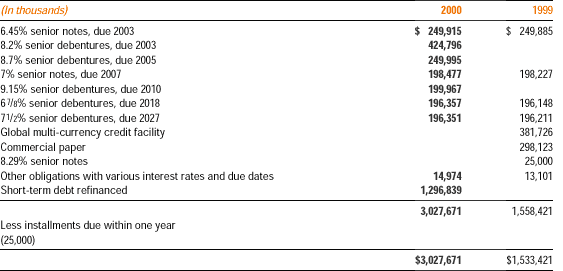
The 7% senior notes and the 7 1/2% senior debentures are not redeemable prior to their maturity. The 6 7/8% senior debentures, 6.45% senior notes, 8.2% senior debentures, 8.7% senior debentures, and 9.15% senior debentures may be prepaid at the option of the company subject to a "make whole" clause. The 8.29% senior notes were repaid in December 2000.
In February 2001, the company entered into a 364-day $625,000,000 credit facility (the “364-day facility”) which expires in February 2002 and a three-year revolving credit agreement providing up to $625,000,000 of available credit. These credit facilities replaced the previously existing 364-day credit facility and the global multi-currency credit facility. The 364-day facility and three-year revolving credit facility bear interest at the applicable eurocurrency rate plus a margin of .75% and .725%, respectively. The company pays the banks a facility fee of .125% and .15% per annum, respectively, related to the 364-day facility and three-year revolving credit facility. In addition, during the first quarter of 2001, the company completed the sale of $1,523,750,000 principal amount at maturity of zero coupon convertible senior debentures (the “convertible debentures”) due February 21, 2021. The convertible debentures were priced with a yield to maturity of 4% per annum and may be converted into the company’s common stock at a conversion price of $37.83 per share. Holders of the convertible debentures may require the company to repurchase the convertible debentures (at the issue price plus accrued original issue discount through the date of repurchase) on February 21, 2006, 2011, or 2016. The company, at its option, may redeem all or part of the convertible debentures (at the issue price plus accrued original issue discount through the date of redemption) any time on or after February 21, 2006. The net proceeds of approximately $672,000,000 were used to repay short-term debt. The consolidated balance sheet has been restated to reflect the reclassification of certain short-term debt to long-term as a result of the debt refinancing subsequent to December 31, 2000.
At December 31, 2000, the estimated fair market value of the 7% senior notes was 93 percent of par, the 7 1/2% senior debentures was 78 percent of par, the 6 7/8% senior debentures was 77 percent of par, the 6.45% senior notes was 95 percent of par, the 8.2% senior debentures was 98 percent of par, the 8.7% senior debentures was 102 percent of par, and the 9.15% senior debentures was 102 percent of par. The balance of the company's borrowings approximate their fair value.
Annual payments of borrowings during each of the years 2001 through 2005, reflecting the refinancing, are $529,261,000, $4,222,000, $675,359,000, $625,608,000, and $250,474,000, respectively, and $1,472,008,000 for all years thereafter.
The three year revolving credit facility, the 364-day facility, the short-term credit facility, and the senior notes and debentures limit the incurrence of additional borrowings and require that working capital, net worth, and certain other financial ratios be maintained at designated levels.
5. Income Taxes
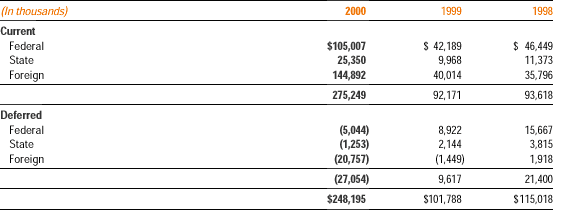
The provision for income taxes for the year ended December 31 consists of the following:
The principal causes of the difference between the U.S. statutory and effective income tax rates for the years ended December 31 are as follows:
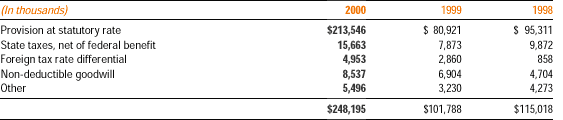
For financial reporting purposes, income before income taxes attributable to the United States was $277,188,000 in 2000, $131,007,000 in 1999, and $183,048,000 in 1998 and income before income taxes attributable to foreign operations was $332,943,000 in 2000, $100,198,000 in 1999, and $89,267,000 in 1998.
The significant components of the company's deferred tax assets at December 31, which are included in prepaid expenses and other assets, are as follows:
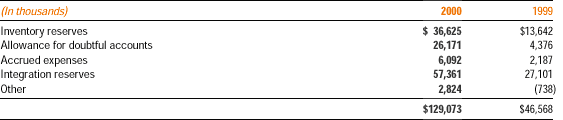
Deferred tax liabilities, which are included in other liabilities, were $20,995,000 and $39,474,000 at December 31, 2000 and 1999, respectively. The deferred tax liabilities are principally the result of the differences in the bases of the company's German assets and liabilities for tax and financial reporting purposes.
6. Shareholders' Equity
In October 2000, the shareholders approved an amendment to the Certificate of Incorporation to increase the number of authorized shares of common stock from 120,000,000 shares to 160,000,000 shares.
The company has 2,000,000 authorized shares of serial preferred stock with a par value of $1.
In 1988, the company paid a dividend of one preferred share purchase right on each outstanding share of common stock. Each right, as amended, entitles a shareholder to purchase one one-hundredth of a share of a new series of preferred stock at an exercise price of $50 (the "exercise price"). The rights are exercisable only if a person or group acquires 20 percent or more of the company's common stock or announces a tender or exchange offer that will result in such person or group acquiring 30 percent or more of the company's common stock. Rights owned by the person acquiring such stock or transferees thereof will automatically be void. Each other right will become a right to buy, at the exercise price, that number of shares of common stock having a market value of twice the exercise price. The rights, which do not have voting rights, may be redeemed by the company at a price of $.01 per right at any time until ten days after a 20 percent ownership position has been acquired. In the event that the company merges with, or transfers 50 percent or more of its consolidated assets or earning power to, any person or group after the rights become exercisable, holders of the rights may purchase, at the exercise price, a number of shares of common stock of the acquiring entity having a market value equal to twice the exercise price. The rights, as amended, expire on March 1, 2008.
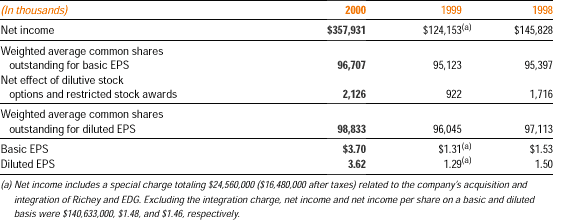
7. Earnings Per Share
The following table sets forth the calculation of basic and diluted earnings per share ("EPS") for the years ended December 31:
8. Employee Stock Plans
Restricted Stock Plan
Under the terms of the Arrow Electronics, Inc. Restricted Stock Plan (the "Plan"), a maximum of 3,960,000 shares of common stock may be awarded at the discretion of the board of directors to key employees of the company.
Shares awarded under the Plan may not be sold, assigned, transferred, pledged, hypothecated, or otherwise disposed of, except as provided in the Plan. Shares awarded become free of forfeiture
restrictions (i.e., vest) generally over a four-year period. The company awarded 211,200 shares of common stock to 115 key employees in early 2001 in respect of 2000, 134,784 shares of common stock to 43 key employees during 2000, 182,525 shares of common stock to 106 key employees in early 2000 in respect of 1999, 325,750 shares of common stock to 114 key employees during 1999, and 215,400 shares of common stock to 140 key employees during 1998.
Forfeitures of shares awarded under the Plan were 31,624, 10,335, and 7,359 during 2000, 1999, and 1998, respectively. The aggregate market value of outstanding awards under the Plan at the respective dates of award is being amortized over the vesting period, and the unamortized balance is included in shareholders' equity as unamortized employee stock awards.
Stock Option Plans
Under the terms of various Arrow Electronics, Inc. Stock Option Plans (the "Option Plans"), both nonqualified and incentive stock options for an aggregate of 21,500,000 shares of common stock were authorized for grant to directors and key employees at prices determined by the board of directors at its discretion or, in the case of incentive stock options, prices equal to the fair market value of the shares at the dates of grant. Options granted under the plans after May 1997 became exercisable in equal installments over a four-year period. Previously, options became exercisable over a two- or three-year period. Options currently outstanding have terms of ten years.
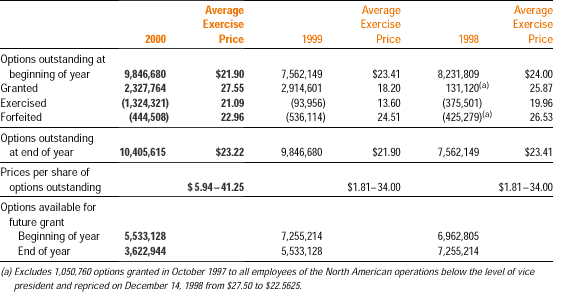
Included in the 1999 options granted are the options converted in January 1999 relating to the acquisition of Richey. The options converted on January 7, 1999 totaled 233,381, with a weighted
average exercise price of $21.17 per share.
In October 1997, all employees of the North American operations below the level of vice president were granted a special award of stock options totaling 1,255,320 at the then market price of the company’s stock as an incentive related to the realignment of the North American Components Operations (“NACO”). In December 1998, the board of directors approved the repricing of the remaining unforfeited options, totaling 1,050,760, reducing the exercise price from $27.50 to $22.5625.
The following information relates to the Option Plans for the years ended December 31:
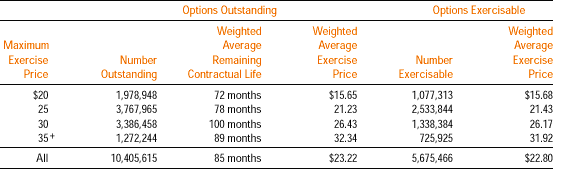
The following table summarizes information about stock options outstanding at December 31, 2000:
The company applies Accounting Principles Board Opinion No. 25, "Accounting for Stock Issued to Employees," and related interpretations in accounting for the Option Plans.
Had stock-based compensation costs been determined as prescribed by SFAS No. 123, “Accounting for Stock-Based Compensation,” net income would have been reduced by $6,144,000 ($.08 per share on a diluted basis) in 2000, $4,143,000 ($.03 per share on a diluted basis) in 1999, and $6,650,000 ($.04 per share on a diluted basis) in 1998.
The estimated weighted average fair value, utilizing the Black-Scholes option-pricing model, at the date of option grant during 2000, 1999, and 1998 was $12.25, $7.07, and $8.35, per share, respectively. The weighted average fair value was estimated using the following assumptions:

There is no expected dividend yield.
Stock Ownership Plan
The company maintains a noncontributory employee stock ownership plan which enables most North American employees to acquire shares of the company's common stock. Contributions, which are determined by the board of directors, are in the form of common stock or cash which is used to purchase the company's common stock for the benefit of participating employees. Contributions to the plan for 2000, 1999, and 1998 amounted to $8,128,000, $6,810,000, and $5,531,000, respectively.
9. Employee Benefit Plans
The company has a defined contribution plan for eligible employees which qualifies under Section 401(k) of the Internal Revenue Code. The company’s contribution to the plan, which is based on a specified percentage of employee contributions, amounted to $7,279,000, $5,801,000, and $4,387,000, in 2000, 1999, and 1998, respectively. Certain domestic and foreign subsidiaries maintain separate defined contribution plans for their employees and made contributions thereunder which amounted to $2,510,000, $2,056,000, and $1,813,000 in 2000, 1999, and 1998, respectively. As a result of the Wyle acquisition in October 2000, the company has an additional defined contribution 401(k) plan for Wyle employees. This plan is expected to be merged with the company’s 401(k) plan on April 2, 2001. The company’s contribution in respect of 2000 includes $386,000 for contributions made to the Wyle 401(k) plan since acquisition.
The company maintains an unfunded supplemental retirement plan for certain executives. The board of directors determines those employees eligible to participate in the plan and their maximum annual benefit upon retirement. Wyle also sponsored a supplemental executive retirement plan for certain of its executives. Benefit accruals for the Wyle plan have been frozen as of December 31, 2000. Expenses relating to the plans were $4,597,000, $2,150,000, and $2,367,000 for the years ended December 31, 2000, 1999, and 1998, respectively. Included in the 2000 amount is $147,000 relating to the Wyle plan since acquisition.
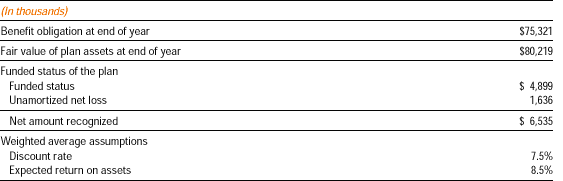
Wyle provided retirement benefits for certain employees under a defined benefit plan. Benefits under this plan have been frozen as of December 31, 2000 and former participants may now participate in
the company’s stock ownership plan. Pension information as of the year ended December 31, 2000 is as follows:
10. Lease Commitments
The company leases certain office, distribution, and other property under noncancelable operating leases expiring at various dates through 2053. Rental expense under noncancelable operating leases,
net of sublease income of $3,151,000, $3,362,000, and $2,469,000 in 2000, 1999, and 1998, respectively, amounted to $47,863,000 in 2000, $40,382,000 in 1999, and $29,231,000 in 1998. Aggregate minimum rental commitments under all noncancelable operating leases, exclusive of real estate taxes, insurance, and leases related to facilities closed in connection with the realignment of NACO and the integration of the acquired businesses, are $63,417,000 in 2001, $45,386,000 in 2002, $34,535,000 in 2003, $27,959,000 in 2004, $20,102,000 in 2005, and $96,498,000 thereafter.
11. Financial Instruments
The company enters into foreign exchange forward contracts (the "contracts") to mitigate the impact of changes in foreign currency exchange rates, principally French franc, Swedish krona, Italian lira, and British pound sterling. These contracts are executed to facilitate the netting of offsetting foreign currency exposures resulting from inventory purchases and sales, and generally have terms of no more than three months. Gains or losses on these contracts are deferred and recognized when the underlying future purchase or sale is recognized. The company does not enter into forward contracts for trading purposes. The risk of loss on a contract is the risk of nonperformance by the counterparties which the company minimizes by limiting its counterparties to major financial institutions. The fair value of the contracts is estimated using market quotes. The notional amount of the contracts at December 31, 2000 and 1999, was $81,736,000 and $59,348,000, respectively. The carrying amounts, which are nominal, approximated fair value at December 31, 2000 and 1999.
12. Segment and Geographic Information
The company is engaged in the distribution of electronic components to original equipment manufacturers and computer products to value-added resellers (VARs). Operating income for the electronic components and computer products segments excludes the effects of special charges relating to the integration of acquired businesses. During the first quarter of 2000, the company redefined its reportable segments to present two distinct worldwide businesses that have different economic cycles, structures, and competitors. Computer products includes North American Computer Products together with UK Microtronica, Nordic Microtronica, ATD (in Iberia), and Arrow Computer Products (in France). The prior years have been restated for comparative purposes. Revenue, operating income, and total assets by segment are as follows:
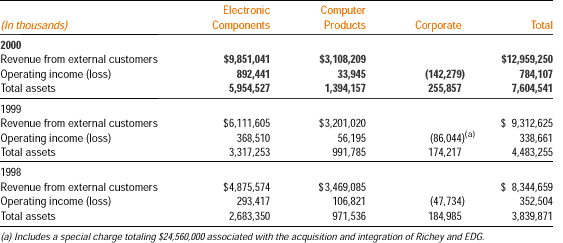
As a result of the company's philosophy of maximizing operating efficiencies through the centralization of certain functions, selected fixed assets and related depreciation, borrowings, and goodwill amortization are not directly attributable to the individual operating segments. In the evaluation of its operating groups' performance, the company excludes the impact of unusual items such as realignment and integration charges.
Revenues, by geographic area, for the years ended December 31 are as follows:

Total assets, by geographic area, at December 31 are as follows:

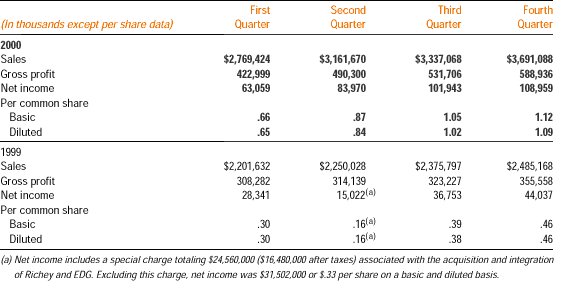
13. Quarterly Financial Data (Unaudited)
A summary of the company's quarterly results of operations follows:
Report of Ernst & Young LLP, Independent Auditors
The Board of Directors and Shareholders
Arrow Electronics, Inc.
We have audited the accompanying consolidated balance sheet of Arrow Electronics, Inc. as of December 31, 2000 and 1999, and the related consolidated statements of income, cash flows, and shareholders' equity for each of the three years in the period ended December 31, 2000. These financial statements are the responsibility of the company's management. Our responsibility is to express an opinion on these financial statements based on our audits.
We conducted our audits in acordance with auditing standards generally accepted in the United States. Those standards require that we plan and perform the audit to obtain reasonable assurance about whether the financial statements are free of material misstatement. An audit includes examining, on a test basis, evidence supporting the amounts and disclosures in the financial statements. An audit also includes assessing the accounting principles used and significant estimates made by management, as well as evaluating the overall financial statement presentation. We believe that our audits provide a reasonable basis for our opinion.
In our opinion, the consolidated financial statements referred to above present fairly, in all material respects, the consolidated financial position of Arrow Electronics, Inc. at December 31, 2000 and 1999, and the consolidated results of its operations and its cash flows for each of the three years in the period ended December 31, 2000, in conformity with accounting principles generally accepted in the United States.
New York, New York
February 13, 2001, except for paragraph 11 of Note 4,
as to which date is March 1, 2001
Management's Responsibility for Financial Reporting
The consolidated financial statements of Arrow Electronics, Inc. have been prepared by management, which is responsible for their integrity and objectivity. These statmenets, prepared in accordance with generally accepted accounting principles, reflect our best use of judgment and estimates where appropriate. Management also prepared the other information in the annual report and is responsible for its accuracy and consistency with the consolidated financial statements.
The company's system of internal controls is designed to provide reasonable assurance that company assets are safeguarded from loss or unauthorized use or disposition and that transactions are executed in accordance with management's authorization and are properly recorded. In establishing the basis for reasonable assurance, management balances the costs of the internal controls with the benefits they provide. The system contains self-monitoring mechanisms, and compliance is tested through an extensive program of site visits and audits by the company's operating controls staff.
The audit committee of the board of directors, consisting entirely of outside directors, meets regularly with the company's management, operating controls staff, and independent auditors and reviews audit plans and results as well as management's actions taken in discharging its responsibilities for accounting, financial reporting, and internal controls. Members of management, the operating controls staff, and the independent auditors have direct and confidential access to the audit committee at all times.
The company's independent auditors, Ernst & Young LLP, were engaged to audit the consolidated financial statements in accordance with generally accepted auditing standards. These standards include a study and evaluation of internal controls for the purpose of establishing a basis for reliance thereon relative to the scope of their audit of the consolidated financial statements.
Francis M. Scricco
President and Chief Executive Officer
Sam R. Leno
Senior Vice President and Chief Financial Officer
Executive Offices
25 Hub Drive
Melville, New York 11747-3509
Independent Auditors
Ernst & Young LLP
787 Seventh Avenue
New York, New York 10019-6018
Transfer Agent and Registrar
Mellon Investor Services, L.L.C.
Overpeck Centre
85 Challenger Road
Ridgefield Park, New Jersey 07660-2104
Price Range of Common Stock
The company's common stock is listed on the New York Stock Exchange (trading symbol: "ARW"). The high and low sales prices during each quarter of 2000 and 1999 were as follows:
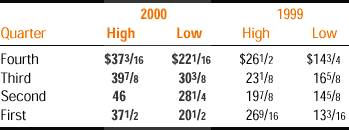
The company did not pay cash dividends in 2000 or 1999. On March 2, 2001, there were approximately 3,200 shareholders of record of the company's common stock.
Annual Meeting
The Annual Meeting of Shareholders will be held at 11:00 a.m. on May 11, 2001 at the offices of J.P. Morgan Chase & Co., 270 Park Avenue, New York, New York. All shareholders are invited to attend.
Form 10-K
A copy of the company's Form 10-K Annual Report, as filed with the Securities and Exchange Commission, may be obtained by writing to the Secretary of the company.
Arrow Electronics is an Equal Opportunity Employer.
Arrow,  , arrow.com, arrow.com PRO-Series,
Arrow CARES, e-compass, and all Arrow domain names and
business group names are trademarks and service marks of
Arrow Electronics, Inc.
, arrow.com, arrow.com PRO-Series,
Arrow CARES, e-compass, and all Arrow domain names and
business group names are trademarks and service marks of
Arrow Electronics, Inc.