





Financial Review

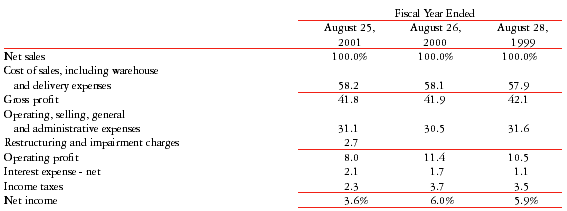
The following table sets forth income statement data of the Company expressed as a percentage of net sales for the periods indicated:
Results of Operations
For an understanding of the significant factors that influenced the
Company's performance during the past three fiscal years, the following
Financial Review should be read in conjunction with the consolidated
financial statements presented in this annual report.
Restructuring and Impairment Charges
In June 2001, the Company announced initiatives designed to further
the creation of shareholder value and improve return on capital. The
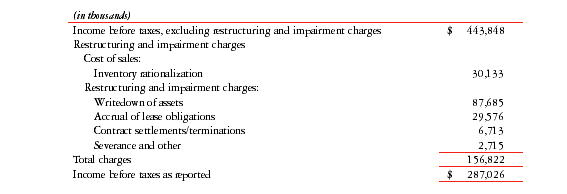
effects of restructuring and impairment charges on income before income
taxes of $156.8 million are summarized as follows and discussed in detail
below:
As a result of a strategic planning process begun
during the third quarter of 2001, the Company established a 15% after-tax
return threshold for all current and future investments. All of the
Company’s assets, including long-lived assets and real estate projects
in process, were examined to identify those not meeting the revised
hurdle rate. A charge of $5.2 million was recorded in the third quarter
related to abandoned real estate projects in process identified during
this review. The review was completed in the fourth quarter, resulting
in additional restructuring and impairment charges of $151.6 million.
The Company completed its evaluation of store performance and determined
that 51 domestic auto parts stores were not meeting acceptable operating
targets, which represents less than two percent of the chain. A reserve
of $4.3 million has been established principally for lease commitments
for stores to be closed and a writedown of $12.5 million has been recorded
on the fixed assets in such stores to reduce carrying value to fair
value. The effect of suspending depreciation on these assets was not
material in fiscal 2001. Additionally, a reserve of $2.1 million was
established for estimated inventory losses expected in closed stores.
These stores are scheduled to be closed during fiscal 2002. The Company
also evaluated all real estate projects in process and excess properties.
These assets have been written down to the lower of carrying value or
fair value less cost to sell, resulting in charges of $21.0 million
for asset writedowns and $18.3 million for net lease obligations. The
Company is actively marketing the assets held for sale through the use
of internal resources and outside agents. Management intends to dispose
of all assets held for sale within the next 12 months.
Additional impairment charges of $25.0 million were taken related primarily
to fixed assets associated with the closure of a supply depot in Memphis,
Tennessee, abandoned or discontinued technology-related assets and assets
abandoned due to reorganization of departments within the Store Support
Center. The Company also established a reserve of $7.0 million principally
for lease commitments associated with the closure of the supply depot
and for the office building recently leased by the Company’s ALLDATA
subsidiary that will not be occupied.
The Company has made a decision to sell TruckPro, its heavy-duty truck
parts subsidiary. The Company has engaged an investment banking firm
to assist in identifying a buyer for TruckPro and to facilitate the
transaction. Based on preliminary offers received, the Company has recorded
asset writedowns and contractual obligations aggregating $29.9 million.
The Company expects to enter into a definitive agreement to sell TruckPro
before the end of calendar year 2001.
The Company has implemented changes in its marketing and merchandising
strategies. The new strategies include reducing quantities of product
on hand in excess of anticipated needs and decisions to discontinue
certain merchandise. This has resulted in an inventory rationalization
charge of $28.0 million. Discontinued inventory will be recalled and
disposed of during the first quarter of fiscal 2002.
After considering the effect of income taxes, the impact of these restructuring
and impairment charges on net earnings was $95.8 million. The remaining
Results of Operations discussion excludes the restructuring and impairment
charges discussed above because the effects of these charges are not
comparable on a year-over-year basis.
Fiscal 2001 Compared to Fiscal 2000
Net sales for fiscal 2001 increased by $335.5
million or 7.5% over net sales for fiscal 2000. Same store sales, or
sales for domestic auto parts stores opened at least one year, increased
4%. As of August 25, 2001, the Company had 3,019 domestic auto parts
stores in operation compared with 2,915 at August 26, 2000.
Gross profit for fiscal 2001, excluding nonrecurring charges, was $2.0
billion, or 42.4% of net sales, compared with $1.9 billion, or 41.9%
of net sales, for fiscal 2000. The increase in the gross profit percentage
was primarily due to a shift in sales mix to higher gross margin products
in the current year and higher warranty expense in the prior year.
Operating, selling, general and administrative expenses for fiscal 2001
increased by $130.6 million over such expenses for fiscal 2000 and increased
as a percentage of net sales from 30.5% to 31.1%. The increase in the
expense ratio was primarily due to an increase in insurance, expenses
related to strategic initiatives not included in the restructuring and
impairment charges and higher levels of payroll primarily in the first
half of the year.
Net interest expense for fiscal 2001 was $100.7 million compared with
$76.8 million for fiscal 2000. The increase in interest expense was
due to higher levels of borrowings.
AutoZone's effective income tax rate was 38.8% of pre-tax income for
fiscal 2001 and 38.5% for fiscal 2000.
Fiscal 2000 Compared to Fiscal 1999
Net sales for fiscal 2000 increased by $366.3 million or 8.9% over net
sales for fiscal 1999. Same store sales, or sales for domestic auto
parts stores opened at least one year, increased 5%. As of August 26,
2000, the Company had 2,915 domestic auto parts stores in operation
compared with 2,711 at August 28, 1999.
Gross profit for fiscal 2000 was $1.9 billion, or 41.9% of net sales,
compared with $1.7 billion, or 42.1% of net sales, for fiscal 1999.
The decrease in gross profit percentage was primarily due to an increase
in warranty expense.
Operating, selling, general and administrative expenses for fiscal 2000
increased by $70.0 million over such expenses for fiscal 1999 and decreased
as a percentage of net sales from 31.6% to 30.5%. The decrease in the
expense ratio was primarily due to leverage of payroll and occupancy
costs in acquired stores coupled with the absence of acquisition related
remodeling and remerchandising activities in fiscal 2000.
Net interest expense for fiscal 2000 was $76.8 million compared with
$45.3 million for fiscal 1999. The increase in interest expense was
due to higher levels of borrowings as a result of stock repurchases
and higher interest rates.
AutoZone's effective income tax rate was 38.5% of pre-tax income for
fiscal 2000 and 36.9% for fiscal 1999. The fiscal 1999 effective tax
rate reflects the utilization of acquired company net operating loss
carryforwards.
Financial Market Risk
The Company is exposed to market risk from changes
in foreign exchange and interest rates. To minimize such risks, the
Company may periodically use various financial instruments. All hedging
transactions are authorized and executed pursuant to policies and procedures.
The Company does not buy or sell financial instruments for trading purposes.
On August 27, 2000, the Company adopted Statements of Financial Accounting
Standards Nos. 133, 137 and 138 (collectively "SFAS 133")
pertaining to the accounting for derivatives and hedging activities.
SFAS 133 requires the Company to recognize all derivative instruments
in the balance sheet at fair value. The adoption of SFAS 133 impacts
the accounting for the Company's interest rate hedging program. The
Company reduces its exposure to increases in interest rates by entering
into interest rate swap contracts. All of the Company's interest rate
swaps are designated as cash flow hedges.
Upon adoption of SFAS 133, the Company recorded the fair value of the
interest rate swaps in its consolidated balance sheet. Thereafter, the
Company has adjusted the carrying value of the interest rate swaps to
reflect their current fair value. The related gains or losses on these
swaps are deferred in stockholders' equity (as a component of comprehensive
income). These deferred gains and losses are recognized in income in
the period in which the related interest rate payments being hedged
have been recognized in expense. However, to the extent that the change
in value of an interest rate swap contract does not perfectly offset
the change in the interest rate payments being hedged, that ineffective
portion is immediately recognized in income.
At August 25, 2001, and August 26, 2000, the fair value of the Company’s
debt was estimated at $1.21 billion and $1.20 billion, respectively,
based on the market value of the debt at those dates. Such fair value
is less than the carrying value of debt at August 25, 2001, by $17.3
million and at August 26, 2000, by $47.1 million. The Company had $730.4
million of variable-rate debt outstanding at August 25, 2001, and $909.9
million at August 26, 2000. At these borrowing levels, a one percentage
point increase in interest rates would have had an unfavorable impact
on the Company’s pre-tax earnings and cash flows of $6.6 million
in 2001 and $8.3 million in 2000. The primary interest rate exposure
on variable-rate debt is based on the London Interbank Offered Rate
(LIBOR).
Liquidity and Capital Resources
The Company’s primary capital requirements
have been the funding of its continued new store expansion program,
inventory requirements and, more recently, stock repurchases. The Company
has opened or acquired 1,596 net new domestic auto parts stores from
the beginning of fiscal 1997 to August 25, 2001. Cash flow generated
from store operations provides the Company with a significant source
of liquidity. Net cash provided by operating activities was $458.9 million
in fiscal 2001, $513.0 million in fiscal 2000 and $311.7 million in
fiscal 1999.
The Company invested $169.3 million in capital assets in fiscal 2001.
In fiscal 2000, the Company invested $249.7 million in capital assets.
In fiscal 1999, the Company invested $428.3 million in capital assets,
including approximately $108 million for real estate and real estate
leases purchased from Pep Boys. In fiscal 2001, the Company opened 107
new auto parts stores in the U.S. and 8 in Mexico, replaced 16 U.S.
stores and closed 3 U.S. stores. In addition, the Company operated 49
TruckPro stores. Construction commitments totaled approximately $24
million at August 25, 2001.
The Company’s new store development program requires working capital,
predominantly for inventories. Historically, the Company has negotiated
extended payment terms from suppliers, minimizing the working capital
required by expansion. The Company believes that it will be able to
continue financing much of its inventory growth through favorable payment
terms from suppliers, but there can be no assurance that the Company
will be successful in obtaining such terms.
The Company maintains $1.05 billion of revolving credit facilities with
a group of banks. Of the $1.05 billion, $400 million expires in May
2002. The remaining $650 million expires in May 2005. The 364-day facility
expiring in May 2002 includes a renewal feature as well as an option
to extend the maturity date of then-outstanding debt by one year. The
credit facilities exist largely to support commercial paper borrowings
and other short-term unsecured bank loans. Outstanding commercial paper
and short-term unsecured bank loans at August 25, 2001, of $400.4 million
are classified as long-term as the Company has the ability and intention
to refinance them on a long-term basis. The rate of interest payable
under the credit facilities is a function of LIBOR, the lending bank’s
base rate (as defined in the agreement) or a competitive bid rate at
the option of the Company. The Company has agreed to observe certain
covenants under the terms of its credit agreements, including limitations
on total indebtedness, restrictions on liens and minimum fixed charge
coverage.
During fiscal year 2001, the Company entered into two unsecured bank
term loans totaling $315 million with a group of banks. Of the $315
million, $115 million matures in December 2003 and $200 million matures
in May 2003. The rate of interest payable is a function of LIBOR or
the bank’s base rate (as defined in the agreement) at the option
of the Company.
In May 2001, the Company issued $150 million of 7.99% Senior Notes due
April 2006, in a private debt placement. The Senior Notes contain certain
covenants limiting total indebtedness and liens. Interest is payable
semi-annually.
Subsequent to year-end, in September 2001, the Company announced Board
approval to repurchase up to $250 million of common stock in the open
market. This is in addition to the $1.45 billion previously authorized
as of August 25, 2001. From January 1998 to August 25, 2001, the Company
had repurchased approximately $1.2 billion of common stock.
The impact of the stock repurchase program in fiscal 2001 was an increase
in earnings per share of $0.05. Subsequent to year-end, the Company
repurchased two million shares in settlement of certain equity instrument
contracts at an average cost of $28.61 per share.
The Company anticipates that it will rely primarily on internally-generated
funds to support a majority of its capital expenditures, working capital
requirements and stock repurchases. The balance will be funded through
borrowings. The Company anticipates that it will be able to obtain such
financing in view of its credit rating and favorable experiences in
the debt market in the past.
Inflation
The Company does not believe its operations have
been materially affected by inflation. The Company has been successful,
in many cases, in mitigating the effects of merchandise cost increases
principally through economies of scale resulting from increased volumes
of purchases, selective forward buying and the use of alternative suppliers.
Seasonality and Quarterly Periods
The Company’s business is somewhat seasonal in nature, with the
highest sales occurring in the summer months of June through August,
in which average weekly per store sales historically have been about
15% to 25% higher than in the slower months of December through February.
Each of the first three quarters of AutoZone’s fiscal year consists
of twelve weeks and the fourth quarter consists of sixteen weeks. Because
the fourth quarter contains the seasonally high sales volume and consists
of sixteen weeks, compared to twelve weeks for each of the first three
quarters, the Company’s fourth quarter represents a disproportionate
share of the annual net sales and net income. The fourth quarter of
fiscal 2001, excluding nonrecurring charges, represented 34.1% of annual
net sales and 43.9% of net income; the fourth quarter of fiscal 2000
represented 33.3% of annual net sales and 39.3% of net income. Fiscal
year 2002 will consist of 53 weeks, with the fiscal fourth quarter having
17 weeks.
Recent Accounting Pronouncements
In June 2001, the Financial Accounting Standards
Board issued Statement of Financial Accounting Standards No. 142, "Goodwill
and Other Intangible Assets" (SFAS 142). Under SFAS 142, goodwill
amortization ceases when the new standard is adopted. The new rule also
requires an initial goodwill impairment assessment in the year of adoption
and annual impairment tests thereafter. The Company is permitted and
has elected to adopt this Statement effective August 26, 2001. Application
of the nonamortization provisions of the Statement is expected to result
in an increase in income before income taxes of $8.6 million per year.
No impairment loss is expected from the initial goodwill impairment
test.
Forward-Looking Statements
Certain statements contained in the Financial
Review and elsewhere in this annual report are forward-looking statements.
These statements discuss, among other things, expected growth, domestic
and international development and expansion strategy, business strategies
and future performance. These forward-looking statements are subject
to risks, uncertainties and assumptions, including without limitation,
competition, product demand, domestic and international economies, the
ability to hire and retain qualified employees, consumer debt levels,
inflation, war and the prospect of war, including terrorist activity,
and availability of commercial transportation. Actual results may materially
differ from anticipated results. For more information, please see the
Risk Factors section of the Company’s most recent Form 10-K as
filed with the Securities and Exchange Commission.