





Notes to Consolidated Financial Statements

Note A – Significant
Accounting Policies
Business: The Company is principally a retailer of light vehicle
parts, supplies and accessories. At the end of fiscal 2001, the Company
operated 3,019 domestic auto parts stores in 42 states and the District
of Columbia and 21 auto parts stores in Mexico. In addition, the Company
sells heavy duty truck parts and accessories through its 49 TruckPro
stores in 15 states, light vehicle diagnostic and repair software through
ALLDATA and diagnostic and repair information through alldatadiy.com.
Fiscal Year: The Company’s fiscal year consists of 52 or
53 weeks ending on the last Saturday in August.
Basis of Presentation: The consolidated financial statements include
the accounts of AutoZone, Inc. and its wholly owned subsidiaries (the
Company). All significant intercompany transactions and balances have
been eliminated in consolidation.
Merchandise Inventories: Inventories are stated at the lower
of cost or market using the last-in, first-out (LIFO) method.
Property and Equipment: Property and equipment is stated at cost.
Depreciation is computed principally by the straight-line method over
the following estimated useful lives: buildings and improvements, 5
to 50 years; equipment, 3 to 10 years; and leasehold improvements and
interests, 5 to 15 years. Leasehold improvements and interests are amortized
over the terms of the leases.
Intangible Assets: The cost in excess of fair value of net assets
of businesses acquired is recorded as goodwill and is amortized on a
straight-line basis over 40 years. The Company continually evaluates
the carrying value of goodwill. Any impairments would be recognized
when the expected future undiscounted operating cash flows derived from
such goodwill is less than its carrying value.
Preopening Expenses: Preopening expenses, which consist primarily
of payroll and occupancy costs, are expensed as incurred.
Advertising Costs: The Company expenses advertising costs as
incurred. Advertising expense, net of vendor rebates, was approximately
$20.7 million in fiscal 2001, $14.4 million in fiscal 2000 and $21.9
million in fiscal 1999.
Warranty Costs: The Company provides the consumer with a warranty
on certain products. Estimated warranty obligations are provided at
the time of sale of the product.
Financial Instruments: The Company has certain financial instruments
which include cash, accounts receivable and accounts payable. The carrying
amounts of these financial instruments approximate fair value because
of their short maturities.
Income Taxes: The Company accounts for income taxes under the
liability method. Deferred tax assets and liabilities are determined
based on differences between financial reporting and tax bases of assets
and liabilities and are measured using the enacted tax rates and laws
that will be in effect when the differences are expected to reverse.
Cash Equivalents: Cash equivalents consist of investments with
maturities of 90 days or less at the date of purchase.
Use of Estimates: Management of the Company has made a number
of estimates and assumptions relating to the reporting of assets and
liabilities and the disclosure of contingent liabilities to prepare
these financial statements in conformity with accounting principles
generally accepted in the United States. Actual results could differ
from those estimates.
Earnings Per Share: Basic earnings per share is based on the
weighted average outstanding common shares. Diluted earnings per share
is based on the weighted average outstanding shares adjusted for the
effect of common stock equivalents.
Revenue Recognition: The Company recognizes sales revenue at the
time the sale is made.
Impairment of Long-Lived Assets: The Company complies with Statement
of Financial Accounting Standards (SFAS) No. 121, "Accounting for
the Impairment of Long-Lived Assets and for Long-Lived Assets to Be
Disposed Of." This statement requires that long-lived assets and
certain identifiable intangibles to be held and used by an entity be
reviewed for impairment whenever events or changes in circumstances
indicate that the carrying amount of an asset may not be recoverable.
Also, in general, long-lived assets and certain identifiable intangibles
to be disposed of are reported at the lower of carrying amount or fair
value less cost to sell.
Derivative Instruments and Hedging Activities: On August 27,
2000, the Company adopted Statements of Financial Accounting Standards
Nos. 133, 137 and 138 (collectively "SFAS 133") pertaining
to the accounting for derivatives and hedging activities. SFAS 133 requires
the Company to recognize all derivative instruments in the balance sheet
at fair value. The adoption of SFAS 133 impacts the accounting for the
Company's interest rate hedging program. The Company reduces its exposure
to increases in interest rates by entering into interest rate swap contracts.
All of the Company's interest rate swaps are designated as cash flow
hedges.
Upon adoption of SFAS 133, the Company recorded the fair value of the
interest rate swaps in its consolidated balance sheet. Thereafter, the
Company has adjusted the carrying value of the interest rate swaps to
reflect their current fair value. The related gains or losses on these
swaps are deferred in stockholders' equity (as a component of comprehensive
income). These deferred gains and losses are recognized in income in
the period in which the related interest rate payments being hedged
have been recognized in expense. However, to the extent that the change
in value of an interest rate swap contract does not perfectly offset
the change in the interest rate payments being hedged, that ineffective
portion is immediately recognized in income.
Recently Issued Accounting Standards: In June 2001, the Financial
Accounting Standards Board issued SFAS No. 142, "Goodwill and Other
Intangible Assets." Under SFAS 142, goodwill amortization ceases
when the new standard is adopted. The new rules also require an initial
goodwill impairment assessment in the year of adoption and annual impairment
tests thereafter. The Company is permitted and has elected to adopt
this Statement effective August 26, 2001, the first day of fiscal 2002.
Application of the non-amortization provisions of SFAS No. 142 is expected
to result in an increase in net income of $5.3 million ($0.05 per share)
per year. During fiscal 2002, the Company will perform the first of
the required impairment tests of goodwill. No impairment loss is expected
from the initial goodwill impairment test.
Reclassifications: Certain prior year amounts have been reclassified
to conform with the fiscal 2001 presentation.
Note B – Restructuring and Impairment Charges
As a result of a strategic planning process begun during the third quarter
of 2001, the Company established a 15% after-tax return threshold for
all current and future investments. All of the Company’s assets,
including long-lived assets and real estate projects
in process, were examined to identify those not meeting the revised
hurdle rate. A total charge of $156.8 million was recorded during fiscal
2001 for the following (in thousands):

Additional impairment charges of $25.0 million were taken related primarily to fixed assets associated with the closure of a supply depot in Memphis, Tennessee, abandoned or discontinued technology-related assets and assets abandoned due to reorganization of departments within the Store Support Center. The Company also established a reserve of $7.0 million principally for lease commitments associated with the closure of the supply depot and for the office building recently leased by the Company’s ALLDATA subsidiary that will not be occupied.
The Company has made a decision to sell TruckPro, its heavy-duty truck parts subsidiary. The Company has engaged an investment banking firm to assist in identifying a buyer for TruckPro and to facilitate the transaction. Based on preliminary offers received, the Company has recorded asset writedowns and contractual obligations aggregating $29.9 million. The Company expects to enter into a definitive agreement to sell TruckPro before the end of calendar year 2001.
The Company has implemented changes in its marketing and merchandising strategies. The new strategies include reducing quantities of product on hand in excess of anticipated needs and decisions to discontinue certain merchandise. This has resulted in an inventory rationalization charge of $28.0 million. This charge is reflected in cost of sales. Discontinued inventory will be recalled and disposed of during the first quarter of fiscal 2002.
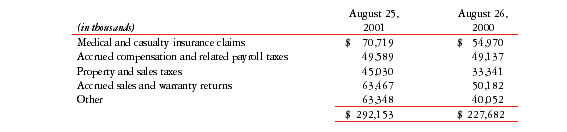
Note C - Accrued Expenses
Accrued expenses consist of the following:
Note D – Income Taxes
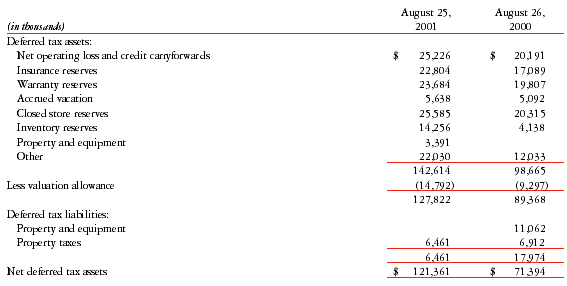
At August 25, 2001, the Company had federal tax net operating loss carryforwards
(NOLs) of approximately $35.6 million that expire in years 2007 through
2017. These carryforwards resulted from the Company's acquisition of ALLDATA
Corporation during fiscal 1996, and Chief Auto Parts Inc. and ADAP, Inc.
(which had been doing business as "Auto Palace") in fiscal 1998.
The use of the federal tax NOLs is limited to future taxable earnings
of these companies and is subject to annual limitations. A valuation allowance
of $8.7 million in fiscal 2001 and $9.3 million in fiscal 2000 relates
to these carryforwards. In addition, the Company has state tax NOLs that
expire in years 2002 through 2020. These state tax NOLs also resulted
from the Company's acquisition of ALLDATA Corporation, Chief Auto Parts
Inc. and ADAP, Inc. The use of the NOLs is limited to future taxable earnings
of these companies and is subject to annual limitations. A valuation allowance
of $6.1 million in fiscal 2001 relates to these carryforwards.
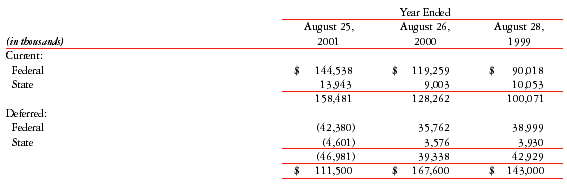
The provision for income tax expense consists of the following:
Significant components of the Company's deferred tax assets and liabilities are as follows:
A reconciliation of the provision for income taxes to the amount computed by applying the federal statutory tax rate of 35% to income before income taxes is as follows:

Note E – Financing Arrangements
The Company’s long-term debt as of August 25, 2001, and August 26,
2000, consists of the following:
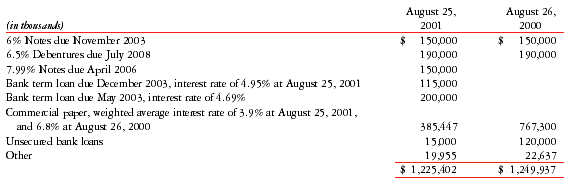
The Company maintains $1.05 billion of revolving credit
facilities with a group of banks. Of the $1.05 billion, $400 million expires
in May 2002. The remaining $650 million expires in May 2005. The 364-day
facility expiring in May 2002 includes a renewal feature as well as an
option to extend the maturity date of the then-outstanding debt by one
year. The credit facilities exist largely to support commercial paper
borrowings and other short-term unsecured bank loans. Outstanding commercial
paper and short-term unsecured bank loans at August 25, 2001, of $400.4
million are classified as long-term as the Company has the ability and
intention to refinance them on a long-term basis. The rate of interest
payable under the credit facilities is a function of the London Interbank
Offered Rate (LIBOR), the lending bank’s base rate (as defined in
the agreement) or a competitive bid rate at the option of the Company.
The Company has agreed to observe certain covenants under the terms of
its credit agreements, including limitations on total indebtedness, restrictions
on liens and minimum fixed charge coverage.
During fiscal 2001, the Company entered into two unsecured bank term loans
totaling $315 million with a group of banks. Of the $315 million, $115
million matures in December 2003 and $200 million matures in May 2003.
The rate of interest payable is a function of LIBOR or the bank’s
base rate (as defined in the agreement) at the option of the Company.
In May 2001, the Company issued $150 million of 7.99% Senior Notes due
April 2006, in a private debt placement. The Senior Notes contain covenants
limiting total indebtedness and liens. Interest is payable semi-annually.
All of the Company’s debt is unsecured, except for $15 million, which
is collateralized by property. Maturities of long-term debt are $200 million
for fiscal 2003, $265 million for fiscal 2004, $420.4 million for fiscal
2005, $150 million for fiscal 2006 and $190 million thereafter.
Interest costs of $1.4 million in fiscal 2001, $2.8 million in fiscal
2000 and $2.8 million in fiscal 1999 were capitalized.
The estimated fair value of the 6.5% Debentures and the 6% Notes, which
are both publicly traded, was approximately $174.6 million and $148.1
million, respectively, based on the estimated market values at August
25, 2001. The estimated fair value of the 6.5% Debentures and the 6% Notes
was approximately $156.7 million and $136.2 million, respectively, at
August 26, 2000. The estimated fair values of all other long-term borrowings
approximate their carrying values primarily because they are short-term
or have variable interest rates.
Note F – Stock Repurchase Program
As of August 25, 2001, the Board of Directors had authorized the Company
to repurchase up to $1.45 billion of common stock in the open market.
In fiscal 2001, the Company repurchased 14.3 million shares of its common
stock at an aggregate cost of $366.1 million. Since fiscal 1998, the Company
has repurchased a total of 47.2 million shares at an aggregate cost of
$1.2 billion. At times, the Company utilizes equity instrument contracts
to facilitate its repurchase of common stock. At August 25, 2001, the
Company held equity instrument contracts that relate to the purchase of
approximately 3.9 million shares of common stock at an average cost of
$33.67 per share.
Subsequent to year-end, the Board authorized the repurchase of an additional
$250 million of the Company’s common stock in the open market. Additionally
in fiscal 2002, the Company purchased two million shares in settlement
of certain equity instrument contracts outstanding at August 25, 2001,
at an average cost of $28.61 per share.
Note G – Employee Stock Plans
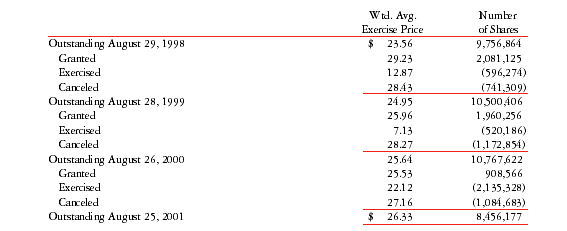
The Company has granted options to purchase common stock to certain employees
and directors under various plans at prices equal to the market value
of the stock on the dates the options were granted. Options are generally
exercisable in a three to seven year period, and generally expire after
ten years. A summary of outstanding stock options is as follows:
The following table summarizes information about stock options outstanding at August 25, 2001:
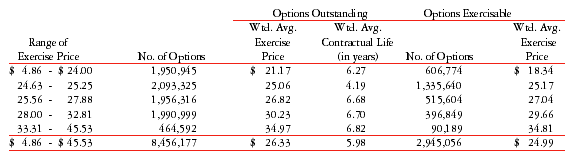
Options to purchase 2.9 million shares at August 25,
2001, 3.5 million shares at August 26, 2000, and 2.4 million shares at
August 28, 1999, were exercisable. Shares reserved for future grants were
5.2 million at August 25, 2001.
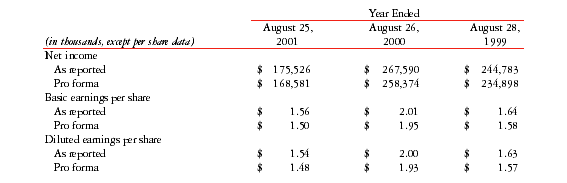
Pro forma information is required by SFAS 123, "Accounting for Stock-Based
Compensation." In accordance with the provisions of SFAS 123, the
Company applies APB Opinion 25 and related interpretations in accounting
for its stock option plans and, accordingly, no compensation expense for
stock options has been recognized. If the Company had elected to recognize
compensation cost based on the fair value of the options granted at the
grant date as prescribed in SFAS 123, the Company’s net income and
earnings per share would have been reduced to the pro forma amounts indicated
below. The effects of applying SFAS 123 and the results obtained through
the use of the Black-Scholes option pricing model in this pro forma disclosure
are not necessarily indicative of future amounts. SFAS 123 does not apply
to awards prior to fiscal 1996.
The weighted average fair value of the stock options
granted during fiscal 2001 was $10.19, during fiscal 2000 was $11.92 and
during fiscal 1999 was $12.74. The fair value of each option granted is
estimated on the date of the grant using the Black-Scholes option pricing
model with the following weighted average assumptions for grants in 2001,
2000 and 1999: expected price volatility of 0.34 to 0.37; risk-free interest
rates ranging from 3.75% to 6.18%; and expected lives between 4.83 and
8.83 years.
Stock options that could potentially dilute basic earnings per share in
the future, that were not included in the fully
diluted computation because they would have been antidilutive, were 7.5
million at August 26, 2000, and 3.6 million at August 28, 1999.
The Company also has an employee stock purchase plan under which all eligible
employees may purchase common stock at 85% of fair market value (determined
quarterly) through payroll deductions. In fiscal 2000, maximum permitted
annual purchases were increased from $4,000 to $15,000 per employee or
10% of compensation, whichever is less. Under the plan, 0.2 million shares
were sold in fiscal 2001, and 0.3 million shares were sold in each of
fiscal 1999 and 2000. The Company repurchased 0.2 million shares in fiscal
years 2001, 2000 and 1999, respectively, for sale under the plan. A total
of 0.8 million shares of common stock is reserved for future issuance
under this plan.
Under the Second Amended and Restated Directors Stock Option Plan each
non-employee director will receive an option to purchase 1,500 shares
of common stock on January 1 of each year. In addition, as long as the
non-employee director owns common stock valued at least equal to five
times the value of the annual fee paid to such director, that director
will receive an additional option to purchase 1,500 shares as of January
1 of each year. New directors receive options to purchase 3,000 shares
plus a grant of an option to purchase a number of shares equal to the
annual option grant, prorated for the time in service for the year.
Under the Second Amended and Restated Directors Compensation Plan a director
may receive no more than one-half of the annual and meeting fees immediately
in cash, and the remainder of the fees must be taken in either common
stock or the fees deferred in units with value equivalent to the value
of share of common stock as of the grant date ("stock appreciation
rights").
Note H – Pension and Savings Plan
Substantially all full-time employees are covered by a defined benefit
pension plan. The benefits are based on years of service and the employee’s
highest consecutive five-year average compensation. In fiscal 2000, the
Company established a supplemental defined benefit pension plan for highly
compensated employees.
The Company makes annual contributions in amounts at least equal to the
minimum funding requirements of the Employee Retirement Income Security
Act of 1974. The following table sets forth the plan’s funded status
and amounts recognized in the Company’s financial statements:
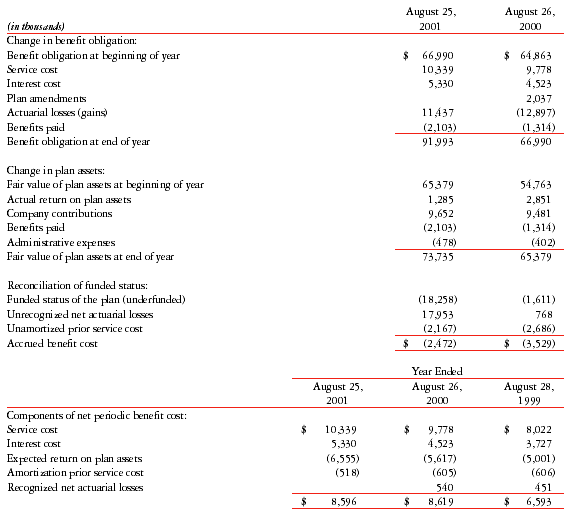
The actuarial present value of the projected benefit
obligation was determined using weighted average discount rates of 7.5%
at August 25, 2001, 8% at August 26, 2000, and 7% at August 28, 1999.
The assumed increases in future compensation levels were generally 5-10%
based on age in fiscal 2001, 2000 and 1999. The expected long-term rate
of return on plan assets was 9.5% at August 25, 2001, August 26, 2000,
and August 28, 1999. Prior service cost is amortized over the estimated
average remaining service lives of the plan participants, and the unrecognized
actuarial gain or loss is amortized over five years.
The Company has also established a defined contribution plan ("401(k)
plan") pursuant to Section 401(k) of the Internal Revenue Code. The
401(k) plan covers substantially all employees that meet the plan’s
service requirements. The Company makes matching contributions, on an
annual basis, up to a specified percentage of employees’ contributions
as approved by the Board of Directors.
Note I – Leases
A portion of the Company’s retail stores, distribution centers and
certain equipment are leased. Most of these leases include renewal options
and some include options to purchase and provisions for percentage rent
based on sales. In addition, some of the leases contain guaranteed residual
values.
Rental expense was $100.4 million for fiscal 2001, $95.7 million for fiscal
2000 and $96.2 million for fiscal 1999. Percentage rentals were insignificant.
Minimum annual rental commitments under non-cancelable operating leases
are as follows at the end of fiscal 2001
(in thousands):

Note J – Commitments and Contingencies
Construction commitments, primarily for new stores, totaled approximately
$24 million at August 25, 2001.
The Company is a defendant in a lawsuit entitled "Coalition for a
Level Playing Field, L.L.C., et. al., v. AutoZone, Inc., et. al.,"
filed in the U.S. District Court for the Eastern District of New York
in February 2000. The case was filed by over 100 plaintiffs, which are
principally automotive aftermarket warehouse distributors and jobbers,
against eight defendants, which are principally automotive aftermarket
parts retailers. The plaintiffs claim that the defendants have knowingly
received volume discounts, rebates, slotting and other allowances, fees,
free inventory, sham advertising and promotional payments, a share in
the manufacturers’ profits, and excessive payments for services purportedly
performed for the manufacturers in violation of the Robinson-Patman Act.
Plaintiffs seek approximately $1 billion in damages (including statutory
trebling) and a permanent injunction prohibiting defendants from committing
further violations of the Robinson-Patman Act and from opening any further
stores to compete with plaintiffs as long as defendants continue to violate
the Act. The Company believes this suit to be without merit and will vigorously
defend against it. The Company and the other defendants filed a motion
to dismiss this action in the fiscal fourth quarter. Subsequently, on
October 23, 2001, the court overruled a substantial portion of the defendants’
motion. While the Company is unable to predict the outcome of this case,
it currently believes that the matter will not likely result in liabilities
material to the Company’s financial condition or results of operations.
The Company currently, and from time to time, is involved in various other
legal proceedings incidental to the conduct of its business. Although
the amount of liability that may result from these proceedings cannot
be ascertained, the Company does not currently believe that, in the aggregate,
these other matters will result in liabilities material to the Company’s
financial condition or results of operations.
The Company is self-insured for workers’ compensation, automobile,
general and product liability losses. The Company is also self-insured
for health care claims for eligible active employees. The Company maintains
certain levels for stop loss coverage for each self-insured plan. Self-insurance
costs are accrued based upon the aggregate of the liability for reported
claims and an estimated liability for claims incurred but not reported.