|
|
 |
|
Page 25 of 54 < Previous Next > |
|
|
|||
|
financial discussion FINANCIAL POSITION
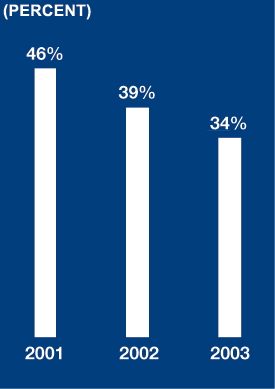
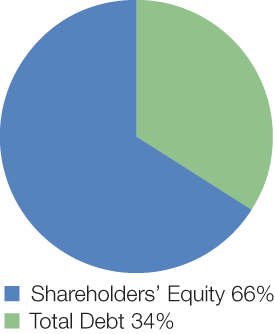
In the liability section of the balance sheet, short-term debt was down significantly due to strong operating cash flow, which allowed us to pay down approximately $94 million of our short-term debt. Income taxes payable increased in 2003 over 2002 due to higher current income tax expense for 2003 as compared to 2002 and lower income tax payments made during the year compared to the prior year. Longterm debt also increased in 2003 due to currency as a large portion of our debt is denominated in euros. During 2002 total assets increased to $2.9 billion from $2.5 billion at year-end 2001. Accounts receivable increased 8 percent over yearend 2001, primarily due to the effect of business acquisitions during 2002, as well as due to the effect of exchange rates. Other assets also increased significantly from year-end 2001 due to payments totaling approximately $125 million to fund our U.S. pension plan during 2002. Other current liabilities increased from year-end 2001 primarily due to an increase in restructuring accruals and due to the effect of exchange rates. TOTAL DEBT TO CAPITALIZATION >
CASH FLOWS
Cash flows used for investing activities included capital expenditures of $212 million in 2003, $213 million in 2002 and $158 million in 2001. Worldwide additions of merchandising equipment, primarily cleaning and sanitizing product dispensers, accounted for approximately 70 percent of each year's capital expenditures. Merchandising equipment is depreciated over 3 to 7 year lives. Cash used for businesses acquired included Adams Healthcare in 2003, Terminix Ltd. and Kleencare Hygiene in 2002 and Henkel-Ecolab in 2001. Financing cash flow activity included cash used to reacquire shares and pay dividends and cash provided and used through our debt arrangements. Share repurchases totaled $227 million in 2003, $9 million in 2002 and $32 million in 2001. These repurchases were funded with operating cash flows and cash from the exercise of employee stock options. In October 2003, we announced a new authorization to repurchase up to 10 million additional shares of Ecolab common stock for the purpose of offsetting the dilutive effect of shares issued for stock option exercises and incentives and general corporate purposes. In 2003, we increased our annual dividend rate for the twelfth consecutive year. We have paid dividends on our common stock for 67 consecutive years. Cash dividends declared per share of common stock, by quarter, for each of the last three years were as follows:
LIQUIDITY AND CAPITAL RESOURCES During 2003, we voluntarily contributed $75 million to our U.S. pension plan. In making this contribution, we considered the normal growth in accrued plan benefits, the impact of lower year-end discount rates on the plan liability, our intent to improve the projected benefit obligation funding ratio and the 29 percent actual asset return on our pension plan in 2003. Our contributions to the pension plan did not have a material effect on our consolidated results of operations, financial condition or liquidity. We do not expect expense for our U.S. pension plan to increase significantly for 2004. As described further in Note 5 of the consolidated financial statements, Henkel KGaA owns 28.2 percent of our common stock outstanding at December 31, 2003. In a December 2003 filing, Henkel reported that it may sell a portion or all of its holdings of Ecolab common stock and/or its holdings of common stock of The Clorox Company, or a combination of both, in connection with refinancing their pending acquisition of The Dial Corporation. Any dispositions by Henkel of any shares of Ecolab common stock would be done in accordance with the stockholder's agreement between Henkel and Ecolab, including our right of first refusal, and applicable law. We do not have relationships with unconsolidated entities or financial partnerships, such as entities often referred to as “structured finance” or “special purposes entities”, which are sometimes established for the purpose of facilitating off-balance sheet financial arrangements or other contractually narrow or limited purposes. As such, we are not exposed to any financing, liquidity, market or credit risk that could arise if we had engaged in such relationships. A schedule of our obligations under various long-term debt agreements and operating leases with noncancelable terms in excess of one year are summarized in the following table:
We lease sales and administrative office facilities, distribution center facilities, computers and other equipment under longer-term operating leases. Vehicle leases are generally shorter in duration. The U.S. vehicle leases have guaranteed residual value requirements that have historically been satisfied by the proceeds on the sale of the vehicles. No amounts have been recorded for these guarantees in the table above as we believe that the potential recovery of value from the vehicles when sold will be greater than the residual value guarantee. We do not have significant unconditional purchase obligations, or significant other commercial commitments, such as commitments under lines of credit, standby letters of credit, guarantees, standby repurchase obligations or other commercial commitments. We are in compliance with all covenants and other requirements of our credit agreements and indentures. Additionally, we do not have any rating triggers that would accelerate the maturity dates of our debt. A downgrade in our credit rating could limit or preclude our ability to issue commercial paper under our current programs. A credit rating downgrade could also adversely affect our ability to renew existing, or negotiate new credit facilities in the future and could increase the cost of these facilities. Should this occur, we could seek additional sources of funding, including issuing term notes or bonds. In addition, we have the ability at our option to draw upon our $450 million committed credit facilities prior to their termination. |
|||||||||||||||||||||||||||||||||||||||||||||||||||||||||||||||||||||||||||||||||||||||

 Total assets reached $3.2 billion at December 31, 2003, an
increase of 13 percent over total assets of $2.9 billion at year-end 2002.
Approximately $290 million of this increase was related to the strengthening
of foreign currencies, primarily the euro. For example, 87 percent
of the increase in accounts receivable was related to currency. The
increase in goodwill in 2003 over 2002 was almost entirely related to
currency. Other assets also increased significantly in 2003 due to a $75
million contribution to fund our U.S. pension plan.
Total assets reached $3.2 billion at December 31, 2003, an
increase of 13 percent over total assets of $2.9 billion at year-end 2002.
Approximately $290 million of this increase was related to the strengthening
of foreign currencies, primarily the euro. For example, 87 percent
of the increase in accounts receivable was related to currency. The
increase in goodwill in 2003 over 2002 was almost entirely related to
currency. Other assets also increased significantly in 2003 due to a $75
million contribution to fund our U.S. pension plan.