 |
 |
 |
 |
 |
 |
 |
 |
 |
 |
 |
 |
 |
 |
 |
 |
 |
 |
 |
 |
 |
 |
 |
 |
 |
 |
 |
 |
 |
 |
 |
 |
 |
|
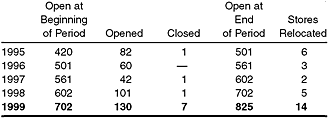
5-Year Financial Highlights | MD&A | Cautionary Statements | Independent Auditors’ Report MANAGEMENT’S DISCUSSION AND ANALYSIS OF FINANCIAL CONDITION AND RESULTS OF OPERATIONS •••••••••••••••••••••••••••••••••••••••••••••••General••••••••••••••••••••••••••••••••••••••••••••••• Office Depot, Inc., together with our subsidiaries, is the largest supplier of office products and services in the world. We sell to consumers and businesses of all sizes through our three business segments: Stores, Business Services and International. Each of these segments is described in more detail below. In 1999, we refined our segment definitions to better reflect our current management responsibilities. We modified our financial systems to allow us to restate 1998 segment information. However, reliable information was not available to restate our 1997 segment information. We operate on a 52- or 53-week fiscal year ending on the last Saturday in December. This Management’s Discussion and Analysis (“MD&A”) is intended to provide information to assist you in better understanding and evaluating our financial condition and results of operations. We recommend that you read this MD&A in conjunction with our Consolidated Financial Statements and the Notes to those statements. This MD&A section contains significant amounts of forward-looking information, and is qualified by our Cautionary Statements regarding forward-looking information. You will find Cautionary Statements throughout this MD&A; however, most of them can be found in a separate section immediately following this MD&A. Without limitation, when we use the words “believe,” “estimate,” “plan,” “expect,” “intend,” “anticipate,” “continue,” “project” and similar expressions in this Annual Report, we are identifying forward-looking statements, and our Cautionary Statements apply to these terms and expressions. On February 24, 1999, our Board of Directors declared a three-for-two stock split in the form of a 50% stock dividend distributed on April 1, 1999 to stockholders of record on March 11, 1999. We have restated all share and per share amounts in our financial statements to reflect this stock split. The split resulted in the issuance of approximately 125 million additional shares. Stores Division Our Stores Division sells office products, copy and print services and other business-related services under the Office Depot® and the Office Place® brands through our chain of high-volume office supply stores in the United States and Canada. We opened our first office supply store in Florida in October 1986. From our inception, we have been a leader in the retail office supplies industry, concentrating on expanding our store base and increasing our sales in markets with high concentrations of small- and medium-sized businesses. As of the end of 1999, our Stores Division operated 825 office supply stores in 46 states, the District of Columbia and Canada. Store activity for the last five years has been as follows:
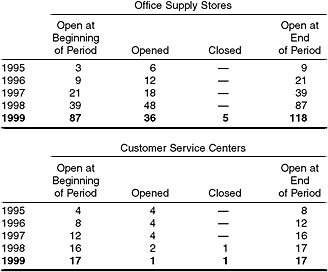
The decline in the number of stores opened in 1996 and 1997 was the result of our proposed merger with Staples, Inc. (“Staples”), which was terminated in July 1997. During this period of uncertainty, several of our key employees in the real estate area left the Company. See Merger and Restructuring Costs for more information on the proposed Staples merger. After the merger discussions with Staples were terminated, we re-staffed our real estate department and re-launched our store expansion program. We currently plan to open approximately 100 new retail stores in the United States and Canada during 2000. Our real estate strategy will stress a more analytical approach in the future, rather than focusing on a specific number of new stores. Over the past year, we have conducted extensive customer and market research that will provide us with a more precise evaluation of the profit potential and return on investment of each new store opening. Business Services Group (“BSG”) In 1993 and 1994, we expanded into the contract business by acquiring eight contract stationers with 18 domestic customer service centers and an established contract sales force. These acquisitions allowed us to enter the contract business and broaden our commercial (primarily catalog) and retail delivery businesses. Today, BSG sells office products and services to contract and commercial customers through our Office Depot® and Viking Office Products® direct mail catalogs and Internet sites, and by means of our dedicated sales force. Customer service centers (“CSCs”) are warehouse and delivery facilities, many of which also house sales offices, call centers and administrative offices. Our CSCs perform warehousing and delivery services on behalf of all our domestic segments of our business. Prior to our merger with Viking Office Products, Inc. (“Viking”) in August 1998, we replaced several outdated, inefficient facilities with new CSCs and converted all of our warehouse and order entry systems to one common technology platform. At the end of 1999, we operated 30 CSCs in the United States, 10 of which we added as a result of the Viking merger. We have initiated plans to integrate our Viking and Office Depot warehouses. We expect to accomplish this integration by either absorbing the Viking operations into existing Office Depot warehouses or by opening new combined warehouses, depending on the particular market circumstances. Once our integration is complete, we will operate 21 combined CSCs after closing nine Viking and two Office Depot CSCs and opening two new combined facilities. We have included the estimated costs of this integration in merger and restructuring costs. See Merger and Restructuring Costs for further information. Although we are integrating our warehouse and delivery network, we will continue to operate under both the Office Depot and Viking brands. In January 1998, we introduced our Office Depot public Web site (www.officedepot.com), offering our customers the convenience of shopping on-line. The addition of this site expanded our domestic electronic commerce capabilities beyond the Viking public Web site (www.vikingop.com) and the Office Depot business-to-business (“B2B”) contract Web sites. In 1999, our domestic Internet sales were $349.7 million, compared to approximately $66.5 million in 1998, an increase of 426%. Although this business channel is still in its infancy, we believe our Internet business will provide significant future growth opportunities for our BSG segment and our business as a whole based on the growth rates we have experienced over the last two years. International Division Our International Division sells office products and services to retail and commercial customers in 17 countries outside the United States and Canada. We launched our international direct marketing business in 1990 under the Viking brand with the establishment of our United Kingdom operations. In December 1993, we initiated our international retail operations by opening our first store in Colombia through a licensing agreement. We have expanded internationally through licensing and joint venture agreements, acquisitions and the merger with Viking. Prior to 1998, our international business was operated entirely through licensing and joint venture agreements. In 1998, we merged with Viking, whose international operations were wholly-owned, and we increased our ownership in our retail operations in France to 100%. In 1999, we increased our ownership in our retail operations in Japan to 100%. In March 1999, we introduced our first international public Web site (www.viking-direct.co.uk) for individuals and businesses in the United Kingdom; and in the first quarter of 2000, we introduced our public Web site in Germany (www.viking.de). We expect to introduce several new international Web sites in 2000 under both the Office Depot and Viking brand names, and we believe that the Internet provides a significant opportunity for international growth. At the end of 1999, there were 118 office supply stores in eight countries outside the United States and Canada operating under the Office Depot name, 32 of which were wholly-owned. This compares to 87 stores in eight countries, 15 of which were wholly-owned, at the end of 1998. In addition to these retail stores, our International Division has catalog and delivery operations in 13 countries. We operate our catalog business under the Viking brand in 11 of these countries and under the Office Depot brand in four of these countries. At the end of 1999, our International Division operated in Australia, Austria, Belgium, Colombia, France, Germany, Hungary, Ireland, Israel, Italy, Japan, Luxembourg, Mexico, the Netherlands, Poland, Thailand and the United Kingdom. International store and CSC operations, including facilities operated through licensing and joint venture agreements, for the last five years are detailed below. All years prior to 1998 have been restated to include facilities operated by Viking prior to our merger.
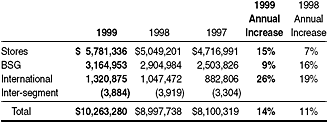
We have begun integrating and restructuring our operations in France and Japan, the only two international operations in which we sell under both our Office Depot and Viking brands. In conjunction with this restructuring, we closed one CSC and one store in Japan, with a second CSC targeted for closure. In France, we merged our Office Depot and Viking headquarters into a new, more conveniently located office. We expect to complete our integration in both countries by the end of 2000. We have included the estimated costs of this integration in merger and restructuring costs. See Merger and Restructuring Costs for further information. ••••••••••••••••••••••••••••••••••••••Results of Operations••••••••••••••••••••••••••••••••••••••• As discussed earlier in this MD&A, we operate in three reportable segments—Stores, BSG and International. Each of these segments is managed separately primarily because it serves different customer groups. Our senior management evaluates the performance of our business based on each segment’s operating income, which is defined as income before income taxes, interest income and expense, goodwill amortization, merger and restructuring costs and general and administrative expenses. In 1999, we refined our segment definitions to better reflect our current management responsibilities. All segment amounts presented throughout this MD&A for prior years have been restated, whenever possible, to reflect this refinement in segment definitions. Sales
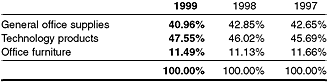
Overall Our worldwide sales by product group were as follows:
Our merchandise mix remained relatively consistent between 1997 and 1998, with a slight shift toward the sale of technology products (i.e., computers, business machines and related supplies), driven primarily by growth in the business machine supplies category. In 1999, aggressive promotional programs offering discounts on certain hardware and software when customers purchased Internet service further expanded the sales of technology products. We have also continued to focus on consultative selling of technology products in our stores. Stores Sales of computer products (i.e., computers, printers, peripherals, software and related supplies) in our stores, with increases of 23% in 1999 and 7% in 1998, contributed significantly to the sales increases in our Stores Division. Growth in units sold of technology products greatly exceeded declines in average selling prices for both years, particularly in computer hardware. Sales of business machine supplies, which are also significant to our Stores product mix, increased 17% in 1999 and 22% in 1998. In late 1999, the SEC released accounting guidance which dictates that retailers named as the legal obligor in an extended warranty service contract must recognize the revenues and direct expenses associated with the sale of such warranties over the service period of the contract, regardless of economic risk. In addition, retailers that are not the legal obligor in a warranty service contract must record their revenues net of direct expenses. We sell extended service plans, administered by an unrelated third party, to customers in our Stores Division. All performance obligations and risk of loss associated with such contracts are economically transferred to our administrator, which insures itself against any liabilities arising under such contracts, at the time the contracts are sold to the customer. While our service plans typically extended over a period of one to four years, we previously recognized the gross revenues and direct expenses from the sale of these contracts immediately. Because we were named as the legal obligor in the majority of the states in which we sell these contracts, we modified our accounting to recognize revenue for warranty service contract sales in those states over the service period. In those states where we are not the legal obligor, we modified our accounting to recognize warranty revenues net of the direct costs. We have given effect to this modification to our accounting in our 1999 financial statements by reducing our sales and cost of goods sold by (1) the cumulative amounts we need to defer and recognize in future periods and (2) the cumulative amounts we need to net against our sales. We are modifying the terms of our extended service contracts in states where we are not legally obligated to serve as the obligor to substantially alleviate the deferral of our warranty revenues and costs in future years. This adjustment, which only impacted our Stores Division, resulted in a reduction in our 1999 gross profit of $15.8 million, or $0.03 per share. BSG We also experienced growth in our Viking brand catalog sales in both years, driven by a more targeted approach to catalog promotions. We have achieved comparatively smaller increases in our Office Depot brand catalog sales from increased circulation of our direct mail catalogs. Sales of business machine supplies, which are significant to our BSG product mix, increased 26% in 1999 and 55% in 1998. International
Overall
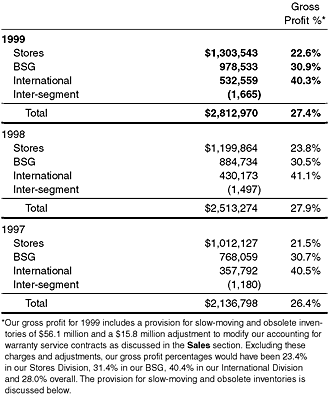
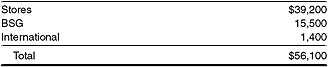
While we believe that this charge is non-recurring, we cannot assure you that we will not incur charges like this in the future. Excluding the charges and adjustments discussed earlier, decreased net product costs derived from merger-related synergies during 1999 drove our slight improvement in margins compared to 1998. However, offsetting these savings were increased occupancy costs in our Stores Division and lowered margins in our International Division, both of which are discussed in more detail later. In 1998, our overall gross profit improved as compared to 1997 as a result of favorable product mix shifts within the technology category and continued strengthening of our vendor relationships which drove overall product costs down. Our overall gross profit percentages fluctuate as a result of numerous factors, including competitive pricing pressures; changes in product, catalog and customer mix; emergence of new technology; suppliers’ pricing changes; as well as our ability to manage our net product costs through growth in total merchandise purchases. Additionally, our occupancy costs may vary as we add stores and CSCs in new markets with different rental and other occupancy costs and as we relocate and/or close existing stores in current markets. Stores BSG International
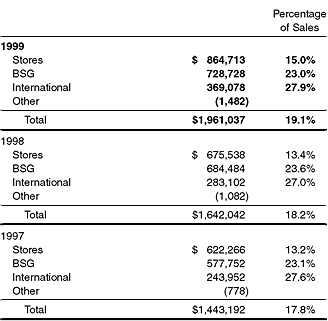
Overall Stores The increase in expenses during 1999 and 1998 was driven largely by personnel-related costs, primarily because of competitive wage pressure and the need to attract more highly skilled associates in certain positions. Approximately 60% of our stores’ operating expenses are personnel related and have a relatively large fixed cost component. In 1999, we also increased our advertising expenses, launching our new “Taking Care of Business” campaign, and incurred additional operating expenses as we focused on several new sales and re-merchandising initiatives. In 1998, we incurred certain incremental expenses in our Stores Division to support our aggressive store remodeling program. We completed approximately 65 and 200 store remodels in 1999 and 1998, respectively. The decrease in the total number of remodels in 1999 stems from an increased focus on re-merchandising our stores (i.e., re-arranging product displays in a way that is more appealing to the customer) rather than performing full remodels. This approach requires less capital and is more appropriate given the number of new stores in our store base.
BSG International Additionally, certain of our operations are in their start-up phase, which also increases our international operating expenses as a percentage of sales when compared to other segments. During 1999, increased advertising costs significantly impacted our operating and selling expenses as a percentage of sales. Increasing competition in many of our established markets, coupled with our efforts to gain market share in certain newer markets, have driven up our advertising costs. Furthermore, as discussed earlier in this MD&A, we began consolidating the results of our French and Japanese retail operations in the fourth quarter of 1998 and the second quarter of 1999, respectively, as opposed to previously using the equity method of accounting. In 1999, we expanded our store base by 31, ending the year with 118 retail stores internationally. This has resulted in increased operating expenses because the fixed costs of operating a store represent a larger percentage of sales for newer stores than for more mature stores. As part of our integration plan (See Merger and Restructuring Costs), we will be consolidating certain of our Office Depot and Viking operations in France and Japan. We believe this will result in improved operating results in those countries. In 1998, our international operating and selling expenses as a percentage of sales improved primarily as a result of our operations continuing to mature in countries such as Germany, which we entered in late 1995. As our operations in a particular market grow, certain fixed operating expenses decline relative to sales. Additionally, as market share increases, advertising costs in the form of prospecting and delivery costs, which are affected by the density of the delivery areas, decline as a percentage of sales. As we continue to grow our international business and establish brand recognition, we expect to leverage certain fixed operating expenses, and our cost to attract new customers should decline as a percentage of sales. We believe, however, that these improvements will be offset, as they were in 1999, by the incremental costs incurred to continue developing new markets, including Japan. Pre-opening Expenses
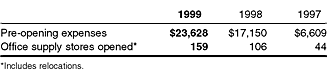
Our pre-opening expenses consist principally of personnel, property and advertising expenses incurred in opening or relocating stores in our Stores Division. We typically incur these expenses during a six-week period prior to the store opening. Because we expense these items as they are incurred, the amount of pre-opening expenses we incur each year is generally proportional to the number of new stores we open during the period. Our pre-opening expenses also include, to a lesser extent, expenses incurred to open or relocate facilities in our Business Services Group and our International Division. In 1999, our pre-opening expenses approximated $155,000 per domestic office supply store and $80,000 per international office supply store. The amount for our domestic stores has increased from our historical average of $125,000 because we acquired a group of stores from another retailer, which generated higher occupancy costs during an extended pre-opening period. Our cost to open a new CSC varies significantly with the size and location of the facility. Historically, we have incurred up to $1,750,000 to open a domestic or international CSC. General and Administrative Expenses
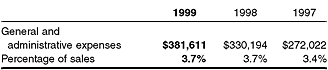
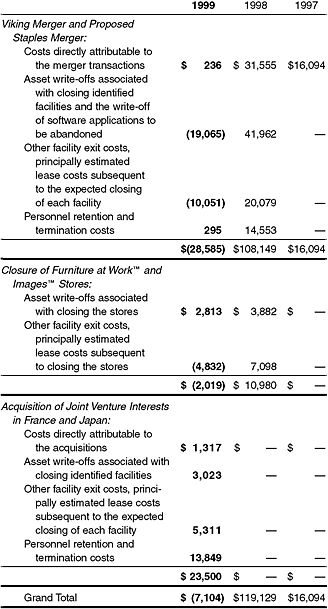
Our general and administrative expenses consist primarily of personnel-related costs associated with support functions. Because these functions, for the most part, support all segments of our business, we do not consider these costs in determining our segment profitability. Throughout 1998 and 1999, we strengthened our corporate infrastructure, particularly in the areas of Supply Chain management and MIS. This initiative was a significant contributor to the increases in our general and administrative expenses in the last two years. The benefits of this increased spending are reflected in our lower levels of inventory per store and improved purchasing efficiencies. Also contributing to the growth in our general and administrative expenses over the last two years was spending to support our Year 2000 compliance efforts, CSC consolidation and integration and electronic commerce initiatives. In 1997, our personnel-related costs were lower than our current trends as a result of the proposed merger with Staples. During that period of uncertainty, many of our corporate departments were reduced in size in preparation for combining the support functions of the two companies. Merger and Restructuring Costs Viking Merger Subsequent to the merger, we immediately began the process of integrating our Office Depot and Viking businesses. Our original plans, which we expected to complete during 2000, initially included the closing of 15 domestic CSCs and the opening of five new domestic CSCs, as well as installing complex new systems in each surviving facility. During the fourth quarter of 1999, after evaluating the results of integrating two test facilities, we modified our CSC integration plans. Our new plans incorporate a more simplified approach and, as a result, require less capital. Furthermore, our new plans require the closing of only 11 existing CSCs and the opening of only two new CSCs, which were opened as test facilities in late 1999. We lease all but two of the closing CSCs. We sold one of the CSCs in 1999, and we plan to sell the other in 2000. Our plan is to vacate all of the buildings. Accordingly, we have written off certain assets such as leasehold improvements and redundant software and conveyor systems in these CSCs. In addition, merger and restructuring costs include certain expenses of exiting these facilities that will provide no future economic benefit to us (e.g., future lease obligations, personnel retention and other termination costs). As a result of modifying our integration plans in the fourth quarter of 1999, we reversed previously accrued merger and restructuring charges of $32.5 million, reducing merger and restructuring costs to a net credit of $7.1 million for the year. We accrue merger and restructuring costs when significant changes in our plan are unlikely, which in most cases requires that planned actions take place within one year. In the case of our CSC integration, we plan to integrate all but three of our CSCs during 2000. We feel confident that significant changes in our plan are unlikely even though three of our CSCs will not be integrated until early 2001. Closure of Furniture at Work™ and Images™ Stores Acquisition of Joint Venture Interests in France and Japan In April 1999, we purchased our joint venture partner’s interest in our Japanese Office Depot retail operations and announced plans to restructure and integrate our operations in Japan. We closed one leased CSC and one leased store in Japan in conjunction with these plans. We expect to close another CSC in 2000. We have recorded merger and restructuring costs in 1999 associated with these activities. We expect our operations in France and Japan to be completely integrated by the end of 2000. Proposed Staples Merger Merger and restructuring costs in 1999, 1998 and 1997 consist of the following charges:
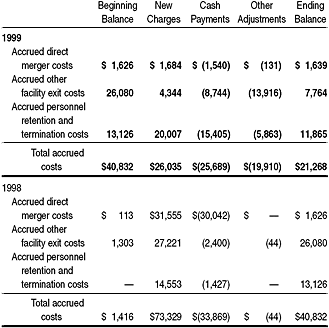
We determined the fair value of assets to be disposed of by estimating the net realizable value at the time of the anticipated closure or discontinuation of use. Estimated proceeds from and costs to dispose of these assets were determined through analysis of historical data and expected outcomes. The costs required to complete our merger and restructuring plans necessarily involve the use of estimates. We believe our estimates are unlikely to change significantly in the future. As of December 25, 1999 and December 26, 1998, we have remaining accruals of approximately $21.3 million and $40.8 million, respectively, for merger and restructuring costs. Amounts expensed for asset write-offs are recorded as a reduction of our fixed assets. All other amounts are recorded as accrued expenses. The activity in the liability accounts by cost category is as follows:
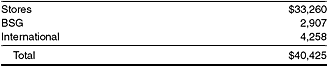
The other adjustments column represents adjustments of original estimates and other adjustments pursuant to plan modifications made during the fourth quarter of 1999. In addition to the amounts we have accrued, we expect to incur additional integration-related costs over the remaining integration periods. Although we expect these costs to be insignificant to our future operating results, there can be no assurance that this will be the case. We expect to rely primarily on cash flows generated from operations to fund our integration-related costs. See Liquidity and Capital Resources. We expected to terminate approximately 171 store, warehouse and support employees worldwide in conjunction with our restructuring and integration plans. To date, all 171 employees have been terminated. We believe the reduction in our revenues and increases in our operating profit arising from these integration activities will be insignificant to our overall and segment results. Store Closure and Relocation Costs We recorded a charge of $46.4 million in the third quarter of 1999 to reflect our decision to accelerate our store closure program for under-performing stores and our relocation program for older stores in our Stores Division. This charge also reflects our decision to sell our interest in our retail operations in Thailand. On October 28, 1999, we entered into an agreement with Central Retail Group, our joint venture partner, to sell to them our Thai operations and license to them certain trademarks, software and operating systems. Central Retail Group now operates the two Thai stores under a licensing agreement. Finally, the charge also reflects our decision to write-off certain other long-lived assets in our BSG. During the fourth quarter of 1999, we reversed $6.0 million of the charge relating to stores that may be relocated after 2000. This reversal is in accordance with guidance issued by the SEC in late 1999 which provides that restructuring charges should not be accrued unless changes in the plan are unlikely, which in most cases requires that planned actions take place within one year. This charge, net of the reversal, consisted of asset impairment costs ($29.2 million), residual lease obligations ($8.3 million) and other exit costs ($2.9 million). Asset impairment costs consist principally of leasehold improvements and other assets that will be retired when the identified stores are closed or relocated. The charge impacted the operating profits of our business segments as follows:
While we believe that this charge is of a non-recurring nature, we cannot assure you that we will not incur similar charges in the future. We do not foresee any impact on our revenues or operating profit as a result of the BSG asset write-offs. We believe the lost revenues and increased operating profit in our Stores and International Divisions from closing these stores and selling our joint venture interest will be insignificant. Other Income and Expenses
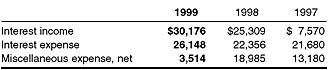
We do not consider interest income and expense arising from our financing activities at the corporate level in determining segment profitability. The increases in interest income in 1999 and 1998 resulted from improved operating cash flows in 1998, which yielded higher average cash balances throughout 1998 and most of 1999. Pursuant to our Board of Directors authorizing stock repurchases in August 1999 of up to $500 million, we purchased 46.7 million shares of our stock at a total cost of $500 million plus commissions during the last half of 1999. As a result, our cash balances have declined, and we expect a proportional impact on our interest income in future periods. In January 2000 and March 2000, our Board authorized additional stock repurchases of up to $200 million. This will further reduce our cash balances in the future. The majority of our interest expense is fixed in nature and relates to our convertible, subordinated debt. Additionally, during 1999, we entered into a number of capital leases, primarily related to new point-of-sale equipment in our stores. This has resulted in increased interest expense, which may continue in future years. In late 1999, we began borrowing against our yen-denominated loan facility to finance our expansion in Japan. Because the interest rate we are currently paying on our yen borrowings is between 1% and 2%, we expect that the effect of these borrowings on our future interest expense will be negligible. See Liquidity and Capital Resources. Our net miscellaneous expense consists of equity in the earnings (losses) of our joint venture investments, royalty and franchise income that we generate from licensing and franchise agreements and the amortization of goodwill. All of our equity investments involve operations outside of the United States and Canada, and our equity in the earnings (losses) of these operations is included in determining the profitability of our International Division. The decrease in net miscellaneous expense in 1999 is primarily attributable to the consolidation of our French and Japanese retail operations beginning in the fourth quarter of 1998 and second quarter of 1999, respectively, when we purchased the remaining 50% interest from our joint venture partners. Prior to that consolidation, we recorded equity losses related to the start-up of those operations. During 1998, we increased our ownership share in our operations in Thailand to 80%. Accordingly, the results of our Thai operations have been consolidated from the date of the ownership increase. See Store Closure and Relocation Costs for a discussion of our decision to subsequently sell our ownership interest in the Thai business in November 1999. In 1999, our remaining joint venture operations in Mexico and Israel were profitable. Through our joint ventures that are accounted for using the equity method, we opened 14 locations in 1999, 40 locations in 1998 and 15 locations in 1997 that required start-up costs. Income Taxes
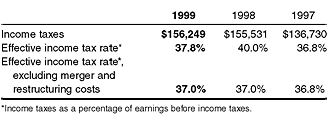
In 1999 and 1998, certain non-deductible merger-related charges caused our overall effective income tax rates to rise. Our overall effective income tax rate, excluding merger and restructuring costs, may fluctuate in the future as a result of the mix of pre-tax income and tax rates between countries. ••••••••••••••••••••••••••••••••Liquidity and Capital Resources•••••••••••••••••••••••••••••••• Cash provided by (used in) our operating, investing and financing activities is summarized as follows:
Operating and Investing Activities We have historically relied on cash flow generated from operations as our primary source of funds because the majority of our store sales are generated on a cash and carry basis. Furthermore, we use private label credit card programs, administered and financed by financial services companies, to expand our sales without the burden of carrying additional receivables. Our cash requirements are also reduced by vendor credit terms that allow us to finance a portion of our inventory. We generally offer credit terms, under which we carry our own receivables, to our contract and certain of our direct mail customers. As we expand our contract and direct mail businesses, we anticipate that our accounts receivable portfolio will continue to grow. Receivables from rebate, cooperative advertising and marketing programs with our vendors comprise a significant percentage of our total receivables. These receivables tend to fluctuate seasonally (growing during the second half of the year and declining during the first half), because certain collections do not happen until after an entire program year has been completed. The decline in our operating cash flows in 1999 is primarily attributable to our increased store openings. On a worldwide basis in 1999, excluding joint venture operations and licensing arrangements, we opened 159 stores, including relocations of older stores, as compared to 106 and 44 stores during 1998 and 1997, respectively. Opening a new domestic store requires that we outlay approximately $600,000 in cash for the portion of our inventories that is not financed by our vendors, as well as approximately $155,000 for pre-opening expenses (see Pre-opening Expenses). Our focus on supply chain management helped boost our 1998 operating cash flows through the $139 million reduction in our inventories. This focus continued to reduce the average inventory balances held in stores and CSCs in 1999; however, this benefit was offset by increases resulting from stocking a large number of new stores with inventories and from incremental Y2K-related purchasing. Our primary investing activity is the acquisition of capital assets. The number of stores and CSCs we open or remodel each year generally drives the volume of our capital investments. As mentioned above, our store openings have increased significantly in each of the years reported. These openings were the most significant contributors to our increased investing cash outflows. Computer and other equipment purchases at our corporate offices and at our facilities, necessary to complete Y2K remediation (see Year 2000) and to support our store expansion, also contributed to our increased cash investing needs. Our Viking integration plans, which are discussed in Merger and Restructuring Costs, will require capital investments, both domestically and internationally, approximating $50 million over the next 12 to 18 months. We also currently plan to open approximately 100 stores in our Stores Division and 35 stores and one warehouse in our International Division during 2000. We estimate that our cash investing requirements will be approximately $1.2 million for each new domestic office supply store. The $1.2 million includes approximately $600,000 for leasehold improvements, fixtures, point-of-sale terminals and other equipment, and approximately $600,000 for the portion of our inventories that will not be financed by our vendors. In addition, each new office supply store requires pre-opening expenses of $155,000 domestically and $80,000 internationally. Our cash investing requirements for a new CSC are significantly more than the requirements for a new store. Each new domestic and international CSC requires between $6 to $16 million for capital assets and inventory and pre-opening expenses up to $1.8 million, depending on the size, type and location of the facility. We have expanded our presence in the electronic commerce marketplace by entering into strategic business relationships with several Web-based providers of business-to-business (“B2B”) electronic commerce solutions. We have made equity investments in these companies, including PurchasePro.com ($5.2 million), and three other companies ($45.5 million). Of these investments, only the shares in PurchasePro.com are traded publicly. Although our investment in PurchasePro.com has increased in value by more than $100 million since our initial investment, our other investments may not generate similar appreciation. Furthermore, the gain on our investment in PurchasePro.com will not be realized until our investment is sold. In February 2000, we exercised 250,000 warrants and sold the underlying shares of PurchasePro.com on the open market for $19.0 million, net of commissions. The exercise price was satisfied through the exercise of an additional 27,777 warrants. We will realize a gain on this transaction in the first quarter of 2000. The value of our remaining investments could decrease before they are realized. We will continue to look for opportunities to invest in companies that provide B2B electronic commerce solutions for small- and medium-sized businesses. Financing Activities In February 1998, we entered into a credit agreement with a syndicate of banks. This credit agreement (the “domestic credit facility”) provides us with a working capital line and letters of credit totaling $300 million. This agreement provides for various borrowing rate options, including a rate based on credit rating and fixed charge coverage ratio factors that currently would result in an interest rate of .18% over LIBOR. Our domestic credit facility expires in February 2003 and contains certain restrictive covenants relating to various financial statement ratios. During December 1999, we borrowed and repaid a total of $44.2 million. As of December 25, 1999, we had no outstanding borrowings under this facility, but we had outstanding letters of credit under this facility totaling $18.0 million. In July 1999, we entered into term loan and revolving credit agreements with several Japanese banks (the “yen facilities”) to provide financing for our operating and expansion activities in Japan. The yen facilities provide for maximum aggregate borrowings of ¥9.76 billion (the equivalent of $96 million at December 25, 1999) at an interest rate of .875% over the Tokyo Interbank Offered Rate (“TIBOR”). Although the loans mature at varying rates of three to six months, we have classified these borrowings as non-current on our Balance Sheet because we intend to renew them as they come due. These yen facilities contain covenants similar to those in our domestic credit facility as described earlier. During 1999, we borrowed the equivalent of $47 million under the yen facilities. We have borrowed the equivalent of an additional $8 million subsequent to the end of the year. Effective as of October 28, 1999, we entered into a yen interest rate swap for a principal amount equivalent to $23 million at December 25, 1999 in order to hedge against the volatility of the interest payments on a portion of our yen borrowings. The terms of the swap specify that we pay an interest rate of .7% and receive TIBOR. In addition to bank borrowings, we have historically used equity capital, convertible debt and capital equipment leases as supplemental sources of funds. In August 1999, our Board approved a $500 million stock repurchase program reflecting its belief that our common stock represented a significant value at its then-current trading price. We purchased 46.7 million shares of our stock at a total cost of $500 million plus commissions during the third and fourth quarters of 1999. In January 2000 and March 2000, our Board approved additional stock repurchases of up to $200 million, bringing our total authorization to $700 million. As of March 3, 2000 we had purchased an additional 9.2 million shares of our stock at a total cost of $100 million plus commissions. The remaining authorization does not have an expiration date, and we can acquire our common stock either on the open market or through negotiated purchases. The decline in cash from our financing activities in 1999, as compared to 1998, was driven by our stock repurchases. The increase in cash flows from financing activities in 1998 as compared to 1997 was driven by our repayment of short-term borrowings in 1997 and by funds received from stock options exercised by our employees in 1998. In connection with our merger with Viking, all options held by Viking employees prior to the merger, with the exception of those granted under Viking’s annual option award in July 1998, vested fully on the merger date. In 1992 and 1993, we issued Liquid Yield Option Notes (“LYONs”) which are zero coupon, convertible subordinated notes maturing in 2007 and 2008, respectively. Each LYON® is convertible at the option of the holder at any time on or prior to its maturity into Office Depot common stock at conversion rates of 43.895 and 31.851 shares per 1992 and 1993 LYON®, respectively. On November 1, 2000 for the 1993 LYONs® and December 11, 2002 for the 1992 LYONs®, the holder may require us to purchase the LYONs® from them at the issue price plus accrued original issue discount. If the holder decides to exercise their put option, we have the choice of paying the holder in cash, common stock or a combination of the two. For that reason, our 1993 LYONs® have been classified as a current liability on our 1999 Balance Sheet. Unless our stock price increases substantially above current levels, we expect that a significant number of LYONs® will be put to the Company in November of this year. Our current intention is to pay cash for any puts exercised on November 1, 2000. We continually review our financing options. Although we currently anticipate that we will finance all of our 2000 expansion, integration and other activities through cash on hand, funds generated from operations, equipment leases and funds available under our credit facilities, we will consider alternative financing as appropriate for market conditions. Our financing requirements beyond 1999 will be affected primarily by the number of new stores or CSCs we open or acquire, the specific actions required to integrate our Office Depot and Viking operations, and the decisions of the LYONs® holders. ••••••••••••••••••••Significant Trends, Developments and Uncertainties•••••••••••••••••••• Over the years, we have seen continued development and growth of competitors in all segments of our business. Mass merchandisers have increased their assortment of home office merchandise, attracting additional back-to-school customers and year-round casual shoppers. We also face competition from other office superstores that compete directly with us in numerous markets. These other office superstores compete with us in geographical locations where we have traditionally been the market leader, just as we have begun penetrating markets where they have historically held the dominant market share. This competition is likely to result in increased competitive pressures on pricing, product selection and services provided. We have also seen growth in new and innovative competitors that offer office products over the Internet, featuring special purchase incentives and one-time deals (such as close-outs). Through our own successful Internet and business-to-business Web sites, we believe that we have positioned ourselves competitively in the electronic commerce arena. We have invested in strategic partnerships with several business-to-business Internet companies offering innovative solutions to small businesses, a target customer group. We are committed to supporting our Internet channel to meet the needs of our customers, including investing in new and innovative electronic commerce business enterprises. •••••••••••••••••••••••••••••••••••••••••••••••••Euro••••••••••••••••••••••••••••••••••••••••••••••••• On January 1, 1999, 11 of the 15 member countries of the European Economic and Monetary Union (“EMU”) established fixed conversion rates between their existing currencies and the EMU’s common currency (the “euro”). The euro is presently trading on currency exchanges and may be used in business transactions. The ultimate conversion to the euro will eliminate currency exchange rate risk among the member countries. The former currencies of the participating countries are scheduled to remain legal tender as denominations of the euro until January 1, 2002. During this transition period, parties may settle transactions using either the euro or a participating country’s former currency. On July 1, 2002, new euro-denominated bills and coins will become the sole legal currency, and all former currencies will be withdrawn from circulation. We have adapted our internal systems to accommodate euro-denominated transactions. We generate significant sales in Europe and are currently evaluating the business implications of the conversion to the euro. The use of a single currency in the participating countries may affect our ability to price our products differently in various European markets because of price transparency. We realize that we may be faced with price harmonization at lower average prices for items we sell in some markets. Nevertheless, other market factors such as local taxes, customer preferences and product assortment may reduce the likelihood or impact of price equalization. Based on these evaluations, we do not expect the conversion to the euro to have a material effect on our financial position or the results of our operations. ••••••••••••••••••••••Interest Rate and Foreign Exchange Market Risks•••••••••••••••••••••• Interest Rate Risks When we invest our funds in short-term investments, which generate income subject to variable interest rates, we are subject to interest rate risk. We did not, however, have any funds invested in such instruments as of December 25, 1999. Our zero coupon, convertible subordinated notes offer stated yields to maturity which are not subject to interest rate risks. Borrowings under our domestic and Japanese credit facilities are both subject to variable interest rates. As of December 25, 1999, there were no borrowings under our domestic credit agreement. The interest rate risk on our Japanese bank borrowings has been partially mitigated by an interest rate swap that fixes the interest rate on a portion of our yen borrowings for the remaining life of the loan. With interest rates currently approximating 1% in Japan, a 10% change in interest rates would not materially change our total interest expense. Foreign Exchange Rate Risks The nature and magnitude of our foreign exchange risks have not changed materially in the past year. We conduct business in various countries outside the United States where the functional currency of the country is not the U.S. dollar. This results in foreign exchange translation exposure when these foreign currency earnings are translated into U.S. dollars in our consolidated financial statements. As of December 25, 1999, a 10% change in the applicable foreign exchange rates would have resulted in an increase or decrease in our after-tax earnings of approximately $3 million on an annual basis. We are also subject to foreign exchange transaction exposure when our subsidiaries transact business in a currency other than their own functional currency. This exposure arises primarily from inventory purchases in a foreign currency. The introduction of the euro and our decision to consolidate our European purchases has greatly reduced these exposures. During 1999, we entered into foreign exchange forward contracts to hedge certain inventory exposures. The maximum contract amount outstanding during the year was $13.7 million. •••••••••••••••••••••••••••••••••••••Inflation and Seasonality••••••••••••••••••••••••••••••••••••• Although we cannot accurately determine the precise effects of inflation on our business, we do not believe inflation has a material impact on our sales or the results of our operations. We consider our business to generally be somewhat seasonal, with sales in our Stores Division and Business Services Group slightly higher during the first and fourth quarters of each year and sales in our International Division slightly higher in the third quarter. •••••••••••••••••••••••••••••••New Accounting Pronouncements••••••••••••••••••••••••••••••• In June 1998, the Financial Accounting Standards Board (the “FASB”) issued Statement of Financial Accounting Standards (“SFAS”) No. 133, “Accounting for Derivative Instruments and Hedging Activities.” SFAS No. 133 requires that we record all derivatives as assets or liabilities measured at their fair value. Gains or losses resulting from changes in the values of those derivatives would be accounted for according to the intended use of the derivative and whether it qualifies for hedge accounting. In July 1999, the FASB issued SFAS No. 137, which defers the effective date of SFAS No. 133 until the start of fiscal years beginning after June 15, 2000. We will adopt SFAS No. 133 for our fiscal year 2001. Assuming our current level of involvement in derivative instruments and hedging activities does not change before we adopt this Statement, we do not expect the adoption of SFAS No. 133 to have a material impact on our financial position or the results of our operations. 5-Year Financial Highlights | MD&A | Cautionary Statements | Independent Auditors’ Report
|