 |
 |
 |
 |
 |
 |
 |
 |
 |
 |
 |
 |
 |
 |
 |
 |
 |
 |
 |
 |
 |
 |
 |
 |
 |
 |
 |
 |
 |
 |
 |
 |
 |
|
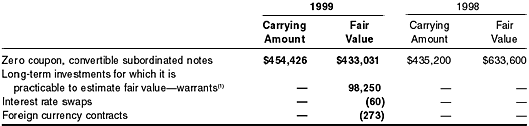
5-Year Financial Highlights | MD&A | Cautionary Statements | Independent Auditors’ Report NOTES TO CONSOLIDATED FINANCIAL STATEMENTS ••••••••••••••••••••••Note A—Summary of Significant Accounting Policies•••••••••••••••••••••• Office Depot, Inc., together with our subsidiaries, is the world’s largest supplier of office products and services, operating in 19 countries throughout the world and doing business primarily under two brands—Office Depot and Viking Office Products. We serve our customers, including those in countries operated under licensing and joint venture agreements, through multiple sales channels. They include an international chain of high-volume office supply stores located in ten countries; a domestic contract sales network; three Internet sites, serving both our domestic and international customers; and catalog, mail order and delivery operations in 15 countries. After merging with Viking Office Products, Inc. (“Viking”) in August 1998, we now have operations, either owned directly or operated through joint ventures or licensing arrangements, in Australia, Austria, Belgium, Canada, Colombia, France, Germany, Hungary, Ireland, Israel, Italy, Japan, Luxembourg, Mexico, the Netherlands, Poland, Thailand, the United Kingdom and the United States. Basis of Presentation: We operate on a 52- or 53-week fiscal year ending on the last Saturday in December. All periods presented in our consolidated financial statements consisted of 52 weeks. We have included account balances from our wholly-owned and majority-owned subsidiaries in our consolidated financial statements. We eliminate any significant inter-company transactions when consolidating the account balances of our subsidiaries. We have reclassified certain amounts in our prior year statements to conform them to the presentation used in the current year. We currently maintain licensing agreements for the operation of Office Depot stores in Colombia, Hungary, Poland and Thailand, and we have entered into joint venture agreements for the operation of our stores in Israel and Mexico, which are accounted for using the equity method. Our portion of the income or loss from the operations of those two joint ventures is included in miscellaneous expense on our Consolidated Statements of Earnings. The financial position, results of operations and cash flows from our French and Japanese retail operations have been included in our consolidated financial statements since November 1998 and April 1999, respectively, as a result of increasing our ownership share to 100% in each of those operations. Similarly, our share of the Thai joint venture’s financial position, results of operations and cash flows have been included in our consolidated financial statements from April 1998 to October 1999, when our ownership interest was 80%. In November 1999, we sold our interest in our Thai operations back to our joint venture partner (see Note C). On February 24, 1999, our Board of Directors declared a three-for-two stock split in the form of a 50% stock dividend distributed on April 1, 1999 to stockholders of record on March 11, 1999. We have restated all shares and per share amounts in our financial statements to reflect this stock split. In conjunction with the stock split, we issued 124,560,075 additional shares on April 1, 1999. Use of Estimates: When we prepare our financial statements, accounting guidelines require us to make estimates and assumptions that affect amounts reported in our financial statements and disclosure of contingent assets and liabilities at the date of our financial statements. Actual results could differ from those estimates. Foreign Currency Translation: Our subsidiaries outside of the United States record transactions using their local currency as their functional currency. In accordance with Statement of Financial Accounting Standards (“SFAS”) No. 52, “Foreign Currency Translation,” the assets and liabilities of our foreign subsidiaries are translated into U.S. dollars using either the exchange rates in effect at the balance sheet dates or historical exchange rates, depending upon the account translated. Income and expenses are translated at average daily exchange rates each month. The translation adjustments that result from translating the balance sheets at different rates than the income statements are included in accumulated other comprehensive income, which is a separate component of our stockholders’ equity. Accumulated other comprehensive income also includes gains and losses on inter-company loans that are not expected to be repaid in the foreseeable future. Cash and Cash Equivalents: We consider all highly liquid investments with original maturities of three months or less to be cash equivalents. Receivables: Included in our receivables are our trade receivables not sold through outside credit card programs and our other non-trade receivables. Our trade receivables totaled $506.7 million and $464.0 million on December 25, 1999 and December 26, 1998, respectively. We record an allowance for doubtful accounts, reducing our receivables balance to an amount we estimate is collectible from our customers. We encounter limited credit risk associated with our trade receivables because we have a large customer base that extends across many different industries and geographic regions. Other receivables, totaling $342.8 million and $257.4 million as of December 25, 1999 and December 26, 1998, respectively, consist primarily of receivables from our vendors under purchase rebate, cooperative advertising and various other marketing programs. Amounts we expect to receive from our vendors that relate to our purchase of merchandise inventories are capitalized and recognized as a reduction of our cost of goods sold as the merchandise is sold. Amounts relating to cooperative advertising and marketing programs are recognized as a reduction of our advertising expense in the period that the related expenses are incurred. Merchandise Inventories: Our inventories are stated at the lower of cost or market value. We use a weighted average method for determining the cost of approximately 90% of our inventories and the first-in-first-out (FIFO) method for the remainder of our inventories, primarily in our International segment. In the third quarter of 1999, we increased our provision for slow-moving and obsolete inventories in our warehouses and stores by $56.1 million (as more fully discussed in Note C). Income Taxes: We use the provisions of SFAS No. 109, “Accounting for Income Taxes,” to calculate our current Federal and state income tax liability, as well as any deferred tax assets or liabilities. Under this standard, deferred tax assets and liabilities represent the tax effects, based on current law, of any temporary differences in the timing of when revenues and expenses are recognized for tax purposes and when they are recognized for financial statement purposes. We have not recognized income taxes on the undistributed earnings of certain of our foreign subsidiaries. Our intention is to reinvest such earnings permanently to fund further overseas expansion. Cumulative undistributed earnings of our foreign subsidiaries for which no Federal income taxes have been provided approximated $354.5 million and $248.3 million as of December 25, 1999 and December 26, 1998, respectively. Property and Equipment: We record our property and equipment at cost. We record depreciation and amortization in a manner that recognizes the cost of our depreciable assets in operations over their estimated useful lives using straight-line or accelerated methods. We estimate the useful lives of our depreciable assets to be 10-30 years for buildings and 3-10 years for furniture, fixtures and equipment. We amortize our leasehold improvements over the shorter of the terms of the underlying leases, including probable renewal periods, or the estimated useful lives of the improvements. Investments: All of our investments, except those which are consolidated or accounted for under the equity method, are classified as “available for sale” under the provisions of SFAS No. 115, “Accounting for Certain Investments in Debt and Equity Securities.” Accordingly, we report our investments at fair value if fair value can be determined. Under SFAS No. 115, fluctuations in fair value of investments classified as “available for sale” are included as a separate component of stockholders’ equity, net of applicable taxes. At December 25, 1999, we held investments in four unrelated Internet-based companies. All of these investments, which are included in other assets, were made during 1999 and are classified as long-term on our 1999 Consolidated Balance Sheet. The carrying amount of these investments at December 25, 1999 is $152.0 million. One of these investments is publicly traded and has been adjusted from its cost of $5.2 million to its fair value of $106.5 million, with the unrealized gains included in accumulated other comprehensive income in our Consolidated Statements of Stockholders’ Equity, net of applicable income taxes. The remaining investments are in closely held corporations, and their fair market values cannot be readily determined. These investments are recorded at cost. Goodwill: Goodwill represents the excess of purchase price and related costs over the value assigned to the net tangible and identifiable intangible assets of businesses we have acquired under the purchase method of accounting. We amortize our goodwill on a straight-line basis over 40 years, which is the maximum period allowed. The accumulated amortization of our goodwill was $44.5 million and $37.5 million as of December 25, 1999 and December 26, 1998, respectively. Impairment of Long-Lived Assets: In accordance with SFAS No. 121, “Accounting for the Impairment of Long-Lived Assets and for Long-Lived Assets to Be Disposed Of,” we review our long-lived assets, goodwill and other intangibles for impairment whenever events or changes in circumstances indicate that the carrying amount of such assets may not be recoverable. Measurement of an impairment loss for such long-lived assets and identifiable intangibles is based on the fair value of the asset less any costs to sell that asset. We have recognized impairment losses during the periods presented in association with merger and restructuring (see Note B) and store closure and relocation activities (see Note C). Otherwise, we have not recognized significant impairment losses during the periods presented. Fair Value of Financial Instruments: SFAS No. 107, “Disclosure about Fair Value of Financial Instruments,” requires that we disclose the fair value of our financial instruments when it is practical to estimate. We have determined the estimated fair values of our financial instruments, which are either recognized in our Consolidated Balance Sheets or disclosed within these Notes to our Consolidated Financial Statements, using available market information and appropriate valuation methodologies. However, considerable judgment is required in interpreting market data to develop estimates of fair value. Accordingly, the estimates we have presented are not necessarily indicative of the amounts we could realize in a current market exchange. Short-term Assets and Liabilities: The fair values of our cash and cash equivalents, receivables and accounts payable approximate their carrying values because of their short-term nature. Investments: We use quoted market prices, if available, to determine the fair value of our long-term investments. However, most of our long-term investments are in closely held corporations, and quoted market prices are not available. For these investments, a reasonable estimate of fair value could not be made without incurring excessive costs. However, because of the recent nature of these investments, we believe that cost approximates fair value. Notes Payable: The fair values of our zero coupon, convertible subordinated notes are determined based on quoted market prices. Other Debt: We estimate the fair value of our short- and long-term debt by discounting the cash flows using current interest rates for financial instruments with similar characteristics and maturities. Interest Rate Swaps: We had an interest rate swap agreement outstanding at December 25, 1999 covering a principal amount equivalent to $23 million. Designed to hedge against the volatility of the interest payments on a portion of our yen borrowings, this swap effectively converts a portion of our long-term variable rate debt to a fixed rate obligation. The fair value of our interest rate swaps (used for hedging purposes) is the amount we would receive or have to pay to terminate the swap agreement at the reporting date, taking into account current interest rates. This fair value amount is provided to us by our financial institution, the counterparty to our interest rate swap agreement. Foreign Currency Contracts: We enter into forward currency contracts to hedge against certain foreign currency purchase commitments. Gains and losses from these transactions are included in the cost of the underlying purchases. Similar to our interest rate swaps, the fair value of our foreign currency contracts is the amount we would receive or have to pay to terminate the contract at the reporting date, taking into account current interest rates. This fair value amount is also provided to us by our financial institution. There were no significant differences as of December 25, 1999 and December 26, 1998 between the carrying value and fair value of our financial instruments except as disclosed below:
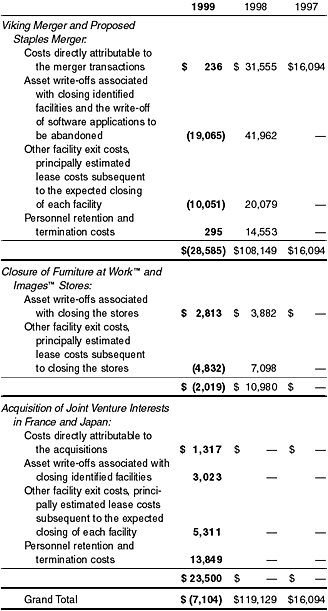
Revenue Recognition: We record revenue at the time of shipment for delivery and catalog sales, and at the point of sale for all retail store sales except for sales of extended warranty service plans. These service plans are sold to our customers and administered by an unrelated third party. All performance obligations and risk of loss associated with such contracts are economically transferred to the administrator at the time the contracts are sold to the customer. Our service plans typically extend over a period of one to four years. Because we are the legal obligor in the majority of states in which we sell these contracts, we defer any revenues and direct expenses associated with the sale of these warranty plans and recognize them over the service period of the contract. We recognize losses on the sale of our credit card receivables in accordance with SFAS No. 125, “Accounting for Transfers and Servicing of Financial Assets and Extinguishments of Liabilities.” The related losses are recorded as store and warehouse operating and selling expenses in our Consolidated Statements of Earnings. Advertising: Advertising costs are either charged to expense when incurred or, in the case of direct marketing advertising, capitalized and amortized in proportion to the related revenues. We participate in cooperative advertising programs with our vendors in which they reimburse us for a portion of our advertising costs. Advertising expense, net of cooperative advertising allowances, amounted to $285.3 million in 1999, $230.8 million in 1998 and $201.8 million in 1997. Pre-opening Expenses: Pre-opening expenses related to opening new stores and warehouses or relocating existing stores and warehouses are expensed as incurred. Self-Insurance: We are primarily self-insured for workers’ compensation, auto and general liability and our employee medical insurance programs. Self-insurance liabilities are based on claims filed and estimates of claims incurred but not reported. These liabilities are not discounted. Comprehensive Income: Comprehensive income represents the change in stockholders’ equity from transactions and other events and circumstances arising from non-stockholder sources. Our comprehensive income for 1999 consists of net income, foreign currency translation adjustments and unrealized gains or losses on investment securities that are available for sale, net of applicable income taxes. Our comprehensive income for 1998 and 1997 consists of net income and foreign currency translation adjustments. Derivative Financial Instruments: We use a variety of derivative financial instruments, including foreign currency contracts and interest rate swaps, to hedge our exposure to foreign currency exchange and interest rate risks. We have established policies and procedures for assessing the risk and approving the use of derivative financial instrument activities. We do not enter into these types of financial instruments for trading or speculative purposes. Interest rate swaps involve the periodic exchange of payments without the exchange of the underlying principal amounts. New payments are recognized as an adjustment to interest expense. In 1999, we entered into a yen interest rate swap for a principal amount equivalent to $23 million, the full amount of which was outstanding on December 25, 1999, in order to hedge against the volatility of the interest payments on a portion of our yen borrowings. The swap will mature in July 2000. Foreign currency contracts involve the future exchange of currencies at an agreed-upon exchange rate. We often enter into contracts to hedge certain of our inventory purchases when we pay our suppliers in a different currency than we sell to our customers. At December 25, 1999, we had approximately $300,000 of foreign currency contracts outstanding which will mature at varying dates through June 2000. At December 26, 1998, we had no foreign currency contracts outstanding. Since the introduction of the euro on January 1, 1999, the exchange rates between the European member countries have been effectively fixed. Because the United Kingdom is not one of the member countries, we currently use these foreign currency contracts to hedge our exposure to fluctuations in the exchange rate between the British pound and the euro. Gains and losses from these transactions are included in the cost of the underlying inventory purchases, which are not recognized in earnings until the inventory is sold. New Accounting Pronouncements: In June 1998, the Financial Accounting Standards Board issued SFAS No. 133, “Accounting for Derivative Instruments and Hedging Activities.” SFAS No. 133 requires that we record all derivatives as assets or liabilities measured at their fair value. Gains or losses resulting from changes in the values of those derivatives should be accounted for according to the intended use of the derivative and whether it qualifies for hedge accounting. In July 1999, the FASB issued SFAS No. 137, which defers the effective date of SFAS No. 133 until the start of fiscal years beginning after June 15, 2000. We will adopt SFAS No. 133 for our fiscal year 2001. Assuming our current level of involvement in derivative instruments and hedging activities does not change before we adopt this Statement, we do not expect the adoption of SFAS No. 133 to have a material impact on our financial position or the results of our operations. •••••••••••••••••••••••Note B—Merger and Restructuring Transactions••••••••••••••••••••••• Viking Merger: In August 1998, we completed our merger with Viking. Transactional and other direct expenses of this merger, primarily legal and investment banking fees, were recorded as merger and restructuring costs in 1998. Subsequent to the merger, we immediately began the process of integrating our Office Depot and Viking businesses. Our original plans, which we expected to complete during 2000, initially included the closing of 15 domestic CSCs and the opening of five new domestic CSCs, as well as installing complex new systems in each surviving facility. During the fourth quarter of 1999, after evaluating the results of integrating two test facilities, we modified our CSC integration plans. Our new plans incorporate a more simplified approach and, as a result, require less capital. Furthermore, our new plans require the closing of only 11 existing CSCs and the opening of only two new CSCs, which were opened as test facilities in late 1999. We lease all but two of the closing CSCs. We sold one of the CSCs in 1999, and we plan to sell the other in 2000. Our plan is to vacate all of the buildings. Accordingly, we have written off certain assets such as leasehold improvements and redundant software and conveyor systems in these CSCs. In addition, merger and restructuring costs include certain expenses of exiting these facilities that will provide no future economic benefit to us (e.g., future lease obligations, personnel retention and other termination costs). As a result of modifying our integration plans in the fourth quarter of 1999, we reversed previously accrued merger and restructuring charges of $32.5 million, reducing merger and restructuring costs to a net credit of $7.1 million for the year. We accrue merger and restructuring costs when significant changes in our plan are unlikely, which in most cases requires that planned actions take place within one year. In the case of our CSC integration, we plan to integrate all but three of our CSCs during 2000. We feel confident that significant changes in our plan are unlikely even though three of our CSCs will not be integrated until early 2001. Closure of Furniture at Work™ and Images™ Stores: As a result of our decision to focus on the continued growth of our core businesses and on expanding our international operations, we closed nine of our Furniture at Work™ and Images™ stores in 1999 and one in the fourth quarter of 1998. Eight of the ten facilities were leased; the other two were owned. We have sold one of the owned facilities and are presently in negotiations to sell the second. In addition, we exercised a purchase option on one of our leased facilities since we have negotiated a sale of that facility as well. We have recorded the exit costs related to closing these facilities in merger and restructuring costs. Acquisition of Joint Venture Interests in France and Japan: In November 1998, we purchased our joint venture partner’s interest in our French Office Depot retail operations. Following this purchase, we decided to restructure and integrate the separate Office Depot and Viking operations in France. During 1999, we merged the Office Depot and Viking headquarters into a new office that is more conveniently located. We do not expect to close any facilities in conjunction with our restructuring and integration programs in France. Instead, we will integrate the warehousing and delivery of our Office Depot and Viking brand merchandise in each of our existing warehouses. In April 1999, we purchased our joint venture partner’s interest in our Japanese Office Depot retail operations and announced plans to restructure and integrate our operations in Japan. We closed one leased CSC and one leased store in Japan in conjunction with these plans. We expect to close another CSC in 2000. We have recorded merger and restructuring costs in 1999 associated with these activities. We expect our operations in France and Japan to be completely integrated by the end of 2000. Proposed Staples Merger: In September 1996, we entered into an agreement and plan of merger with Staples, Inc. (“Staples”). In June 1997, the proposed merger was blocked by a preliminary injunction granted by the Federal District Court at the request of the Federal Trade Commission. In July 1997, we announced that the merger agreement had been terminated. Costs directly attributable to the merger transaction, primarily legal expenses, were recorded in 1997. Merger and restructuring costs in 1999, 1998 and 1997 consist of the following charges:
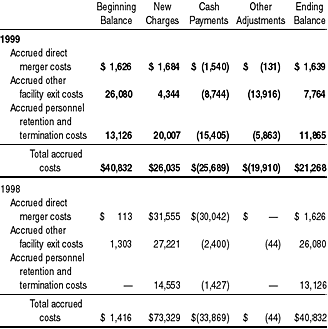
We determined the fair value of assets to be disposed of by estimating the net realizable value at the time of the anticipated closure or discontinuation of use. Estimated proceeds from and costs to dispose of these assets were determined through analysis of historical data and expected outcomes. The costs required to complete our merger and restructuring plans necessarily involve the use of estimates. We believe our estimates are unlikely to change significantly in the future. As of December 25, 1999 and December 26, 1998, we have remaining accruals of approximately $21.3 million and $40.8 million, respectively, for merger and restructuring costs. Amounts expensed for asset write-offs are recorded as a reduction of our fixed assets. All other amounts are recorded as accrued expenses. The activity in the liability accounts by cost category is as follows:
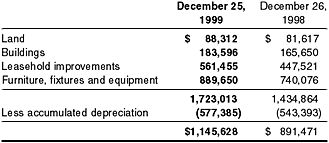
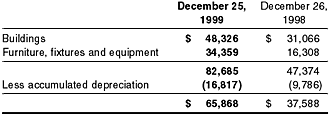
The other adjustments column represents adjustments of original estimates and other adjustments pursuant to plan modifications made during the fourth quarter of 1999. We expect to incur additional merger and restructuring costs over the remaining integration periods. Although we expect these costs to be insignificant to our future operating results, there can be no assurance that this will be the case. •••••••••••••••••••••Note C—Other One-time Charges and Adjustments••••••••••••••••••••• In 1999, we increased our provision for slow-moving and obsolete inventories by $56.1 million. The need for this provision resulted from two factors: 1) slow-moving technology related products whose market values have been adversely affected by accelerated rates of change in technology, and 2) a rationalization of our warehouse inventory assortments in connection with the Viking warehouse consolidation. This provision has been included in our cost of goods sold. We recorded a charge of $46.4 million in 1999 to reflect our decision to accelerate our store closure program for under-performing stores and our relocation program for older stores in our Stores Division. This charge also reflects our decision to sell our interest in our retail operations in Thailand. On October 28, 1999, we entered into an agreement with Central Retail Group, our joint venture partner, to sell to them our Thai operations and license to them certain trademarks, software and operating systems. Central Retail Group now operates the two stores under a licensing agreement. Finally, the charge also reflects our decision to write-off certain other long-lived assets in our BSG. We subsequently reversed $6.0 million of the charge relating to stores that may be relocated after 2000. This reversal is in accordance with recently issued guidance from the SEC which provides that charges should not be accrued unless changes in our plans are unlikely, which in most cases requires that planned actions take place within one year. This charge, net of the reversal, consists of asset impairment costs ($29.2 million), residual lease obligations ($8.3 million) and other exit costs ($2.9 million) and reduces our operating profit. ••••••••••••••••••••••••••••••••Note D—Property and Equipment•••••••••••••••••••••••••••••••• Property and equipment consisted of:
Assets held under capital leases included above consisted of:
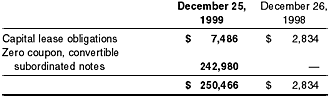
•••••••••••••••••••••••••••••••••••••Note E—Long-term Debt•••••••••••••••••••••••••••••••••••••• Debt that will mature within one year consisted of the following:
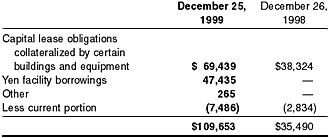
Our 1993 LYONs® (described in more detail in Note F) have an option feature that allows each holder of a note to require us, on November 1, 2000, to purchase the LYON® from them at the issue price plus accrued original discount. If the option is exercised, we have the choice of paying the holder in cash, common stock or a combination of the two. Because the option on the 1993 LYONs® is exercisable in the next 12 months, we have classified this debt as current as of December 25, 1999. This debt was classified as long-term at December 26, 1998. Long-term debt consisted of the following:
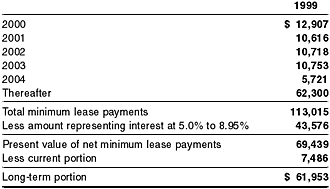
In February 1998, we entered into a credit agreement with a syndicate of banks. This credit agreement (the “domestic credit facility”) provides us with a working capital line and letters of credit totaling $300 million. This agreement provides for various borrowing rate options, including a rate based on credit rating and fixed charge coverage ratio factors that currently would result in an interest rate of .18% over LIBOR. Our domestic credit facility expires in February 2003 and contains certain restrictive covenants relating to various financial statement ratios. During 1999, we borrowed and repaid a total of $44.2 million. As of December 25, 1999, we had no outstanding borrowings under this facility, but we had outstanding letters of credit under this facility totaling $18.0 million. In July 1999, we entered into term loan and revolving credit agreements with several Japanese banks (the “yen facilities”) to provide financing for our operating and expansion activities in Japan. The yen facilities provide for maximum aggregate borrowings of Ą9.76 billion (the equivalent of $96 million at December 25, 1999) at an interest rate of .875% over the Tokyo Interbank Offered Rate (“TIBOR”). Although the loans mature at varying rates of three to six months, we have classified these borrowings as non-current on our Balance Sheet because we intend to renew them as they come due. These yen facilities contain covenants similar to those in our domestic credit facility as described earlier. During 1999, we borrowed the equivalent of $47 million under these yen facilities. We have borrowed the equivalent of an additional $8 million subsequent to the end of the year. Effective as of October 28, 1999, we entered into a yen interest rate swap with a financial institution for a principal amount equivalent to $23 million at December 25, 1999 in order to hedge against the volatility of the interest payments on a portion of our yen borrowings. The terms of the swap specify that we pay an interest rate of .7% and receive TIBOR. The swap will mature in July 2000. Under our capital lease agreements, we are required to make certain monthly, quarterly or annual lease payments through 2017. Our aggregate minimum capital lease payments for the next five years and beyond, with their present value as of December 25, 1999, are as follows:
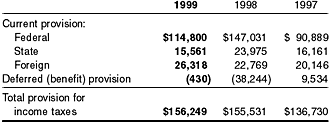
•••••••••••••••••••Note F—Zero Coupon, Convertible Subordinated Notes••••••••••••••••••• On December 11, 1992, we issued to the public Liquid Yield Option Notes (“LYONs®”) with principal amounts totaling $316 million and proceeds of $151 million (the “1992 LYONs®”). We issued each 1992 LYON® for a price of $476.74, and we are not required to make periodic interest payments on the notes. Our 1992 LYONs® will mature on December 11, 2007 at $1,000 per LYON®, representing a yield to maturity, computed on a semi-annual bond equivalent basis, of 5%. On November 1, 1993, we issued to the public LYONs® with principal amounts totaling $345 million and proceeds of $191 million (the “1993 LYONs®”). We issued each 1993 LYON® for a price of $552.07, and we are not required to make periodic interest payments on the notes. Our 1993 LYONs® will mature on November 1, 2008 at $1,000 per LYON®, representing a yield to maturity, computed on a semi-annual bond equivalent basis, of 4%. All LYONs® are subordinated to all of our existing and future senior indebtedness. Each LYON® is convertible at the option of the holder at any time on or prior to maturity into our common stock at a conversion rate of 43.895 shares per 1992 LYON® and 31.851 shares per 1993 LYON®. On November 1, 2000 for the 1993 LYONs® and December 11, 2002 for the 1992 LYONs®, the holder may require us to purchase the LYONs® from them at the issue price plus accrued original issue discount. If the holder decides to exercise their put option, we have the choice of paying the holder in cash, common stock or a combination of the two. For that reason, our 1993 LYONs® have been classified as current (see Note F). The total outstanding amounts of the 1992 and 1993 LYONs® as of December 25, 1999, including accrued interest, approximated $211.4 million and $243.0 million, respectively. In addition, if we experience a change in control prior to November 1, 2000, the holders of our 1993 LYONs® can require us to purchase the 1993 LYONs® from them for cash. This option is no longer available to the holders of our 1992 LYONs®. Beginning on December 11, 1996 for the 1992 LYONs® and on November 1, 2000 for the 1993 LYONs®, we can redeem all or part of these notes at any time from the holders for cash equal to the issue price plus accrued original issue discount through the date of redemption. As of December 25, 1999, we have reserved 24,740,713 shares of unissued common stock for conversion of the zero coupon, convertible subordinated notes. ••••••••••••••••••••••••••••••••••••••Note G—Income Taxes•••••••••••••••••••••••••••••••••••••• Our income tax provision consisted of the following:
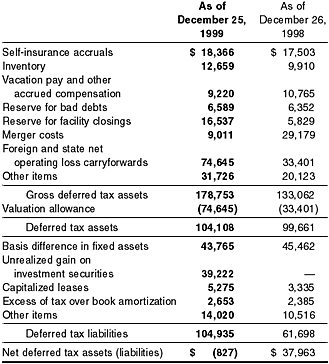
The tax-effected components of deferred income tax assets and liabilities consisted of the following:
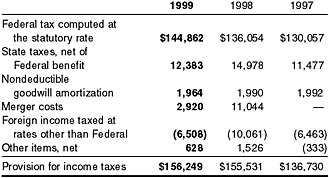
As of December 25, 1999, we had approximately $163 million of foreign and $167 million of state net operating loss carryforwards. Of these carryforwards, $10 million can be carried forward indefinitely, $6 million will expire in 2000 and the balance will expire between 2001 and 2012. The valuation allowance has been developed to reduce our deferred tax asset to an amount that is more likely than not to be realized, and is based upon the uncertainty of the realization of certain foreign and state deferred tax assets relating to net operating loss carryforwards. The following is a reconciliation of income taxes at the Federal statutory rate to our provision for income taxes:
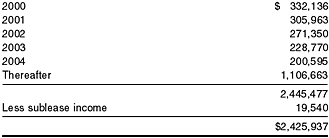
•••••••••••••••••••••••••••Note H—Commitments and Contingencies••••••••••••••••••••••••••• Operating Leases: We lease facilities and equipment under agreements that expire in various years through 2020. Substantially all such leases contain provisions for multiple renewal options. In addition to minimum rentals, we are required to pay certain executory costs such as real estate taxes, insurance and common area maintenance on most of our facility leases. We are also required to pay additional rent on certain of our facility leases if sales exceed a specified amount. The table below shows you our future minimum lease payments due under non-cancelable leases as of December 25, 1999. These minimum lease payments do not include facility leases that were accrued as merger and restructuring costs (See Note B) or store closure and relocation costs (See Note C).
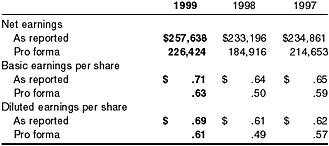
The above amounts include lease commitments for 36 stores that had not yet opened as of December 25, 1999. We are in the process of opening new stores and CSCs in the ordinary course of business, and leases signed subsequent to December 25, 1999 are not included in the above described commitment amounts. Rent expense, including equipment rental, was approximately $321.5 million, $249.2 million and $218.4 million in 1999, 1998 and 1997, respectively. Included in this rent expense was approximately $0.8 million, $1.1 million and $1.5 million of contingent rent, otherwise known as percentage rent, in 1999, 1998 and 1997, respectively. Rent expense was reduced in 1999, 1998 and 1997 by sublease income of approximately $3.2 million, $4.0 million and $3.0 million, respectively. Receivables Sold with Recourse: We have two private label credit card programs that are managed by financial services companies. All credit card receivables related to these programs were sold on a recourse basis during 1999, 1998 and 1997. Proceeds from the sale of these receivables were approximately $1.1 billion in 1999, 1998 and 1997. Our maximum exposure to off-balance sheet credit risk is represented by the outstanding balance of private label credit card receivables with recourse, which totaled approximately $223.6 million at December 25, 1999. Other: We are involved in litigation arising in the normal course of our business. In our opinion, these matters will not materially affect our financial position or results of our operations. •••••••••••••••••••••••••••••••••Note I—Employee Benefit Plans••••••••••••••••••••••••••••••••• Long-Term Equity Incentive Plan: Our Long-Term Equity Incentive Plan, which was approved effective October 1, 1997, provides for the grants of stock options and other incentive awards, including restricted stock, to our directors, officers and key employees. When we merged with Viking, their employee and director stock option plans were terminated. When outstanding options issued under Viking’s prior plans are exercised, Office Depot common stock is issued. As of December 25, 1999, we had 40,723,118 shares of common stock reserved for issuance to directors, officers and key employees under our Long-Term Equity Incentive Plan. Under this plan, stock options must be granted at an option price that is greater than or equal to the market price of the stock on the date of the grant. If an employee owns at least 10% of our outstanding common stock, the option price must be at least 110% of the market price on the date of the grant. Options granted under this plan and options granted in July 1998 under Viking’s prior plans become exercisable from one to five years after the date of grant, provided that the individual is continuously employed with us. The vesting periods for all other options granted under Viking’s prior plans were accelerated, and the options became exercisable, as of the date of our merger with Viking in August 1998. All options granted expire no more than ten years from the date of grant. Under this plan, we have also issued 211,193 shares of restricted stock at no cost to the employees, 13,565 of which have been canceled. The fair market value of these awards approximated $2.9 million at the date of the grants. Common stock issued under this plan is restricted and vests over a three to four year period. We recognize compensation expense over the vesting period. Long-Term Incentive Stock Plan: Viking has a Long-Term Incentive Stock Plan that, prior to the merger, allowed Viking’s management to award up to 2,400,000 restricted shares of common stock to key Viking employees. Under this plan, 1,845,000 shares were issued at no cost to employees, 1,135,000 of which have been canceled. Pursuant to the merger agreement, shares issued under this plan were converted to Office Depot common stock, and no additional shares may be issued under the plan. The fair market value of these restricted stock awards approximated $10.0 million at the date of the grants. Prior to the merger, the vesting period was 15 years. Because of the plan’s change in control provision, however, the employees now vest in their stock ratably over the 15-year period. Compensation expense is recognized over the vesting period. Employee Stock Purchase Plan: Our Employee Stock Purchase Plan, which was approved effective July 1999, replaces our prior plan and Viking’s plan and permits eligible employees to purchase our common stock at 85% of its fair market value. The maximum aggregate number of shares eligible for purchase under this plan is 1,125,000. Other Stock-Based Compensation Plans: Viking has two stock-based compensation plans that are effective in Australia and the United Kingdom. These plans allow eligible employees to purchase up to 537,813 shares of common stock at 80-85% of its fair market value. Retirement Savings Plans: We have a 401(k) retirement savings plan which allows eligible employees to contribute up to 18% of their salaries, commissions and bonuses, up to $10,000 annually, to the plan on a pretax basis in accordance with the provisions of Section 401(k) of the Internal Revenue Code. We make matching contributions of common stock into the plan that is equivalent to 50% of the first 3% of an employee’s contributions. We may, at our option, make discretionary matching common stock contributions in addition to the normal match. We also have a deferred compensation plan, which permits eligible employees to make tax-deferred contributions of up to 18% of their salaries, commissions and bonuses to the plan. We make matching contributions to the deferred compensation plan similar to those under our 401(k) retirement savings plan described above. Additionally, Viking has a profit sharing plan that includes a 401(k) plan allowing eligible employees to make pretax contributions. Under the profit sharing plan, we make matching cash contributions of 25% of the first 6% of the employee’s contributions. Accounting for Stock-Based Compensation: We apply Accounting Principles Board Opinion No. 25, “Accounting for Stock Issued to Employees,” and related Interpretations in accounting for our stock-based compensation plans. The compensation cost that we have charged against income for our Long-Term Equity Incentive Plan, Long-Term Incentive Stock Plan, Employee Stock Purchase Plans, and retirement savings plans approximated $12.5 million, $19.9 million and $4.1 million in 1999, 1998 and 1997, respectively. No other compensation costs have been recognized under our stock-based compensation plans. Had compensation cost for awards under our stock-based compensation plans been determined using the fair value method prescribed by SFAS No. 123, “Accounting for Stock-Based Compensation,” our net earnings and earnings per share would have been reduced to the pro forma amounts presented below:
The fair value of each stock option granted is established on the date of the grant using the Black-Scholes option-pricing model with the following weighted average assumptions for grants in 1999, 1998 and 1997:
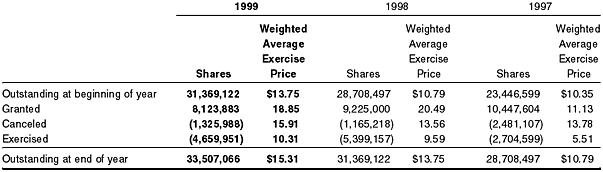
A summary of the status of and the changes in our stock option plans for the last three years is presented below.
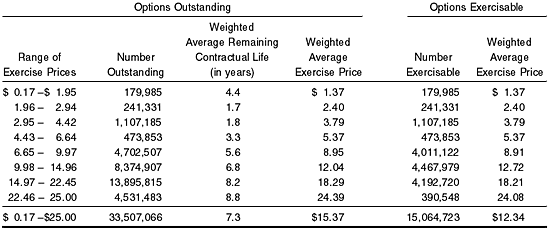
As of December 25, 1999, the weighted average fair values of options granted during 1999, 1998 and 1997 were $8.24, $6.77 and $4.34, respectively. The following table summarizes information about options outstanding at December 25, 1999.
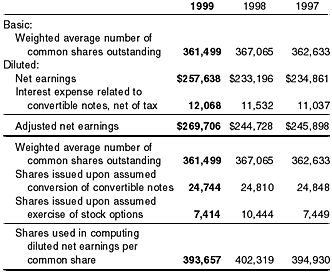
•••••••••••••••••••••••••••••••••••••••Note J—Capital Stock••••••••••••••••••••••••••••••••••••••• Preferred Stock: As of December 25, 1999, there were 1,000,000 shares of $.01 par value preferred stock authorized of which none are issued or outstanding. Stockholder Rights Plan: Effective September 4, 1996, we adopted a Stockholder Rights Plan (the “Rights Plan”). Under this Rights Plan, each of our stockholders is issued one right to acquire one one-thousandth of a share of our Junior Participating Preferred Stock, Series A at an exercise price of $63.33, subject to adjustment, for each outstanding share of Office Depot common stock they own. These rights are only exercisable if a single person or company were to acquire 20% or more of our outstanding common or if we announced a tender or exchange offer that would result in 20% or more of our common stock being acquired. If we are acquired, each right, except those of the acquirer, can be exchanged for shares of our common stock with a market value of twice the exercise price of the right. In addition, if we become involved in a merger or other business combination where (1) we are not the surviving company, (2) our common stock is changed or exchanged, or (3) 50% or more of our assets or earning power is sold, then each right, except those of the acquirer, and an amount equal to the exercise price of the right can be exchanged for shares of our common stock with a market value of twice the exercise price of the right. We may redeem the rights for $0.01 per right at any time prior to an acquisition. Stock Split: On February 24, 1999, we declared a three-for-two stock split in the form of a 50% stock dividend, payable April 1, 1999. All share and per share amounts have been restated in our financial statements to reflect this stock split. In conjunction with the stock split, we issued 124,560,075 additional shares on April 1, 1999. Treasury Stock: In August 1999, our Board approved a $500 million stock repurchase program. We purchased 46.7 million shares of our stock at a total cost of $500 million plus commissions during the third and fourth quarters of 1999. In January 2000 and March 2000, our Board approved additional stock repurchases of up to $200 million, bringing our total authorization to $700 million. As of March 3, 2000, we had purchased an additional 9.2 million shares of our stock at a total cost of $100 million plus commissions. The remaining authorization does not have an expiration date, and we can acquire our common stock either in the open market or through negotiated purchases. ••••••••••••••••••••••••••••••••Note K—Net Earnings per Share•••••••••••••••••••••••••••••••• Basic earnings per share is based on the weighted average number of shares outstanding during each period. Diluted earnings per share further assumes that the zero coupon, convertible subordinated notes, if dilutive, are converted as of the beginning of the period and that, under the treasury stock method, dilutive stock options are exercised. Net earnings under this assumption have been adjusted for interest on the notes, net of the related income tax effect. The information required to compute basic and diluted net earnings per share is as follows:
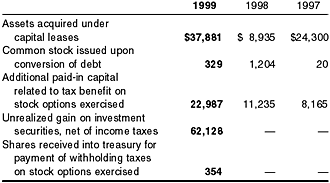
Options to purchase 26,672,312 shares of common stock at an average exercise price of approximately $17.44 per share were not included in our computation of diluted earnings per share for 1999 because their effect would be anti-dilutive. •••Note L—Supplemental Information on Non-cash Investing and Financing Activities••• Our Consolidated Statements of Cash Flows for 1999, 1998 and 1997 do not include the following non-cash investing and financing transactions:
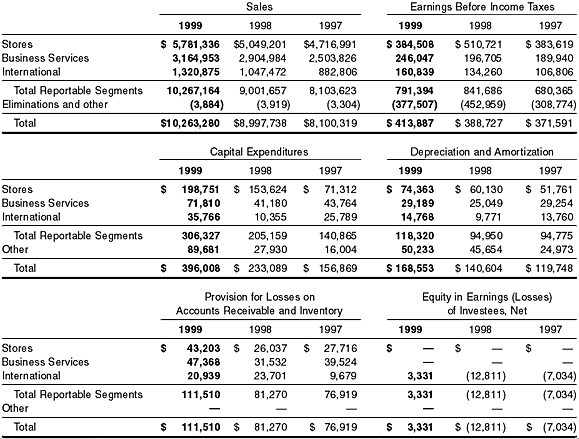
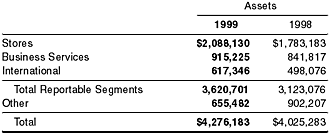
••••••••••••••••••••••••••••••••••Note M—Segment Information•••••••••••••••••••••••••••••••••• We adopted SFAS No. 131, “Disclosures about Segments of an Enterprise and Related Information,” effective for our fiscal year ended December 26, 1998. We operate in three reportable segments: Stores, BSG and International. Each of these segments is managed separately primarily because it serves different customer groups. Our senior management evaluates the performance of our business based on each segment’s operating income, which is defined as income before income taxes, interest income and expense, goodwill amortization, merger and restructuring costs and general and administrative expenses. In 1999, we refined our segment definitions to better reflect our current management responsibilities. We modified our financial systems to allow us to restate 1998 information. However, reliable information was not available to restate our 1997 segment information. The following is a summary of our significant accounts and balances by segment, reconciled to our consolidated totals.
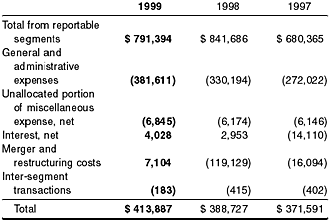
A reconciliation of our earnings before income taxes reported by our reportable segments to earnings before income taxes in our consolidated financial statements is as follows:
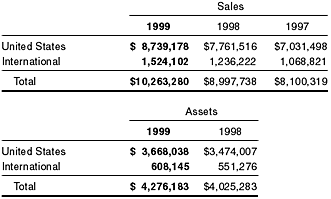
Our total sales by operating segment include inter-segment sales, which are generally recorded at the cost to the selling entity. The accounting policies of our segments are the same as those described in the summary of significant accounting policies (see Note A). Assets not allocated to segments consist primarily of our corporate cash balances, tax related accounts, employee benefit plan balances and assets associated with corporate investing and financing transactions. We have operations, either owned directly or operated through joint ventures or licensing arrangements, in Australia, Austria, Belgium, Canada, Colombia, France, Germany, Hungary, Ireland, Israel, Italy, Japan, Luxembourg, Mexico, the Netherlands, Poland, the United Kingdom and the United States. During 1999, we sold our operations in Thailand (as more fully discussed in Note C). There is no single geographic area outside of the United States in which we generate 10% or more of our total revenues. Summarized financial information relating to our operations is as follows:
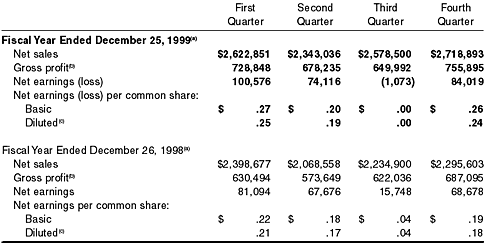
••••••••••••••••••••••••Note N—Quarterly Financial Data (Unaudited)••••••••••••••••••••••••
5-Year Financial Highlights | MD&A | Cautionary Statements | Independent Auditors’ Report
|