
In 2002, we plan to expand our International Division by opening 10 to 15 new retail stores in France and Japan, adding the European Business Service Division to two new countries and launching service in Spain and Switzerland.
As part of the overall restructuring of our management team, all of our European operations were consolidated under the leadership of Rolf van Kaldekerken, who is President of our European business. Mr. van Kaldekerken reports to our Chairman and CEO, Bruce Nelson. During 2001, we also changed the management of our operations in Japan, and named Richard Lepley, an experienced international retailer, as President of Office Depot Japan and Viking Japan. Mr. Lepley reports directly to our Chairman and CEO, Bruce Nelson.
Results of Operations
Fiscal 2001 was a year of improved operational performance across the Company and increased overall earnings compared to 2000, even in the face of difficult economic conditions and a decline in our consolidated sales. Diluted earnings per share improved to $0.66 from $0.16 in 2000, and down from $0.69 in 1999. Fiscal year 2000 was adversely affected by charges associated with a comprehensive business review that resulted in the closing of 70 retail stores, the write-down of certain assets and the elimination of some employee positions. Additional store closure and impairment costs, the write-down of certain Internet investments, settlement of certain employee claims and gain on the sale of our London warehouse were recognized in 2001. Without these charges and credits, EPS was $0.79 in 2001 and $0.70 in 2000. See Charges and Credits section below for additional discussions on these items.
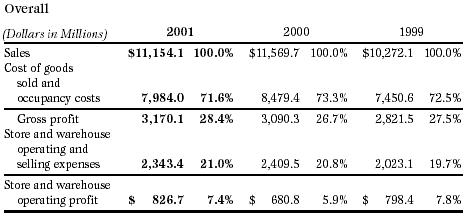
Our overall sales decreased 4% in 2001 and increased 13% in 2000, while comparable sales decreased 2% in 2001 and grew 7% in 2000. Fiscal year 2000 included 53 weeks in accordance with our 52-53 week accounting convention. Adjusting 2000 to a 52-week basis, sales decreased 2% in 2001. The overall sales decrease in 2001 reflects a 10% decrease in our North American Retail Division, a 4% increase in our Business Services Group and a 6% increase in our International Division. Sales across the United States were adversely affected in 2001 by the slowing domestic economy. Additionally, the decline in sales of our North American Retail Division reflects our decision to close 73 stores during 2001, following our comprehensive business review performed in the latter part of 2000. The largest percentage sales increases in 2000 were realized in our BSG segment, driven most significantly by the growth in our contract and Internet businesses. E-commerce sales have improved in all periods, increasing almost 60% in 2001 to $1.6 billion. Also contributing significantly to our sales growth in 2000 was the continued expansion of our store base.
Our worldwide sales by product group were as follows:
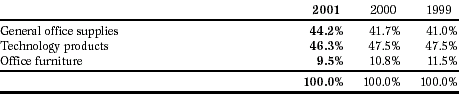
In both 2001 and 2000, our sales mix shifted toward our core office supply items. Sales of technology products decreased significantly in 2001, reflecting to a large extent, a general slowing of technology-related product sales in the overall economy. Moreover, many more general and specialty retailers outside the office products retail segment (including discount retailers, drug store chains and warehouse club retailers) have broadened their assortments of technology products. Technology products generally have lower profit margins compared to many of the core office supplies. Also, within the technology products category, the mix shifted from technology hardware and software towards machine supplies. Sales of office furniture declined, reflecting lower volume and unit prices in 2001 and lower average selling prices during 2000, as many business customers deferred large purchases because of concerns about the economy.
Our overall gross profit percentages fluctuate as a result of numerous factors, including competitive pricing pressures; changes in product, catalog and customer mix; emergence of new technology; suppliers’ pricing changes; as well as our ability to improve our net product costs through growth in total merchandise purchases. Additionally, our occupancy costs may vary as we add stores and CSCs in new markets with different rental and other occupancy costs, and as we relocate and/or close existing stores in current markets.
In mid-2000, we reduced prices for paper and machine supplies across all of our domestic sales channels in response to competitive pressures from discount clubs and other non-traditional sellers of those supply items. These price reductions, along with increased product costs, primarily for paper and machine supplies, had the most significant effect on our decreased gross profit percentage in 2000 compared to 1999. These two product groups accounted for approximately 34% of our total sales mix in 2000.



