
Store and warehouse operating and selling expenses consist of personnel costs; maintenance and other facility costs; advertising expenses; delivery and transportation costs; credit card and bank charges and certain other operating and selling costs. These costs, expressed as a percentage of sales, increased in both 2001 and 2000. The increase in 2001 reflects the impact of declining sales on the ratio, while the increase in 2000 is primarily the result of higher personnel and warehouse costs. In 2001, we scaled back our personnel-related costs in response to weaker sales. Other expenses, such as credit card fees and delivery fees, have also declined along with sales. In 2000, however, we experienced higher delivery-and personnel-related costs in our warehouse operations as third-party carriers increased their rates, and our facility integration efforts took longer to complete than originally planned. We also had a significant increase during 2000 in personnel expenses in our domestic stores, largely related to wage pressures stemming from a tight labor market. Also included in this category are certain charges and credits that affect the comparisons of on-going operations and are more fully discussed below.
Our financial results were significantly affected in 2001, 2000 and 1999 by charges and credits that do not relate to on-going sales and service activities. Charges recorded in 2000 were the largest and provide a context for some of the charges in 2001. During the latter half of 2000, we conducted a comprehensive business review of all aspects of our business. Commitments made at that time resulted in a significant change in the Company’s strategic direction and led to modifications of our important business practices. Among other things, the review resulted in a decision to close 70 under-performing North American retail stores, close and relocate two warehouses, invest in new warehouse technologies, reduce the number of slower-moving SKUs in our retail stores and North American warehouses and modify business practices to increase efficiency. A total net charge of $260.6 million was recorded and is summarized in the table below. Included in the $174.7 million facility-related charge is $110.0 million in facility closure costs and $64.7 million for the write-down of other impaired assets and related exit costs. Other business review charges included $38.4 million for inventory reductions, a net $10.5 million provision for sales returns and allowances and $12.6 million for the disposal of certain fixed assets. Also in 2000, we recorded $32.5 million in severance costs, primarily related to changes in senior management, and a net $6.8 million credit to adjust a previous merger accrual for improved estimates of actual costs. Outside of operations, we recorded impairment charges of $11.1 million relating to goodwill in Japan and $45.5 million of other than temporary declines in the value of certain Internet investments. Earlier in 2000, we also realized a $57.9 million gain on the sale of certain Internet investments.
During 2001, we closed 73 stores, 70 of which were identified as part of our comprehensive business review. We also identified 10 additional underperforming stores to be closed in 2002. Charges of $43.6 million were recorded for asset impairments relating to these stores, and to adjust estimated lease termination costs recorded in 2000 resulting from a softening in the market for retail space subleases, partially offset by a $10.2 million gain on sale of a warehouse. We also reached settlement of certain non-recurring legal claims and recognized amortization of an existing retention agreement. Non-operating expenses included charges of $14.1 million, primarily to recognize an additional other than temporary decline in value of certain Internet investments. As of the end of 2001, our Internet investment portfolio was carried at $15.2 million.
In late 1999, we changed our method of accounting for revenue generated from sales of extended service warranty contracts. Under the laws of certain states, we are obligated to assume the risk of loss associated with such contracts. In these states, we modified our accounting to recognize revenue for warranty service contract sales over the service period, which typically extends over a period of one to four years. In those states where we are not the legal obligor, we modified our accounting to recognize warranty revenues after deducting the related direct costs. This change resulted in a reduction in our 1999 gross profit of $15.8 million.
Also in 1999, we recorded a charge of $56.1 million to establish a provision for slow-moving and obsolete inventories and we recorded facility closure charges of $40.4 million to reflect our decision to accelerate our store closure program for under-performing stores and our relocation program for older stores in our North American Retail Division.
The following tables summarize the charges and credits by category and segment:
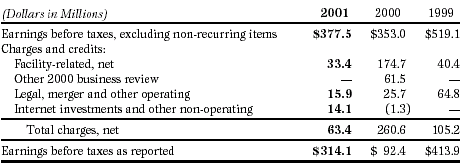
See Note B of the Notes to Consolidated Financial Statements for additional discussion and line item presentation of the 2000 charges and credits.



