

Our general and administrative expenses primarily consist of personnelrelated costs associated with support functions. Because these functions, for the most part, support all segments of our business, we do not consider these costs in determining our segment profitability. Throughout 2000 and 1999, we developed improvements in our infrastructure, particularly in the areas of Supply Chain Management, MIS and International. These areas were significant contributors to the increases in our general and administrative expenses in those years. The primary benefits derived from this increased spending were the expansion and improvement of our e-commerce services, a new data center, improvements in our inventory in-stock positions and support for our rapidly growing International Division. Also included in this category in 1999 are expenses relating to our CSC consolidation and integration initiatives.

Financing and investing activities are not included in determining segment profitability. During 2001, we issued $250 million of senior subordinated notes that mature in 2008. We also entered into swap agreements to convert these notes to a variable interest rate, to balance our fixed and variable interest portfolio. Interest expense in 2001 reflects this additional borrowing. Higher cash balances from this borrowing and increased cash flow from operations contributed to the increase in interest income in 2001, despite a decreasing interest rate environment. Cash balances, and related interest income, declined in 2000 from $300.8 million of cash used for purchases of our stock.
During the fourth quarter of 2000, we began borrowing against our domestic credit facility, which led to increased interest expense over 1999. These borrowings were repaid during 2001. Also, reserves established in connection with the 2000 comprehensive business review, and in 2001 for future lease obligations related to our facility closures and merger activities, are recorded at the net present value of the obligation. As we pay these obligations, the imputed interest cost on the discounted obligations is recognized as interest expense. This has also caused interest expense to increase in 2000 compared to 1999 and should be expected to continue in future years.
Our net miscellaneous income (expense) consists of equity in the earnings of our joint venture investments, royalty and franchise income that we generate from licensing and franchise agreements and gains or impairments on Internet investments. All of our equity investments involve operations outside of the United States and Canada. Impairment charges for other than temporary declines in value of certain Internet investments were $14.7 million in 2001 and $45.5 million in 2000. Fiscal year 2000 also included a realized gain of $57.9 million from the sale of certain Internet investments and $11.1 million of goodwill impairment in Japan. Under accounting rules that apply in 2002, we will no longer record goodwill amortization, but will test each year for possible impairment. See New Accounting Standards below.
*
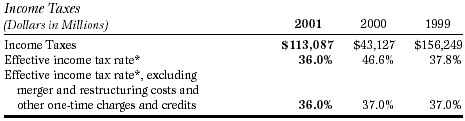
Income Taxes as a percentage of earnings before income taxes.
The effective income tax rate in 2001 declined to 36%, primarily reflectingthe increase in International activity taxed at lower rates. The effective tax rate may decline further during 2002.
In 2000 and 1999, certain non-deductible merger-related charges and other one-time charges caused our overall effective income tax rates to rise. Our overall effective income tax rate, excluding these charges, may fluctuate in the future as a result of the mix of pre-tax income and tax rates between countries.
Liquidity and Capital Resources
Cash provided by (used in) our operating, investing and financing activities is summarized as follows:




