
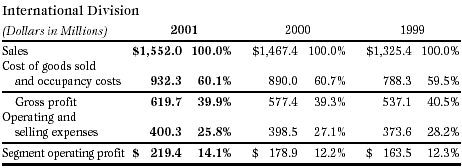
Sales in our International Division grew 6% in 2001 and 11% in 2000. Adjusting fiscal 2000 to a 52-week basis, sales increased 8% in 2001. Foreign currency translations adversely affected sales in all periods. Excluding the foreign currency effect, sales in our International Division grew 11% in 2001 and 23% in 2000. Comparable sales, excluding the foreign currency effect, increased 12% in the current year compared with growth of over 30% in 2000. These increases in 2001 were achieved despite softness experienced in our operations in larger European countries relating to softer economic conditions generally throughout Europe. Although the Office Depott brand continues to grow as a percentage of the total sales in this segment, our Viking Office Productst brand still accounts for the vast majority of our international business, representing approximately 87% of all international sales in 2001 and 88% in 2000. These Viking catalog operations had local currency comparable sales increases of 11% in 2001 and 16% in 2000. Competitive, political, and economic conditions in international markets in which we operate may impact our sales in the future.
As noted above, sales in local currencies have substantially increased in recent years. For U.S. reporting, these sales are translated into U.S. dollars at average exchange rates during the year. The strong U.S. dollar has adversely affected reported sales in each of the three years presented, in some cases significantly. To the extent the U.S. dollar continues to strengthen relative to the currencies where we conduct business, this adverse effect on reported sales can be expected to continue.
Gross profit as a percentage of sales increased in 2001 and reflects pricing initiatives in certain machine and general office supply categories, partially offset by the introduction of our lower-margin contract sales in certain European countries. The decrease in gross profit as a percent of sales in 2000 resulted from an unfavorable mix shift towards machine supplies, primarily ink and toner cartridges, which yield lower gross profit margins than other products. As with our other segments, our International Division was affected by higher costs for paper and machine supplies in 2000. However, unlike our domestic segments, the effect of these cost increases was lessened with increased pricing in our catalogs during the latter half of the year.
Operating and selling expenses as a percentage of sales are higher in our International Division than in our other segments primarily because we use an extensive marketing program to drive sales in new and existing markets, and we have start-up activities in several markets. Similar to our BSG, personnel and delivery expenses are significant components of our International Division’s operating and selling expenses. Additionally, the cost of catalog preparation and mailing is a significant component to support the direct mail channel.
Continuing a trend that began in 2000, advertising expenses continued to decline, reflecting the impact of improved mailing efficiencies throughout Europe in 2001, as well as continued improvement in our use of more effective advertising campaigns in Japan. In 1999, increasing competition in many of our established markets, coupled with our efforts to gain market share in certain newer markets, drove up our advertising costs.
During 2001, we incurred additional operating expenses related to the start up of contract businesses in Europe along with the acquisition of a contract stationer in Australia. These incremental costs are normal as we continue developing our business in new markets. These expenses are offset by continuing improvement in certain fixed operating expenses. As our operations grow in a particular market, fixed operating expenses decline relative to sales. For example, advertising costs in the form of prospecting and delivery costs, which are affected by the density of the delivery areas, decline as a percentage of sales as the market grows. We expect to leverage certain fixed operating expenses, and our cost to attract new customers should decline as a percentage of sales as we continue to establish our brands and grow our international business.
Fiscal 2001 includes a gain of $10.2 million from the sale of a London warehouse and fiscal 2000 includes charges of $5.3 million for closed stores and facilities resulting from the 2000 comprehensive business review.
Corporate and Other

*
Includes domestic and wholly-owned international openings and relocations.
Our pre-opening expenses consist principally of personnel, property and advertising expenses incurred in opening or relocating stores in our North American Retail Division. Our pre-opening expenses also include, to a lesser extent, expenses incurred to open or relocate facilities in our BSG and International Division. We typically incur pre-opening expenses during a six-week period prior to a store opening. Because we expense these items as they are incurred, the amount of pre-opening expenses each year is generally proportional to the number of new stores opened during the period. This has been the primary contribution to the fluctuation in pre-opening expenses over the three years presented. For 2001, our pre-opening expenses approximated $160,000 per domestic office supply store and $101,000 per international office supply store. Our cost to open a new CSC varies significantly with the size and location of the facility. We currently estimate costs to open a domestic or international CSC to be $1.5 million per facility.



