|
Revenue Recognition:
Revenue is recorded at the time of shipment for delivery and catalog
sales, and at the point of sale for essentially all retail store transactions.
When revenue is recorded, an allowance for sales returns is estimated
based on past experience. Revenue from sales of extended warranty service
plans is either recognized at the point of sale or over the warranty
period, depending on various states’ laws determination of legal
obligor status. All performance obligations and risk of loss associated
with such contracts are transferred to an unrelated third party administrator
at the time the contracts are sold. Costs associated with these contracts
are recognized in the same period as the related revenue.
Shipping and
Handling Fees and Costs: Income generated from shipping and handling
fees is classified as revenues for all periods presented. The costs
related to shipping and handling are presented as a component of store
and warehouse operating and selling expenses. These costs were $748.6
million in 2001, $756.6 million in 2000 and $594.2 million in 1999.
Advertising:
Advertising costs are either charged to expense when incurred or,
in the case of direct marketing advertising, capitalized and amortized
in proportion to the related revenues. We participate in cooperative
advertising programs with our vendors in which they reimburse us for
a portion of our advertising costs. Advertising expense, net of cooperative
advertising allowances, amounted to $317.0 million in 2001, $295.8 million
in 2000 and $285.3 million in 1999.
Pre-opening
Expenses: Pre-opening expenses related to opening new stores and
warehouses or relocating existing stores and warehouses are expensed
as incurred and included in other operating expenses.
Self-Insurance:
Office Depot is primarily self-insured for workers’ compensation,
auto and general liability and employee medical insurance programs.
Self-insurance liabilities are based on claims filed and estimates of
claims incurred but not reported. These liabilities are not discounted.
Comprehensive
Income (Loss): Comprehensive income (loss) represents the change
in stockholders’ equity from transactions and other events and
circumstances arising from non-stockholder sources. Comprehensive income
(loss) consists of net earnings, foreign currency translation adjustments
and realized or unrealized gains (losses) on investment securities that
are available for sale, net of applicable income taxes.
Derivative Financial
Instruments: Certain derivative financial instruments may be used
to hedge the exposure to foreign currency exchange rate and interest
rate risks, subject to established risk management policies. Such approved
financial instruments include swaps, options, caps, forwards and futures.
Use of derivative financial instruments for trading or speculative purposes
is prohibited by Company policies.
New
Accounting Standards: In July 2001, the Financial Accounting Standards
Board (“FASB”) issued Statement No. 141, Accounting for
Business Combinations, and Statement No. 142, Goodwill and Other
Intangible Assets. These Statements modify accounting for business
combinations after June 30, 2001 and will affect the Company’s
treatment of goodwill and other intangible assets at the start of fiscal
year 2002. The Statements require that goodwill existing at the date
of adoption be reviewed for possible impairment and that impairment
tests be periodically repeated, with impaired assets written-down to
fair value. The initial test of goodwill must be completed within six
months of adoption, or by June 2002 for Office Depot, with a completion
of testing by the end of 2002. Additionally, existing goodwill and intangible
assets must be assessed and classified consistent with the Statements’
criteria. Intangible assets with estimated useful lives will continue
to be amortized over those periods. Amortization of goodwill and intangible
assets with indeterminate lives will cease. We have not yet completed
the initial test of existing goodwill and, accordingly, cannot estimate
the full impact of these rules. However, goodwill amortization, which
totaled $7.0 million for 2001, will no longer be recorded.
In July 2001, the
FASB issued Statement No. 143, Accounting for Asset Retirement Obligations.
This Statement requires capitalizing any retirement costs as part of
the total cost of the related long-lived asset and subsequently allocating
the total expense to future periods using a systematic and rational
method. Adoption of this Statement is required for Office Depot with
the beginning of fiscal year 2003. We have not yet completed our evaluation
of the impact of adopting this Statement.
In October 2001,
the FASB issued Statement No. 144, Accounting for the Impairment
or Disposal of Long-Lived Assets. This Statement supersedes Statement
No. 121 but retains many of its fundamental provisions. Additionally,
this Statement expands the scope of discontinued operations to include
more disposal transactions. The provisions of this Statement are effective
for Office Depot with the beginning of fiscal year 2002. We do not anticipate
a significant impact to the Company’s results of operations from
adoption of this Statement.
Note
B — 2000 Comprehensive Business Review and Other
During the second
half of 2000, following a change in senior management, Company personnel
performed a comprehensive review of the business. As a result of this
review, a significant number of facilities were closed, assets were
written down and employees were severed. At the same time, initiatives
were launched to enhance the shoppers’ experience and improve efficiency.
Essentially all actions resulting from the business review were put
in place during the last part of 2000 or early 2001. Additionally in
2000, costs were recorded relating to executive severance arrangements
and gains were realized from the sale of certain Internet investments.
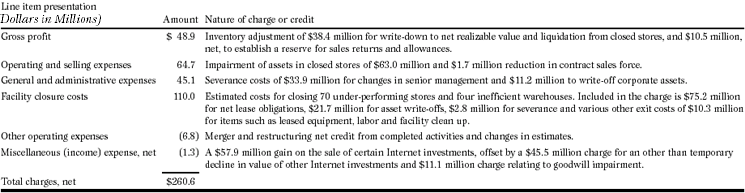
The primary elements of the net
charge of $260.6 million relating to the business review and other significant
charges and credits recorded in 2000, are summarized below:
|