Corporate Home | Investor Relations Home | Feedback





 |
||
|
||
|
|
|
||||||||||||||||||||||||||||||||||||||||||||||||||||||||||||||||||||||||||||||||||||||||||||||||||||||||||||||||||||||||||||||||||||||||||||||||||||||||||||||||||||||||||||||||||||||||||||||||||||||||||||||||||||||||||||||||||||||||||||||||||||||||||||||||||||||||||||||||||||||||||||||||||||||||||||||||||||||||||||||||||||||||||||||||||||||||||||||||||||||||||||||||||||||||||||||||||||||||||||||||||||||||||||||||||||||||||||||||||||||||||||||
|
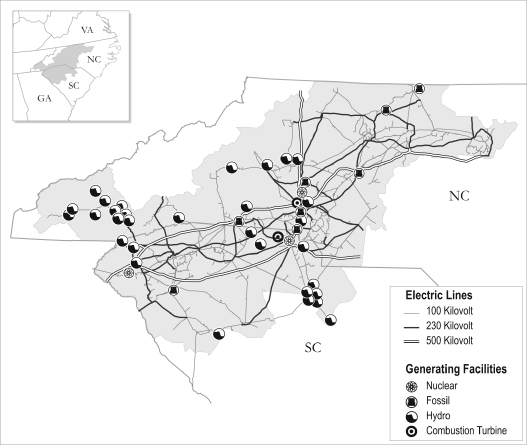
Service Area and Customers Franchised Electric generates, transmits, distributes and sells electricity. Its service area covers about 22,000 square miles with an estimated population of 5.7 million in central and western North Carolina and western South Carolina. Franchised Electric supplies electric service to approximately two million residential, commercial and industrial customers over 94,000 miles of distribution lines and a 13,300 mile transmission system. Electricity is sold wholesale to incorporated municipalities and to public and private utilities. In addition, municipal and cooperative customers who purchased portions of the Catawba Nuclear Station buy power through contractual agreements. (For statistics related to gigawatt-hour sales by customer type, see “Operating Statistics” in this section. For more information on the Catawba Nuclear Station joint ownership, see Note 5 to the Consolidated Financial Statements, “Joint Ownership of Generating Facilities.”) Industrial and commercial development in Franchised Electric’s service area is highly diversified. The textile industry, machinery and equipment manufacturing, and chemical industries are of major significance to the area’s economy. Other industries operating in the area include rubber and plastic products, paper and related products, and other manufacturing and service businesses. The textile industry, the largest industry served by Franchised Electric, accounted for approximately $335 million of Franchised Electric’s revenues for 2002, representing 7% of total electric revenues and 31% of industrial revenues. Franchised Electric normally experiences seasonal peak loads in summer and winter.
Energy Capacity and Resources Electric energy for Franchised Electric’s customers is generated by three nuclear generating stations with a combined net capacity of 5,020 megawatts (MW) (including Duke Energy’s 12.5% ownership in the Catawba Nuclear Station), eight coal-fired stations with a combined capacity of 7,699 MW, 31 hydroelectric stations (including two pumped-storage facilities) with a combined capacity of 2,806 MW and seven combustion turbine stations with a combined capacity of 2,135 MW. Energy and capacity are also supplied through contracts with other generators and purchased on the open market. Franchised Electric has interconnections and arrangements with its neighboring utilities to facilitate planning, emergency assistance, exchange of capacity and energy, and reliability of power supply. Franchised Electric expects that additional construction, purchased power contracts and open market purchases will meet customers’ energy needs in the future. (For statistics on sources of electric energy, see “Operating Statistics” in this section.) Fuel Supply Franchised Electric relies principally on coal and nuclear fuel for its generation of electric energy. The following table lists Franchised Electric’s sources of power and fuel costs for the three years ending December 31, 2002.
Coal. Franchised Electric meets its coal demand through purchase supply contracts and spot agreements. Large amounts of coal are obtained under supply contracts with mining operators who mine both underground and at the surface. Franchised Electric has an adequate supply of coal to fuel its current operations. Expiration dates for its supply contracts, which have price adjustment provisions, range from 2003 to 2005. Duke Energy expects to renew these contracts or enter into similar contracts with other suppliers for the quantities and quality of coal required. The coal purchased under these contracts is produced from mines in eastern Kentucky, southern West Virginia and southwestern Virginia. Franchised Electric uses spot market purchases to meet coal requirements not met by supply contracts. The average sulfur content of coal purchased by Franchised Electric is approximately 1%. This satisfies the current emission limitation for sulfur dioxide for existing facilities. (See Note 16 to the Consolidated Financial Statements, “Commitments and Contingencies—Environmental,” for additional information regarding particulate matter.) Nuclear. Developing nuclear generating fuel generally involves the mining and milling of uranium ore to produce uranium concentrates, the conversion of uranium concentrates to uranium hexafluoride gas, enrichment of that gas, and then the fabrication of the enriched uranium hexafluoride into usable fuel assemblies. Franchised Electric has contracted for uranium materials and services required to fuel the Oconee, McGuire and Catawba Nuclear Stations. Uranium concentrates, conversion services and enrichment services are primarily met through a diversified portfolio of long-term supply contracts. The contracts are diversified by supplier, country of origin and pricing. Franchised Electric staggers its contracting so that its portfolio of long-term contracts covers the majority of its fuel requirements at Oconee, McGuire and Catawba in the near term, but so that its level of coverage decreases each year into the future. Due to the technical complexities of changing suppliers of fuel fabrication services, Franchised Electric generally sole sources these services to domestic suppliers on a plant by plant basis using multi-year contracts. Based upon current projections, Franchised Electric’s existing portfolio of contracts will meet the requirements of Oconee, McGuire and Catawba Nuclear Stations through the following years:
After the years indicated above, a portion of the fuel requirements at Oconee, McGuire and Catawba are covered by long-term contracts. For requirements not covered under long-term contracts, Duke Energy believes it will be able to renew contracts as they expire, or enter into similar contractual arrangements with other suppliers of nuclear fuel materials and services. Near-term requirements not met by long-term supply contracts have been and are expected to be fulfilled with uranium spot market purchases. Duke Power, a division of Duke Energy, has entered into a contract under which Duke Power has agreed to prepare the McGuire and Catawba nuclear reactors for use of mixed oxide fuel and to purchase mixed oxide fuel for use in such reactors. Mixed oxide fuel is fabricated from the U.S. government’s surplus plutonium and is similar to conventional uranium fuel. Before using the fuel, Duke Energy must apply for and obtain amendments to the facilities’ operating licenses from the Nuclear Regulatory Commission (NRC). (See Note 17 to the Consolidated Financial Statements, “Guarantees and Indemnifications,” for additional information.) Insurance and Decommissioning Duke Energy owns and operates the McGuire and Oconee Nuclear Stations and operates and has a partial ownership interest in the Catawba Nuclear Station. The McGuire and Catawba Nuclear Stations have two nuclear reactors each and Oconee has three. Nuclear insurance includes: liability coverage; property, decontamination and decommissioning coverage; and business interruption and/or extra expense coverage. The other joint owners of the Catawba Nuclear Station reimburse Duke Energy for certain expenses associated with nuclear insurance premiums. The Price-Anderson Act requires Duke Energy to insure against public liability claims resulting from nuclear incidents to the full limit of liability, approximately $9.5 billion. (See Note 16 to the Consolidated Financial Statements, “Commitments and Contingencies—Nuclear Insurance,” for more information.) Estimated site-specific nuclear decommissioning costs, including the cost of decommissioning plant components not subject to radioactive contamination, total approximately $1.9 billion stated in 1999 dollars, based on decommissioning studies completed in 1999 (studies are completed every five years). This includes costs related to Duke Energy’s 12.5% ownership in the Catawba Nuclear Station. The other joint owners of the Catawba Nuclear Station are responsible for decommissioning costs related to their ownership interests in the station. (See Note 12 to the Consolidated Financial Statements, “Nuclear Decommissioning Costs,” for more information.) After spent fuel is removed from a nuclear reactor, it is cooled in a spent fuel pool at the nuclear station. Under provisions of the Nuclear Waste Policy Act of 1982, Duke Energy has contracted with the U.S. Department of Energy (DOE) for the disposal of spent nuclear fuel. The DOE failed to begin accepting spent nuclear fuel on January 31, 1998, the date specified by the Nuclear Waste Policy Act and in Duke Energy’s contract with the DOE. In 1998, Duke Energy filed a claim with the U.S. Court of Federal Claims against the DOE related to the DOE’s failure to accept commercial spent nuclear fuel by the required date. Damages claimed in the lawsuit are based upon Duke Energy’s costs incurred as a result of the DOE’s partial material breach of its contract, including the cost of securing additional spent fuel storage capacity. Duke Energy will continue to safely manage its spent nuclear fuel until the DOE accepts it. Payments made to the DOE for disposal costs are based on nuclear output and are included in the Consolidated Statements of Income as Fuel Used in Electric Generation. Competition Duke Energy continues to monitor electric industry restructuring and actively participates in regulatory reform deliberations in North Carolina and South Carolina. However, movement toward retail deregulation in these and other states has recently slowed. (For more information, see “Management’s Discussion and Analysis of Results of Operations and Financial Condition, Current Issues—Electric Competition.”) Franchised Electric competes in some areas with government-owned power systems, municipally owned electric systems, rural electric cooperatives and other private utilities. By statute, the NCUC and the PSCSC assign all service areas outside municipalities in North Carolina and South Carolina to regulated electric utilities and rural electric cooperatives. Substantially all of the territory comprising Franchised Electric’s service area has been assigned in this manner. In unassigned areas, Franchised Electric’s business remains subject to competition. A decision of the North Carolina Supreme Court limits, in some instances, the right of North Carolina municipalities to serve customers outside their corporate limits. In South Carolina, competition continues between municipalities and other electric suppliers outside the municipalities’ corporate limits, subject to the regulation of the PSCSC. In addition, Franchised Electric continues to compete with natural gas providers. Regulation The NCUC and the PSCSC approve rates for retail electric sales within their respective states. The FERC approves Franchised Electric’s rates for some electric sales to wholesale customers. (For more information on rate matters, see Note 4 to the Consolidated Financial Statements, “Regulatory Matters—Franchised Electric.”) The FERC, the NCUC and the PSCSC also have authority over the construction and operation of Franchised Electric’s facilities. Certificates of public convenience and necessity issued by the FERC, the NCUC and the PSCSC authorize Franchised Electric to construct and operate its electric facilities, and to sell electricity to retail and wholesale customers. Prior approval from the NCUC and the PSCSC is required to issue securities. NCUC, PSCSC and FERC regulations govern access to regulated electric customer data by non-regulated entities, and services provided between regulated and non-regulated affiliated entities. These regulations affect DENA’s and Other Energy Services’ activities with Franchised Electric. The Energy Policy Act of 1992 and the FERC’s subsequent rulemaking activities opened the wholesale energy market to competition. Open-access transmission for wholesale customers, as defined by the FERC’s rules, provides energy suppliers, including Duke Energy, with opportunities to sell and deliver capacity and energy at market-based prices. From the FERC’s open-access rule, Franchised Electric obtained the rights to sell capacity and energy at market-based rates from its own assets, which also allows Franchised Electric to purchase, at attractive rates, a portion of its capacity and energy requirements resulting in lower overall costs to customers. Open access also provides Franchised Electric’s existing wholesale customers with competitive opportunities to seek other suppliers for their capacity and energy requirements. In 1999 and 2000, the FERC issued its Order 2000 and Order 2000-A regarding Regional Transmission Organizations (RTOs). These orders set minimum characteristics and functions RTOs must meet, including independent authority to establish the terms and conditions of transmission service over the facilities they control. The orders provide for an open and flexible RTO structure to meet the needs of the market, and for the possibility of incentive ratemaking and other benefits for transmission owners that participate. As a result of these rulemakings, Duke Power and the franchised electric units of two other investor-owned utilities, Progress Energy (formerly known as Carolina Power & Light Company) and South Carolina Electric & Gas Company, planned to establish GridSouth Transco, LLC (GridSouth), as an RTO responsible for the functional control of the companies’ combined transmission systems. As of December 31, 2002, Duke Energy had invested $37 million in GridSouth, including carrying costs. This amount is included in Other Regulatory Assets and Deferred Debits on the Consolidated Balance Sheets. The sponsors expected that GridSouth would be substantially operational by the FERC’s Order 2000 “deadline” date of December 15, 2001. In March 2001, GridSouth received provisional approval from the FERC. However, in July 2001 the FERC ordered GridSouth and other utilities in the Southeast to join in a mediation to negotiate terms of a Southeastern RTO. It does not appear that the FERC will issue an order specifically based on that proceeding. In 2002, the GridSouth sponsors withdrew their applications to the NCUC and the PSCSC for approval of the transfer of functional control of their electric transmission assets to GridSouth, and announced that development of the GridSouth implementation project had been suspended until the sponsors have an opportunity to further consider regulatory circumstances and the outcome of initiatives such as the FERC’s Notice of Proposed Rulemaking (NOPR) on Standard Market Design (SMD) and the RTO cost/benefit study initiated by the Southeastern Association of Regulatory Utility Commissioners (SEARUC). The SEARUC cost/benefit study, issued in November 2002, states that under most scenarios neither RTOs nor SMDs provide net benefits to retail customers in the Southeast over the next few years. The final rule from the SMDNOPR is not expected to be issued until after July 2003. Duke Energy believes that more open wholesale electric markets will at some point provide benefits to consumers and other market participants. Duke Energy continues to examine its specific options relative to RTOs in light of the existing complex regulatory environment. Management believes its investment in GridSouth is probable of recovery. Franchised Electric is subject to the NRC jurisdiction for the design, construction and operation of its nuclear generating facilities. In 2000, the NRC renewed the operating license for Duke Energy’s three Oconee nuclear units through 2033 and 2034. Applications to renew the operating licenses for Duke Energy’s Catawba and McGuire nuclear units were filed with the NRC in June 2001. These operating licenses currently expire between 2021 and 2026. Franchised Electric’s hydroelectric generating facilities are licensed by the FERC under Part I of the Federal Power Act, with license terms expiring from 2005 to 2036. The FERC has authority to extend hydroelectric generating licenses. Other hydroelectric facilities whose licenses expire between 2005 and 2008 are in various stages of relicensing. Franchised Electric is subject to the jurisdiction of the Environmental Protection Agency (EPA) and state environmental agencies. (For a discussion of environmental regulation, see “Environmental Matters” in this section.) |
|||||||||||||||||||||||||||||||||||||||||||||||||||||||||||||||||||||||||||||||||||||||||||||||||||||||||||||||||||||||||||||||||||||||||||||||||||||||||||||||||||||||||||||||||||||||||||||||||||||||||||||||||||||||||||||||||||||||||||||||||||||||||||||||||||||||||||||||||||||||||||||||||||||||||||||||||||||||||||||||||||||||||||||||||||||||||||||||||||||||||||||||||||||||||||||||||||||||||||||||||||||||||||||||||||||||||||||||||||||||||||||||
|
|||
|
©Copyright 2003 |