Corporate Home | Investor Relations Home | Feedback





 |
||
|
||
|
|
|
||||||||||||||||||||||||||||||||||||||||||||||||||||||||||||||||||||||||||||||||||||||||||||||||||||||||||||
|
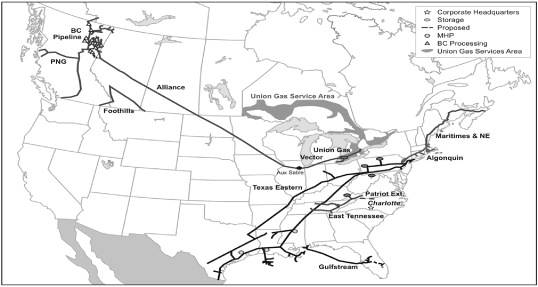
Natural Gas Transmission provides transportation and storage of natural gas for customers throughout the East Coast and Southern U.S. and in Canada. Natural Gas Transmission also provides distribution services to retail customers in Ontario and Western Canada, and gas gathering and processing service to customers in Western Canada. Natural Gas Transmission does business primarily through Duke Energy Gas Transmission Corporation. Duke Energy acquired Westcoast on March 14, 2002. (See Note 2 to the Consolidated Financial Statements, “Business Acquisitions and Dispositions.”) Natural Gas Transmission’s significant investments include Gulfstream Natural Gas System, LLC (Gulfstream), an interstate natural gas pipeline system owned and operated jointly by Duke Energy and The Williams Companies, Inc. The Gulfstream gas pipeline has a capacity of 1.1 billion cubic feet (Bcf) of natural gas per day and transports gas from the Mobile Bay area, across the Gulf of Mexico, to growing gas markets in south and central Florida. Gulfstream went in-service in May 2002. Alliance Pipeline, in which Natural Gas Transmission owns a 23.6% equity interest, is a natural gas transmission pipeline with a daily transportation capacity of 1.3 Bcf of natural gas per day from northeastern British Columbia, through Alberta and Saskatchewan, to a terminus near Chicago, Illinois. Vector Pipeline, in which Natural Gas Transmission owns a 30% equity interest, is a natural gas transmission pipeline from a point near Chicago, Illinois to Union Gas Limited’s (Union Gas) Dawn hub in Ontario. The Vector Pipeline connects with the Alliance Pipeline and the Northern Border Pipeline near Chicago, Illinois and delivers gas into markets in Indiana, Michigan and Ontario. The Vector Pipeline has a capacity of approximately 1 Bcf per day. For 2002, Natural Gas Transmission’s proportional throughput for its pipelines totaled 3,160 trillion British thermal units (TBtu), compared to 1,781 TBtu in 2001, a 77% increase mainly due to the Westcoast acquisition. This includes throughput on Natural Gas Transmission’s wholly owned U.S. and Canadian pipelines and its proportional share of throughput on pipelines that are not wholly owned. (See natural gas delivery statistics under “Operating Statistics” in this section.) A majority of Natural Gas Transmission’s contracted transportation volumes are under long-term firm service agreements with local distribution company (LDC) customers in the pipelines’ market areas. Firm transportation services are also provided to gas marketers, producers, other pipelines, electric power generators and a variety of end-users. In addition, the pipelines provide both firm and interruptible transportation to various customers on a short-term or seasonal basis. Demand on Natural Gas Transmission’s pipeline systems is seasonal, with the highest throughput occurring during colder periods in the first and fourth calendar quarters. Natural Gas Transmission’s deliveries are in Canada (primarily the Western and Atlantic regions of Canada, plus Ontario and Quebec), and the U.S. (primarily Connecticut, Maine, Massachusetts, Michigan, New Jersey, New York, Pennsylvania, Rhode Island, Tennessee and Virginia). Natural Gas Transmission provides distribution services through its Union Gas and Pacific Northern Gas (PNG) subsidiaries. Union Gas’ distribution service area encompasses approximately 400 communities and extends throughout northern Ontario from the Manitoba border to the North Bay/Muskoka area, through southern Ontario from Windsor to just west of Toronto, and across eastern Ontario from Port Hope to Cornwall. Union Gas’ distribution system consists of approximately 20,000 miles of distribution lines serving approximately 1.17 million residential, commercial and industrial customers. PNG serves approximately 39,000 customers in west-central and northeastern British Columbia.
Natural Gas Transmission’s pipeline systems consist of over 18,000 miles of transmission pipelines. The pipeline systems receive natural gas from major North American producing regions for delivery to markets primarily in British Columbia, the Western U.S., Ontario, the Pacific Northwest, and the Mid-Atlantic, Southeastern and New England states. (For detailed descriptions of Natural Gas Transmission’s pipeline systems, see “Properties, Natural Gas Transmission.”) Natural Gas Transmission, through Market Hub Partners (MHP), wholly owns natural gas salt cavern facilities in south Texas and Louisiana with a total storage capacity of approximately 29 Bcf. MHP markets natural gas storage services to pipelines, LDCs, producers, end users and natural gas marketers. Texas Eastern Transmission, LP (Texas Eastern) and East Tennessee Natural Gas (ETNG) also provide firm and interruptible open-access storage services. Storage is offered as a stand-alone unbundled service or as part of a no-notice bundled service with transportation. Texas Eastern has two joint-venture storage facilities in Pennsylvania and one wholly owned and operated storage field in Maryland. Texas Eastern’s certificated working capacity in these three fields is 75 Bcf. ETNG has a liquefied natural gas storage facility in Tennessee with a certificated working capacity of 1.2 Bcf. Union Gas owns approximately 150 Bcf of natural gas storage capacity in 20 underground facilities located in depleted gas fields near Sarnia, Ontario. Competition Natural Gas Transmission’s pipeline, storage and field services businesses compete with other pipeline and storage facilities in the transportation, processing and storage of natural gas. Natural Gas Transmission competes directly with other pipelines serving the Mid-Atlantic, Northeastern, Southeastern and Pacific Northwestern states, Western Canada, Ontario and along Canada’s Atlantic coast. Natural Gas Transmission also competes directly with other natural gas storage facilities in south Texas, Louisiana and Ontario. The principal elements of competition are rates, terms of service, and flexibility and reliability of service. Union Gas’ sales to industrial customers are affected by economic conditions and the price of competitive energy sources. Most of Union Gas’ industrial and commercial customers, and a portion of residential customers, purchase their natural gas supply directly from suppliers or marketers. As Union Gas earns income from the distribution of natural gas and not the sale of the natural gas commodity, the gas distribution margin is not affected by the source of the customer’s gas supply. Natural gas competes with other forms of energy available to Duke Energy’s customers and end-users, including electricity, coal and fuel oils. The primary competitive factor is price. Changes in the availability or price of natural gas and other forms of energy, the level of business activity, conservation, legislation, governmental regulations, the capability to convert to alternative fuels, weather and other factors affect the demand for natural gas in the areas served by Duke Energy. Regulation The FERC has authority to regulate rates and charges for natural gas transported or stored for U.S. interstate commerce or sold by a natural gas company via interstate commerce for resale. (For more information on rate matters, see Note 4 to the Consolidated Financial Statements, “Regulatory Matters—Natural Gas Transmission.”) The FERC also has authority over the construction and operation of U.S. pipelines and related facilities used in the transportation, storage and sale of natural gas in interstate commerce, including the extension, enlargement or abandonment of such facilities. Texas Eastern, Algonquin Gas Transmision Company (Algonquin), ETNG, Gulfstream, Alliance Pipeline, Vector Pipeline, MHP and Maritimes & Northeast Pipeline (M&N Pipeline) hold certificates of public convenience and necessity issued by the FERC, authorizing them to construct and operate pipelines, facilities and related properties, and to transport and store natural gas via interstate commerce. The MHP storage assets located in Texas are also subject to the Texas Railroad Commission’s rules and regulations. As required by FERC Order 636, Natural Gas Transmission’s U.S. pipelines operate as open-access transporters of natural gas, providing unbundled firm and interruptible transportation and storage services on an equal basis for all gas supplies, whether purchased from the pipeline or from another gas supplier. The FERC regulations govern access to regulated natural gas transmission customer data by non-regulated entities and to services provided between regulated and non-regulated affiliated entities. These regulations affect the activities of DENA with Natural Gas Transmission. Natural Gas Transmission’s U.S. operations are subject to the jurisdiction of the EPA and state environmental agencies. (For a discussion of environmental regulation, see “Environmental Matters” in this section.) Natural Gas Transmission’s interstate natural gas pipelines are subject to the regulations of the U.S. Department of Transportation (DOT) concerning pipeline safety. DOT regulations have incorporated certain provisions of the Natural Gas Pipeline Safety Act of 1968, which regulates gas pipeline and liquefied natural gas plant safety requirements. In addition, the DOT is developing regulations that will require pipelines to implement integrity management programs, including more frequent inspections and other safety protections in areas where the consequences of potential pipeline accidents pose the greatest risk to people and their property. The Pipeline Safety Improvement Act of 2002, which was enacted on December 17, 2002, establishes mandatory inspections of high-consequence areas for all U.S. oil and natural gas pipelines within 10 years. The natural gas gathering, processing, transmission, storage and distribution operations in Canada are subject to regulation by the National Energy Board and provincial agencies in Canada, such as the Ontario Energy Board and the British Columbia Utilities Commission. These agencies have authorization similar to the FERC for setting rates, regulating the operations of facilities and construction of any additional facilities. |
|||||||||||||||||||||||||||||||||||||||||||||||||||||||||||||||||||||||||||||||||||||||||||||||||||||||||||||
|
|||
|
©Copyright 2003 |