|
 |

|
Management’s
Discussion and Analysis
of Financial Condition and Results of Operations |
|
CONTINUED |
|
|
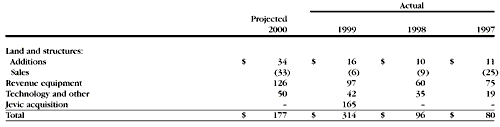
Projected net capital expenditures for 2000 are $177 million, a decrease over 1999 capital expenditures of $314 million. 1999 capital expenditures include $165 million for the acquisition of Jevic. Net capital for both periods pertains primarily to replacement of revenue equipment at all subsidiaries, growth capital at Jevic, Saia, WestEx and Action Express and additional investments in information technology. In 2000, additional capital expenditures are planned for land and structures. Net capital expenditures in 1998 totaled $96 million an increase from $80 million in 1997. Actual and projected net capital expenditures are summarized below (in millions):
On July 9, 1999 the company completed a cash tender offer for all of the common stock of Jevic Transportation, Inc. at $14 share. The aggregate purchase price of the stock, including vested stock options and transaction costs, was approximately $160.8 million, net of anticipated tax benefits relating to the cost of the stock options. Including the assumption of debt, the total transaction cost was approximately $200 million. The acquisition was financed under the company’s existing $300 million credit facility and the company’s ABS agreement. In December 1998, the company acquired Action Express, a regional LTL company that operates primarily in the Northwest. The consolidated financial statements include the results of operations of Jevic and Action Express from their acquisition dates. The Action acquisition was not material to the consolidated financial statements. At year-end 1999 total debt was $276 million compared to $157 million at year-end 1998. This increase of $119 million was primarily the result of the Jevic acquisition. These facilities provide adequate capacity to fund working capital and capital expenditures requirements. Management believes its current financial condition and access to capital is adequate for current operations including anticipated expenditures as well as future growth opportunities. OtherThe company provides a “pay for performance” incentive compensation plan that rewards employees based on financial goals of operating income and return on capital goals as well as personal goals. Consolidated results include pay for performance accruals for nonunion employees of $33.1 million, $8.8 million and $25.9 million, in 1999, 1998 and 1997 respectively. Another component of pay for performance is the company’s stock option programs which are discussed on page 20 of the notes to the consolidated financial statements. Yellow Corporation Board of Directors have authorized three programs to repurchase shares of the Company’s outstanding common stock with an aggregate purchase price of up to $25 million for each program resulting in total purchases of $70.3 million through December 31, 1999. During 1999 the company purchased 855,500 additional treasury shares. Through December 31,1999, approximately 3.8 million shares had been repurchased at an average price of $18.60 per share. The company suspended its stock repurchase program in April 1999 as a result of the Jevic acquisition and internal investment opportunities. Year 2000 The company began its Year 2000 project in 1995 with original estimates for remediation costs of approximately $17.5 million. The final cost of remediation was approximately $15.8 million, which represents approximately 6 percent of its information technology budget over the project period. The company was able to implement process modifications that provided greater efficiency and flexibility in remediating code while working around the system needs of the business. The early start coupled with the efficient process allowed the company to keep pace with demand for new IT development. There were no significant projects deferred as a result of the Year 2000 remediation effort. |