|
 |

|
|
|
Management’s
Discussion and Analysis
of Financial Condition and Results of Operations |
|
CONTINUED |
|
|
As a result of these efforts, the transition from 1999 to 2000 proved to be uneventful. The company has not identified any unusual business trends relative to the transition to Year 2000. The company expensed modification costs of $1.9 million for the year ended December 31,1999 compared to $5.9 million for the year ended December 31, 1998.
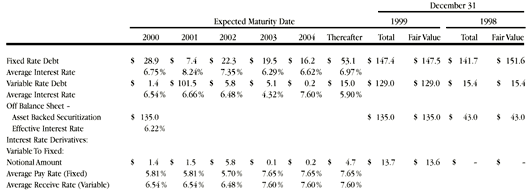
Market Risk The company is exposed to a variety of market risks, including the effects of interest rates, fuel prices and foreign currency exchange rates. To ensure adequate funding through seasonal business cycles and minimize overall borrowing costs, the company utilizes a variety of both fixed rate and variable rate financial instruments with varying maturities. At December 31, 1999, approximately 64 percent of the company’s long-term financing including ABS is at variable rates with the balance at fixed rates.The company acquired interest rate swaps on a portion of debt assumed in the Jevic acquisition. The company has not entered into any additional interest rate swaps subsequent to this transaction. The interest rate swaps hedge a portion of the company’s exposure to variable interest rates.The detail of the company’s debt structure, including off balance sheet financial instruments is more fully described on page 17 of the notes to financial statements. The company uses swaps and options as hedges in order to manage a portion of its exposure to variable diesel prices. These agreements provide protection from rising fuel prices, but limit the ability to benefit from price decreases below the purchase price of the agreement. The swap transactions are generally based on the price of heating oil. Based on historical information, the company believes the correlation between the market prices of diesel fuel and heating oil is highly effective. The company’s fuel hedges are discussed in more detail on page 15 of the notes to the financial statements. The company’s revenues and operating expenses, assets and liabilities of its Canadian and Mexican subsidiaries are denominated in foreign currencies, thereby creating exposures to changes in exchange rates, however the risks related to foreign currency exchange rates are not material to the company’s consolidated financial position or results of operations. The table below provides information about the company’s fixed rate financial instruments as of December 31, 1999 and 1998.The table presents principal cash flows (in millions) and related weighted average interest rates by contractual maturity dates. Medium-term notes included in fixed rate debt maturing within one year, and intended to be refinanced are classified as long-term in the consolidated balance sheet. For interest rate swaps the table presents notional amounts and weighted average interest rates by contractual maturity.Weighted average variable rates are based on LIBOR rate as of December 31, 1999.
|
|
 |
|