At this time last year, we expected that deteriorating business conditions in the iron and steel industry would make 2001 an extremely challenging year. It turned out to be that, and more, as the financial collapse of much of the North American steel industry produced the worst crisis in the history of the industry. Cliffs recorded its first loss since 1986, which was also a very difficult year for the steel industry. The disappointing financial result was largely caused by major production curtailments, triggered by weak pellet demand, and a significant loss from our Trinidad venture.
The decline in iron ore pellet sales, which dropped to 8.4 million tons in 2001 from 10.4 million tons in 2000, reflected the depressed conditions in the steel industry and the closures of LTV Steel, Acme Steel and Geneva Steel. To adjust for lower sales volume and avoid inventory accumulation, we curtailed production at all of our mines. The curtailments, which totaled about 5 million tons, or 40 percent of production capacity, penalized pre-tax results by about $48 million.
We successfully demonstrated the operational improvements that were completed at our HBI plant in Trinidad in early 2001, and steadily ramped-up production rates. The quality and market acceptance of the 134,000 tons of CIRCAL™ briquettes produced and sold was good. Unfortunately, the market for ferrous metallics products plummeted with the rest of the steel business, forcing the suspension of operations in the fourth quarter until market fundamentals improve.
Our financial position was managed very carefully in 2001. We significantly reduced headcount, outsourced information technology operations, and sold non-strategic assets. Inventory and credit exposure were carefully managed, although steadily deteriorating sales resulted in a higher than targeted year-end inventory.
Organizationally, we streamlined our corporate and central service staffs and added Dave Gunning, our new Vice Chairman, to lead our business development efforts. We implemented a Talent Management Process that is having a profound effect on employee development efforts.
After much persistence, we closed an innovative transaction to acquire the assets of LTV Steel Mining Company in Minnesota just weeks before LTV Corporation decided to liquidate. We realized a cash infusion of $50 million and acquired assets that could have significant future value in exchange for the assumption of mine closure liabilities. At worst, this transaction should be a no-cost financing. At best, the assets that have been acquired could provide new business opportunities.
Strategically, we redefined our business plan to consolidate the North American iron ore business. On January 31, 2002, we acquired Algoma Steel's 45 percent interest in the Tilden Mine for the assumption of mine liabilities. We also executed a new sales agreement with Algoma that made Cliffs the sole supplier of iron ore pellets purchased by Algoma for the next 15 years. We are pursuing similar transactions with several other steel companies where the transactions make economic sense for Cliffs and the steel companies.
There is one area of our business that made us particularly proud
in 2001 - our continuing improvement in employee
safety. Measured against 1999, our benchmark year, our accident
rate was down by 15 percent. This reflects the results of our Safety
Leadership Team, which has made all employees accountable for
safety. Our Northshore and Hibbing Mines were standouts in safety
leadership. Northshore's mining operation in Babbitt, Minnesota,
had no lost time injuries in 2001 and, therefore, qualified for
the Sentinels of Safety Award presented annually by the National
Mining Association and the Mine Safety and Health Administration.
Please click here for additional discussion of our safety
performance for 2001.
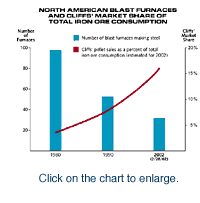
The integrated steel industry in North America is in a battle for its survival. Most of the companies that melt iron ore to make steel are in financial distress, and a number of these companies have been forced into bankruptcy. As the steel industry has fallen on tough times and utilization rates have declined, iron ore consumption rates have plummeted. Cliffs has joined its partners and customers in a war for the survival of North American blast furnaces. The only commercial use for iron ore pellets is making raw steel starting with the production of iron in a blast furnace, and there are only 32 blast furnaces making steel in North America today. That number is down from nearly 100 just 20 years ago.
 The
blast furnace has been under attack for the last 20 years. Most
recently, the blast furnace has been challenged by imported semi-finished
steel. Integrated steel makers, fighting for their lives, have been
buying imported steel slabs rather than maintaining and operating
their blast furnaces to produce hot metal. We strongly support the
enforcement of trade laws applicable to slab imports, but we recognize
that import restrictions cannot save the domestic iron ore industry. The
blast furnace has been under attack for the last 20 years. Most
recently, the blast furnace has been challenged by imported semi-finished
steel. Integrated steel makers, fighting for their lives, have been
buying imported steel slabs rather than maintaining and operating
their blast furnaces to produce hot metal. We strongly support the
enforcement of trade laws applicable to slab imports, but we recognize
that import restrictions cannot save the domestic iron ore industry.
While there has been a 67 percent decline in the number of blast furnaces making steel since 1980, iron ore consumption has declined by approximately 32 percent. This reflects the survival of the larger, more efficient furnaces and improvements in blast furnace practices. In a period where total iron ore consumption has declined, Cliffs' market share has increased significantly. In 1980, Cliffs' sales represented less than 4 percent of total iron ore consumption. In 2002, Cliffs' sales are expected to approximate 16 percent of total consumption.
It is very clear that Cliffs has its work cut out. Cliffs must do everything possible to keep the customers it has, and gain market share from its competitors. Our key objectives are:
First, we must produce and deliver iron ore pellets that meet or beat the competition in terms of quality and cost. Under the ForCE banner we are making major changes in how we operate in the relentless pursuit of cost reduction and greater production efficiency.
Second, we must help our blast furnace customers stay in business by substantially lowering their raw material costs. Our customers must be incentivized to use their blast furnaces rather than purchasing imported steel slabs, or developing electric furnace capacity to replace their blast furnaces. We must achieve this objective in a way that allows Cliffs to be profitable and attractive to investors.
We believe consolidation of the North American iron ore industry is strategically consistent with the needs of our customers. Within the last year, we have developed a strategy and taken several actions to reposition Cliffs in the North American iron ore business. The mine partnerships involving Cliffs and various steel companies provided a very successful business model for many years, but steel company priorities have changed. They need their precious capital to make steel, not to produce iron ore pellets.
Steel fundamentals have been improving in the early part of 2002, but it is too early to project sustained improvement. We have substantial uncertainty regarding our pellet sales in 2002, however, we currently expect sales will represent only 70 percent of our production capacity, which will require continuing production curtailments. With our current cost structure, we cannot operate at this level and be profitable. We are working to increase our sales volume, but we recognize that the opportunities to add volume are limited, and thus, we are intensely focused on lowering our cost structure to meet the current economic realities.
With respect to Cliffs and Associates Limited (CAL), we are closely monitoring the market for ferrous metallic products. The Trinidad plant is capable of quickly resuming production; however, we will need to see a sustained improvement in demand and pricing before we restart the Trinidad plant. We have reduced holding costs at CAL to the absolute minimum while protecting the asset and retaining key employees in our highly skilled work force. We remain committed to the ferrous metallics business as demonstrated by our participation in a new project at our Northshore Mine to develop Kobe Steel's ironmaking technology for converting iron ore into nearly pure iron in nugget form.
The challenges facing Cliffs today are as great as they have been in the Company's 155-year history. At the same time, the opportunities that have been created by adversities in the iron and steel business are also as great as they have ever been. Cliffs is highly motivated to maintain North American blast furnace capacity and to optimize the Company's position as the supplier of choice for iron ore pellets. We seek creative ways to work with those who are involved in restructuring the steel business, and expect this will lead to new business opportunities. Despite the woeful condition of the business at present, it is our firm belief that a transformed steel industry will continue to be significant to the economies of the United States and Canada.
The year 2002 will be a pivotal year for the iron and steel industry, and for
Cliffs, as we seek to capitalize on our opportunities and lead the
remaking of the iron ore business in North America. Your Board of
Directors and management team realize that success in executing
our business plan is critical to shareholders, employees and the
many others that have a stake in Cliffs' future. While we do not
underestimate the difficult road immediately ahead, we are confident
that we will prevail in our mission to better serve a “new” steel
industry and restore Cliffs' shareholder value. We appreciate your
support.
|
John S. Brinzo |
| Chairman and Chief Executive
Officer |
February 28, 2002 |
|