 |
|||
|
|
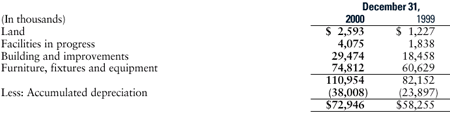
The Company’s franchise agreements require the payment of franchise fees which include marketing and reservation fees. These fees, which are based on a percentage of the franchisees’ gross room revenues, are used exclusively by the Company’s marketing and reservation funds for expenses associated with providing such franchise services as central reservation systems, national marketing and media advertising. The Company is contractually obligated to expend the marketing and reservation fees it collects from franchisees in accordance with the franchise agreements; as such, no income or loss to the Company is generated. Accordingly, marketing and reservation fees collected and associated expenses are reported net by the Company. The Company generates partner services revenue from hotel industry vendors based on the level of goods or services purchased from the vendors by hotel owners and hotel guests who stay in the Company’s franchised hotels. In accordance with Staff Accounting Bulletin No. 101, “Revenue Recognition,” the Company recognizes partner services revenues (i) upon the completion of service or delivery of product, assuming reasonable assurance of collectibility; (ii) upon completion of a specific event; or, failing the previous two conditions, (iii) over the life of the contract, regardless of whether monies are received in advance or in arrears, and regardless of whether the monies are non-refundable. Self-Insurance Program. The Company maintains its own health insurance program, which includes certain levels of retained risk. Estimated costs are accrued at present values based on actuarial projections for known and anticipated claims. Reclassifications. Certain reclassifications have been made to the prior year consolidated financial statements to conform to the current year presentation. The components of property and equipment in the consolidated balance sheets are:
Depreciation has been computed for financial reporting purposes using the straight-line method. A summary of the ranges of estimated useful lives upon which depreciation rates have been based follows:
Goodwill primarily represents an allocation of the excess purchase price of the stock of the Company over the recorded minority interest that was previously held by members of the Company’s former management team. Goodwill is amortized on a straight-line basis over 40 years. Such amortization amounted to $2.0 million in each of the years ended December 31, 2000, 1999 and 1998, respectively. Goodwill is net of accumulated amortization of $12.1 million and $10.1 million at December 31, 2000 and 1999, respectively. |

|
|
 |

|