| |
|
|
|
Consolidated Results Consolidated sales increases in fiscal 2000 and 1999 resulted primarily from the opening of new Borders superstores and increases in comparable store sales for Borders superstores. Consolidated gross margin decreased as a percentage of sales in 2000, but was flat in 1999. The decrease in 2000 was driven by lower gross margin percentages for both the Borders and Waldenbooks segments. Among the reasons for the decrease in gross margin percentage of Borders was a change in sales mix to lower-margin items. The decrease in gross margin percentage of Waldenbooks was due to its fixed expenses (primarily store occupancy expenses) being spread over a smaller store base and lower sales volume in 2000 compared to 1999.
Consolidated selling, general and administrative expenses increased in 2000 and 1999 primarily due to continued spending on the Company’s strategic initiatives, primarily international superstores and web-based convergence initiatives. The 1999 increase also included a $5.5 million pre-tax charge related to the resignation of the Company’s former Chief Executive Officer. In the fourth quarter of fiscal 2000, the Company took a pre-tax charge of $36.2 million related to the impairment of certain long-lived assets and other writedowns. The carrying value of long-lived assets are evaluated whenever changes in circumstances indicate the carrying amount of such assets may not be recoverable. In performing such reviews for recoverability, the Company compares the expected cash flows to the carrying value of long-lived assets. If the expected future cash flows are less than the carrying amount of such assets, the Company recognizes an impairment loss for the difference between the carrying amount and their estimated fair value. Fair value is estimated using expected discounted future cash flows. The charge taken in 2000 primarily consisted of $17.7 million for computer hardware and software of Borders.com and $12.5 million for leasehold improvements and furniture and fixtures primarily related to 103 underperforming Walden stores. The remainder of the charge related to employee severance, the costs of certain lease obligations for redundant headquarter buildings, and the write-off of certain equity investments. Interest expense decreased as a percentage of sales in 2000 as a result of lower consolidated borrowing levels and was flat in 1999. The effective tax rate for the years presented differed from the federal statutory rate primarily as a result of state income taxes. The Company’s effective tax rate was 39.4% in 2000, as compared to 39.1% in 1999. The increase is primarily due to changes in the mix of income subject to tax in the various taxing jurisdictions. In 1998, the effective tax rate was 39.0%. In January 2001, the Company adopted a plan to discontinue operations of All Wound Up, a seasonal retailer of interactive toys and novelty merchandise the Company had acquired in March 1999. The discontinuance and closure of All Wound Up resulted in an after- tax charge of $19.4 million in the fourth quarter of fiscal 2000, and is reflected in the Consolidated Statements of Operations as a discontinued operation. The charge was substantially non- cash and related primarily to the writeoff of goodwill, inventory and fixed assets. The Company includes certain distribution and other expenses in its inventory costs, particularly freight, distribution payroll, and certain occupancy expenses. In addition, certain selling, general and administrative expenses are included in inventory costs. These amounts approximate 2% of total inventory. Segment Results The Company is organized based upon the following oper ating segments: domestic Borders stores, Waldenbooks stores, international Borders and Books etc. stores, online retailing through Borders. com, and other (consisting of interest expense and certain corporate governance costs). See Note 13 of the Notes to Consolidated Financial Statements for further information relating to these segments.
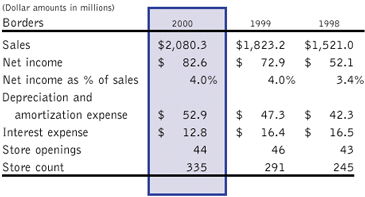
The increases in Borders sales for 2000 and 1999 are primarily the result of new store openings and comparable store sales increases. Borders opened 44 and 46 new stores in 2000 and 1999, respectively, and experienced comparable store sales increases of 2.3% and 5.4% in 2000 and 1999, respectively. Net income for 2000 and 1999 increased primarily due to store openings and Borders’ ability to leverage fixed costs over a larger sales base. As a percentage of sales, net income for 2000 was flat with 1999 despite a decrease in gross margin percentage and an increase in non-payroll store expenses as a percentage of sales. The decrease in gross margin as a percentage of sales was due to a change in sales mix to DVDs and new-release music, a slight increase in promotional costs, and less leverage of store occupancy costs resulting from lower comparable store sales. Non-payroll store expenses as a percentage of sales increased due to lower comparable store sales increases. These items were offset by lower store payroll costs as apercentage of sales. Net income as a percentage of sales for 1999 was greater than 1998 primarily due to an increase in gross margin percentage resulting from improved shrinkage control and merchandise mix. |
| |
|
|