|
|
Notes
to Consolidated Financial Statements
|
|
t
Note 1. Accounting
Policies:
Principles of Consolidation:
The consolidated
financial statements include all significant majority-owned
subsidiaries. Affiliated companies in which Cummins does not
have a controlling interest, or for which control is
expected to be temporary, are accounted for using the equity
method. Use of estimates and assumptions as determined by
management is required in the preparation of consolidated
financial statements in conformity with generally accepted
accounting principles. Actual results could differ from
these estimates and assumptions.
Revenue
Recognition:
The Company recognizes revenues on the sale of its
products, net of estimated costs of returns, allowances and
sales incentives, when the products are shipped to
customers. The Company generally sells its products on open
account under credit terms customary to the region of
distribution. The Company performs ongoing credit
evaluations of its customers and generally does not require
collateral to secure its customers' receivables.
Foreign
Currency:
Assets and liabilities of foreign entities, where the
local currency is the functional currency, have been
translated at year-end exchange rates, and income and
expenses have been translated to US dollars at
average-period rates. Adjustments resulting from translation
have been recorded in shareholders' investment and are
included in net earnings only upon sale or liquidation of
the underlying foreign investment.
For foreign entities where
the US dollar is the functional currency, including those
operating in highly inflationary economies, inventory,
property, plant and equipment balances and related income
statement accounts have been translated using historical
exchange rates. The resulting gains and losses have been
credited or charged to net earnings.
Derivative Instruments:
The Company makes
use of derivative instruments in its foreign exchange,
commodity price and interest rate hedging programs.
Derivatives currently in use are commodity and interest rate
swaps, as well as foreign currency forward contracts. These
contracts are used strictly for hedging, and not for
speculative purposes. Refer to Note 8 for more information
on derivative financial instruments.
The Company enters into
commodity swaps to offset the Company's exposure to price
volatility for certain raw materials used in the
manufacturing process. As the Company has the discretion to
settle these transactions either in cash or by taking
physical delivery, these contracts are not considered
financial instruments for accounting purposes. These
commodity swaps are accounted for as hedges.
Other Costs:
Estimated costs of
commitments for product coverage programs are charged to
earnings at the time the Company sells its
products.
Research & development
expenditures, net of contract reimbursements, are expensed
when incurred and were $228 million in 1998, $250 million in
1997 and $235 million in 1996.
Maintenance and repair costs
are charged to earnings as incurred.
Cash Equivalents:
Cash equivalents
include all highly liquid investments with an original
maturity of three months or less at time of
purchase.
Inventories:
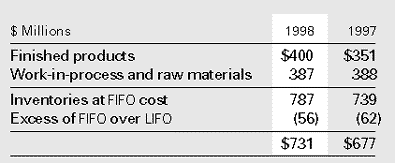
Inventories are
generally stated at cost or net realizable value.
Approximately 25 percent of domestic inventories (primarily
heavy-duty and high-horsepower engines and engine parts) are
valued using the last-in, first-out (LIFO) cost method.
Inventories at December 31 were as follows:
Top
of page
Property, Plant and Equipment:
Property, plant and
equipment are stated at cost. A modified units-of-production
method, which is based upon units produced subject to a
minimum level, is used to depreciate substantially all
engine production equipment. The straight-line depreciation
method is used for all other equipment. The estimated
depreciable lives range from 20 to 40 years for buildings
and 3 to 20 years for machinery, equipment and
fixtures.
Software:
Internal and
external software costs (excluding research, reengineering
and training) are capitalized and amortized generally over 5
years. Effective January 1, 1998, the Company adopted SOP
98-1 on accounting for internal use software costs. Internal
software costs capitalized in 1998 in accordance with this
new rule were $9 million. Capitalized software, net of
amortization, was $75 million at December 31, 1998 and $32
million at December 31, 1997.
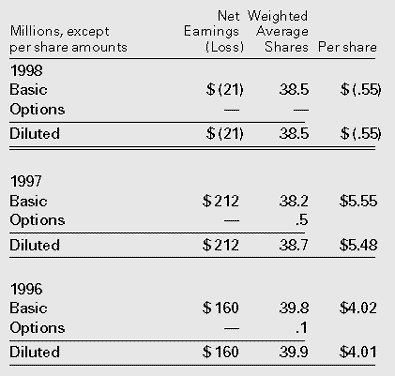
Earnings Per Share:
Effective January 1,
1997, the Company adopted SFAS No. 128, a new accounting
rule on calculating earnings per share. Under the new rule,
basic earnings per share of common stock are computed by
dividing net earnings by the weighted-average number of
shares outstanding for the period. Diluted earnings per
share are computed by dividing net earnings by the
weighted-average number of shares, assuming the exercise of
stock options when the effect of their exercise is dilutive.
Shares of stock held by the employee benefits trust are not
included in outstanding shares for EPS until distributed
from the trust. Years prior to 1997 have been restated to
reflect this new rule.
Top
of page
Note 2.
Acquisition: In
January 1998, the Company completed the acquisition of the
stock of Nelson Industries, Inc., for $453 million. Nelson,
a filtration and exhaust systems manufacturer, was
consolidated from the date of its acquisition. On a pro
forma basis, if the Company had acquired Nelson on January
1, 1997, consolidated net sales for 1997 would have been
$5.9 billion and consolidated earnings would not have been
materially different. In accordance with APB Opinion No. 16,
Nelson's net assets were recorded at fair value at the date
of acquisition. The purchase price in excess of net assets
will be amortized over 40 years.
Note 3. Special
Charges: In 1998,
the Company recorded special charges of $92 million for
product coverage costs and inventory write-downs. The
product coverage special charges of $78 million included $43
million primarily attributable to the recent experience of
higher-than-anticipated base warranty costs to repair
certain automotive engines manufactured in previous years,
and $35 million related to a revised estimate of product
coverage cost liability primarily for extended warranty
programs. The Company believed it was necessary to make
these special charges to accrue for such product coverage
costs expected to be incurred in the future on these engines
currently in the field. The special charges also included
$14 million for inventory write-downs associated with the
Company's restructuring and exit activities. These
write-downs relate to amounts of inventory rendered excess
or unusable due to the closing or consolidation of
facilities. The Company has committed to these facility
closures and consolidations as part of a plan to reduce
costs and improve operating performance.
Note 4. Restructuring and Other
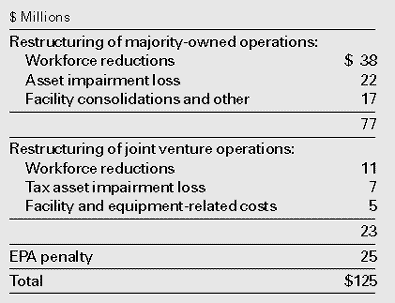
Non-Recurring Charges: In
1998, the Company recorded charges of $125 million,
comprised of $100 million for costs to reduce the worldwide
workforce, as well as costs associated with streamlining
certain majority-owned and international joint venture
operations and
$25 million for a civil
penalty to be paid by the Company as a result of an
agreement reached with the U.S. Environmental Protection
Agency (EPA), the Department of Justice (DOJ) and the
California Air Resources Board (CARB) regarding diesel
engine emissions. The major components of these charges are
as follows:
Top
of page
The restructuring program
was undertaken to address the decline in the Company's
business in Asia, to leverage overhead costs for all
operations and to improve joint venture operating
performance.
The charges for
majority-owned operations include $38 million for severance
and related costs associated with workforce reductions of
approximately 1,100 people. These reductions are in the
engine and power generation businesses and are primarily for
administrative positions. Costs for workforce reductions
were based on amounts pursuant to benefit programs and
contractual provisions or statutory requirements at the
affected operations. Approximately one-half of these
employees left the Company prior to December 31,
1998.
The asset impairment loss,
calculated according to the provisions of SFAS 121, was
recorded primarily for engine manufacturing equipment to be
disposed of upon the closure or consolidation of facilities
or the outsource of production. The recovery value for the
equipment to be disposed of was based on estimated
liquidation value. The carrying value of assets held for
disposal and the effect from suspending depreciation on such
assets is immaterial.
Facility consolidation and
other costs of $17 million include lease termination and
facility exit costs of $10 million, product support costs of
$3 million and litigation and other costs of $4 million. As
the restructuring consists primarily of the closing or
consolidation of smaller operations, the Company does not
expect these actions to have a material effect on future
revenues.
The charges for
restructuring joint venture operations totaled $23 million,
the majority of which relates to actions being taken at the
Company's joint venture with Wartsila, which is part of the
Company's power generation business. The charges include $11
million for employee severance and related benefits for
approximately 1,200 people, $7 million for a tax asset
impairment loss and $5 million for other facility and
equipment-related charges.
Approximately $25 million,
primarily related to employee severance, has been charged to
the restructuring liabilities as of December 31, 1998. Of
the total charges associated with restructuring activities,
cash outlays will approximate $60 million. The program is
expected to be essentially complete by the end of 1999 and
yield approximately $50 million in annual savings at
completion.
In addition to the civil
penalty, the agreement with the EPA/DOJ/CARB provides a
schedule for diesel engines to meet certain emission
standards and requires manufacturers to continue to invest
in environmental projects to further reduce oxides of
nitrogen (NOx) emissions. The Company has developed
extensive corporate action plans to comply with all aspects
of the agreement. Additionally, three separate court actions
have been filed as a result of allegations of the diesel
emissions matter. The New York Supreme Court ruled in favor
of the Company. This matter is now on appeal. A California
State Court recently ruled in favor of the Company. A recent
action was just filed in the U.S. District Court, the
District of Columbia.
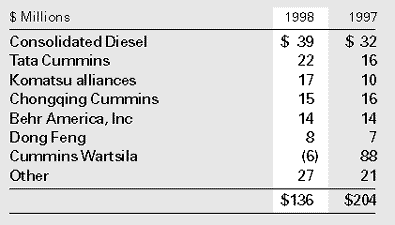
Note 5. Investments in Joint
Ventures and Alliances: Investments
in joint ventures and alliances at December 31 were as
follows:
Net sales of the joint
ventures and alliances were $1.2 billion in 1998 and $1.3
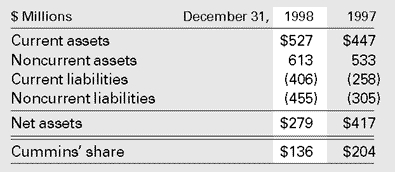
billion in 1997 and 1996. Summary balance sheet information
for the joint ventures and alliances was as
follows:
The Company has guaranteed
$79 million in outstanding debt of the Cummins Wartsila
joint venture as of December 31, 1998.
In connection with various
joint venture agreements, Cummins is required to purchase
products from the joint ventures in amounts to provide for
the recovery of specified costs of the ventures. Under the
agreement with Consolidated Diesel, Cummins' purchases were
$535 million in 1998 and $538 million in 1997.
Top
of page
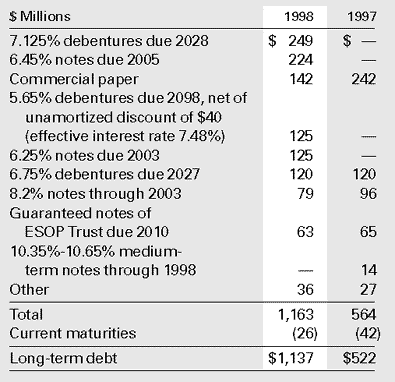
Note 6. Long-Term
Debt: Long-term debt
at December 31 was:
Maturities of long-term debt
for the five years subsequent to December 31, 1998 are $26
million, $26 million, $25 million, $27 million and $141
million. At both December 31, 1998 and 1997, the
weighted-average interest rate on loans payable and current
maturities of long-term debt approximated 7
percent.
The Company maintains a $500
million revolving credit agreement, maturing in 2003, under
which there were no outstanding borrowings at December 31,
1998 or 1997. The revolving credit agreement supports the
Company's commercial paper borrowings. In February 1998, the
Company issued $765 million face amount of notes and
debentures under a $1 billion Registration Statement filed
with the Securities and Exchange Commission in 1997. Net
proceeds were used to finance the acquisition of Nelson and
pay down other indebtedness outstanding at December 31,
1997. The Company also has other domestic and international
credit lines with approximately $193 million available at
December 31, 1998.
In 1997, the Company issued
$120 million of 6.75 percent debentures that mature in 2027.
Holders have a one-time option in 2007 to redeem the
debentures and Cummins has a recall right after ten
years.
The Company has guaranteed
the outstanding borrowings of its ESOP Trust. The notes were
refinanced in July 1998. Cash contributions to the Trust,
together with the dividends accumulated on the common stock
held by the Trust, are used to pay interest and principal.
Cash contributions and dividends to the Trust and the
Company's compensation expense approximated $10 million in
each year. The unearned compensation, which is reflected as
a reduction to shareholders' investment, represents the
historical cost of the shares of common stock that have not
yet been allocated by the Trust to participants.
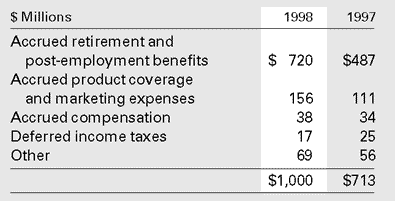
Note 7. Other
Liabilities: Other
liabilities at December 31 included the
following:
Top
of page
Note 8. Financial Instruments and
Risk Management: The
Company is exposed to financial risk resulting from
volatility in foreign exchange rates and interest rates.
This risk is closely monitored and managed through the use
of financial derivative contracts. As clearly stated in the
Company's policies and procedures, financial derivatives are
used expressly for hedging purposes, and under no
circumstances are they used for speculating or trading.
Transactions are entered into only with banking institutions
with strong credit ratings, and thus the credit risk
associated with these contracts is considered immaterial.
Hedging program results and status are reported to senior
management on a periodic basis.
Foreign Exchange
Rates
Due to its international
business presence, the Company uses foreign exchange forward
contracts to manage its exposure to exchange rate
volatility. Foreign exchange balance sheet exposures are
aggregated and hedged at the corporate level. Maturities on
these instruments generally fall within the one-month and
six-month range. The objective of the hedging program is to
reduce earnings volatility resulting from the translation of
net foreign exchange balance sheet positions. The total
notional amount of these forward contracts outstanding at
December 31, 1998, and December 31, 1997, were $174 million
and $257 million, respectively.
Interest Rates
The Company manages its
exposure to interest rate fluctuations through the use of
interest rate swaps. Currently the Company has in place one
interest rate swap that effectively converts fixed-rate debt
into floating-rate debt. The objective of this swap is to
lower the cost of borrowed funds. The contract was
established during October 1998 with a notional value of
$225 million. There were no interest rate swap contracts
outstanding at December 31, 1997.
Fair Value of Financial
Instruments
Based on borrowing rates
currently available to the Company for bank loans with
similar terms and average maturities, the fair value of
total debt, including current maturities, at December 31,
1998, approximated $1,214 million. The carrying value at
that date was $1,227 million. At December 31, 1997, the fair
and carrying values of total debt, including current
maturities, were $664 and $654 million, respectively. The
carrying values of all other receivables and liabilities
approximated fair values.
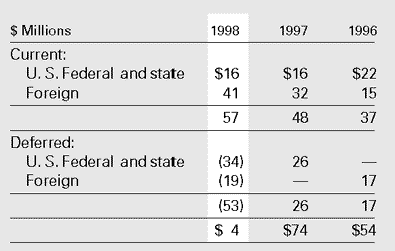
Note 9. Income Taxes:
The provision for
income taxes was as follows:
Top
of page
The Company expects to
realize all of its tax assets, including the use of all
carryforwards, before any expiration.
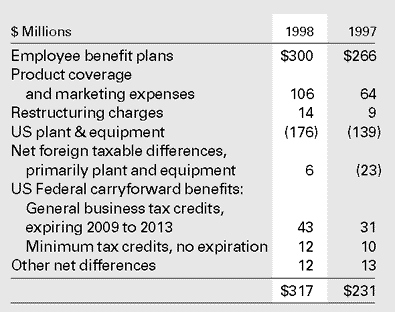
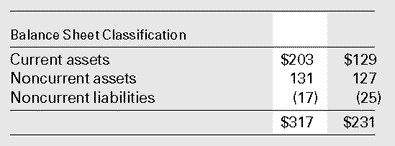
Significant components of
net deferred tax assets related to the following tax effects
of differences between financial and tax reporting at
December 31:
Top
of page
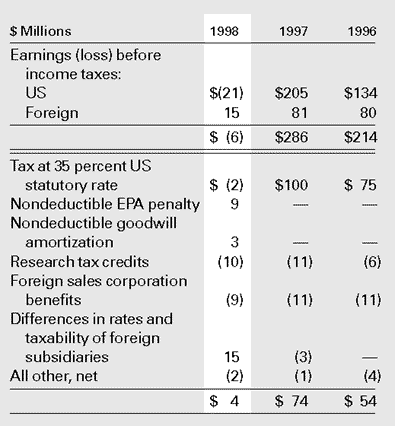
Earnings before income taxes
and differences between the effective tax rate and US
Federal income tax rate were:
Top
of page
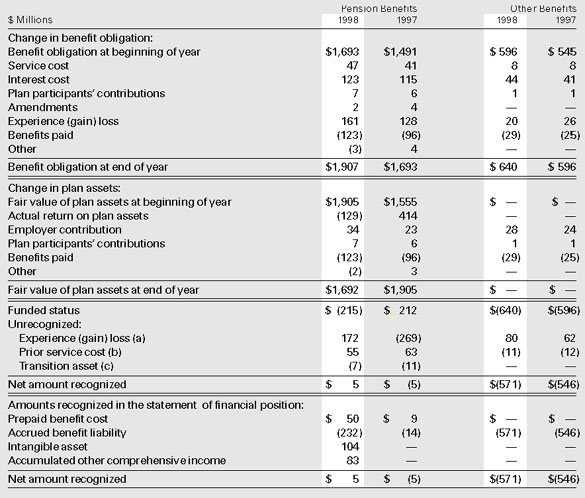
Note 10. Retirement Plans:
The Company has
various contributory and noncontributory pension plans
covering substantially all employees. Cummins common stock
represented 9 percent of pension plan assets at December 31,
1998.
Cummins also provides
various health care and life insurance benefits to eligible
retirees and their dependents but reserves the right to
change benefits covered under these plans. The plans are
contributory with retirees' contributions adjusted annually,
and they contain other cost-sharing features, such as
deductibles, coinsurance and spousal contributions. The
general policy is to fund benefits as claims and premiums
are incurred.
The projected benefit
obligation, accumulated benefit obligation and fair value of
plan assets for plans with accumulated benefit obligations
in excess of plan assets were $1,296 million, $1,251
million, and $999 million, respectively as of December 31,
1998, and $418 million, $381 million, and $339 million,
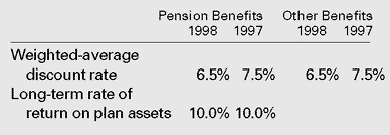
respectively, as of December 31, 1997. The assumed long-term
rate of compensation increase for salaried plans was 4.25%
in 1998 and 5.0% in 1997. Other significant assumptions for
the Company's principal plans were:
For measurement purposes a
7% annual increase in health care costs was assumed for
1999, decreasing gradually to 4.25% in ten years and
remaining constant thereafter.
Increasing the health care
cost trend rate by one percent would increase the obligation
by $42 million and annual expense by $3 million. Decreasing
the health care cost trend rate by one percent would
decrease the obligation by $38 million and annual expense by
$3 million.
Top
of page
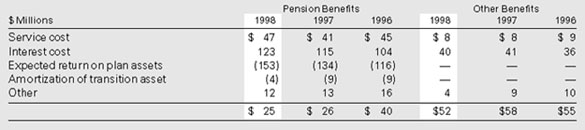
The Company's net periodic
benefit cost under these plans was as follows:
|
(a)
|
The net deferred
gain (loss) resulting from investments, other
experience and changes in assumptions.
|
|
(b)
|
The prior service
effect of plan amendments deferred for recognition
over remaining service.
|
|
(c)
|
The balance of the
initial difference between assets and obligations
deferred for recognition over a 15-year
period.
|
Top
of page
Note 11. Common
Stock: The Company
increased its quarterly common stock dividend from 25 cents
per share to 27.5 cents, effective with the dividend payment
in June 1997.
In 1998, the Company
repurchased 0.4 million shares on the open market at an
aggregate purchase price of $14 million. In 1997, the
Company repurchased 1.3 million shares from Ford Motor
Company and another 0.2 million shares on the open market at
an aggregate purchase price of $75 million. The Company
repurchased 0.8 million shares on the open market at an
aggregate purchase price of $34 million in 1996. All of the
acquired shares are held as common stock in
treasury.
In 1997, the Company issued
3.75 million shares of its common stock to an employee
benefits trust to fund obligations of employee benefit and
compensation plans, principally retirement savings plans.
Shares of the stock held by this trust are not used in the
calculation of earnings per share until allocated to a
benefit plan.
Note 12. Shareholders' Rights
Plan: The Company
has a Shareholders' Rights Plan which it first adopted in
1986. The Rights Plan provides that each share of the
Company's common stock has associated with it a stock
purchase right. The Rights Plan becomes operative when a
person or entity acquires 15 percent of the Company's common
stock or commences a tender offer to purchase 20 percent or
more of the Company's common stock without the approval of
the Board of Directors.
Note 13. Employee Stock
Plans: Under the
Company's stock incentive and option plans, officers and
other eligible employees may be awarded stock options, stock
appreciation rights and restricted stock. Under the
provisions of the stock incentive plan, up to one percent of
the Company's outstanding shares of common stock at the end
of the preceding year is available for issuance under the
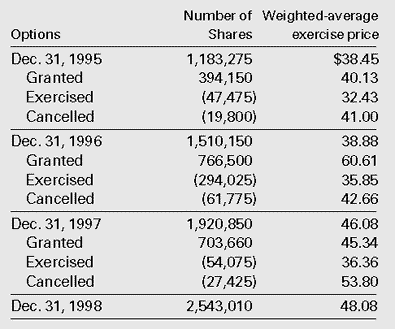
plan each year. At December 31, 1998, there were no shares
of common stock available for grant and 1,234,875 options
exercisable under the plans.
The Company accounts for
stock options in accordance with APB Opinion No. 25 and
related interpretations. No compensation expense has been
recognized for stock options since the options have exercise
prices equal to the market price of the Company's common
stock at the date of grant.
Options outstanding at
December 31, 1998, have exercise prices between $15.94 and
$79.81 and a weighted-average remaining life of 8 years. The
weighted-average fair value of options granted was $18.61
per share in 1998 and $14.94 per share in 1997. The fair
value of each option was estimated on the date of grant
using a risk-free interest rate of 5.6 percent in 1998 and
6.4 percent in 1997, current annual dividends, expected
lives of 10 years and expected volatility of 34 percent. A
fair-value method of accounting for awards subsequent to
January 1, 1996, would have had no material effect on
results of operations.
Top
of page
Note 14.
Comprehensive Income: Effective
January 1, 1998, the Company adopted SFAS No. 130, a new
accounting rule which requires companies to report
comprehensive income. Comprehensive income includes net
income and all other nonowner changes in equity during a
period.
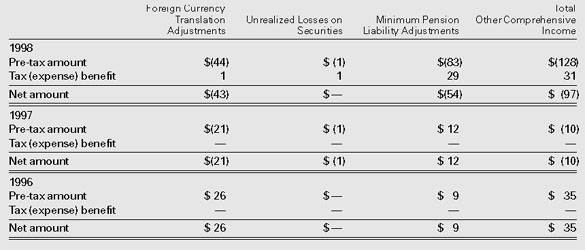
The tax
effect on other comprehensive income is as
follows:
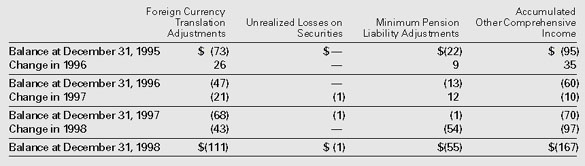
The components of
accumulated other comprehensive income are as
follows:
Top
of page
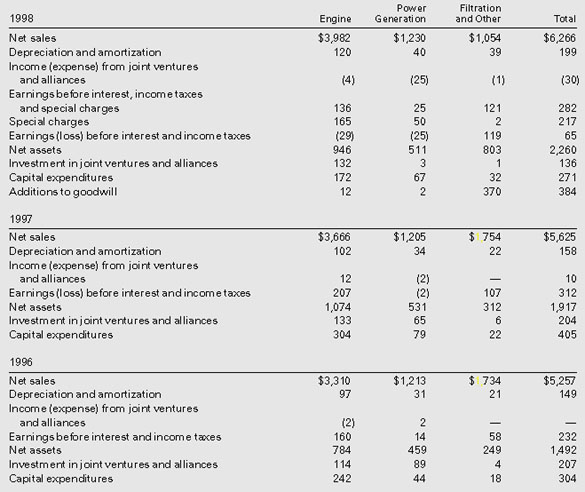
Note 15. Segments of the Business:
Effective for 1998
annual reporting, the Company adopted SFAS No. 131 on
segment reporting. Under the provisions of the new standard,
Cummins has three reportable segments: Engine, Power
Generation, and Filtration and Other. The engine segment
produces engines and parts for sale to customers in
automotive and industrial markets. The engines are used in
trucks of all sizes, buses and recreational vehicles, as
well as various industrial applications including
construction, mining, agriculture, marine, rail and
military. The power generation segment is the Company's
power systems supplier, selling engines, generator sets and
alternators. The filtration and other segment includes sales
of filtration products and exhaust systems, turbochargers
and company-owned distributors.
The Company's reportable
segments are organized according to products and the markets
they each serve. This business structure was designed to
focus efforts on providing enhanced service to a wide range
of customers.
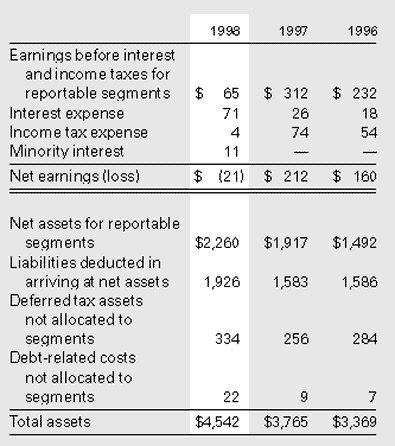
The accounting policies of
the segments are the same as those described in the summary
of significant accounting policies except that the Company
evaluates performance based on earnings before interest and
income taxes and on net assets, and, therefore, no
allocation of debt-related items and income taxes is made to
the individual segments.
Operating segment
information is as follows:
Top
of page
Reconciliation to
Consolidated Financial Statements:
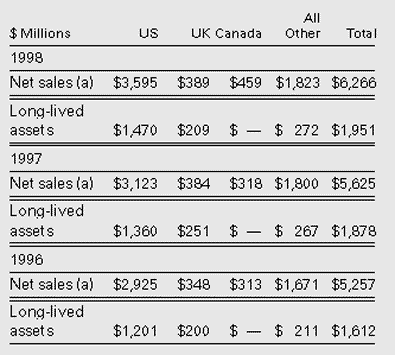
Summary geographic
information is listed below:
(a) Net sales are attributed
to countries based on location of customer.
Revenues from the Company's
largest customer represent approximately $1.1 billion of the
Company's net sales in 1998. These sales are included in the
engine and filtration and other segments.
Top
of page
Note 16. Guarantees, Commitments
and Other Contingencies:
At December 31, 1998, the Company had the following minimum
rental commitments for noncancelable operating leases: $41
million in 1999, $38 million in 2000, $30 million in 2001,
$25 million in 2002, $21 million in 2003 and $46 million
thereafter. Rental expense under these leases approximated
$70 million in 1998, $60 million in 1997 and $55 million in
1996.
Commitments under
outstanding letters of credit, guarantees and contingencies
at December 31, 1998, approximated $195 million.
Cummins and its subsidiaries
are defendants in a number of pending legal actions,
including actions related to use and performance of the
Company's products. The Company carries product liability
insurance covering significant claims for damages involving
personal injury and property damage. In the event the
Company is determined to be liable for damages in connection
with actions and proceedings, the unreserved and uninsured
portion of such liability is not expected to be material.
The Company also has been identified as a potentially
responsible party at several waste disposal sites under US
and related state environmental statutes and regulations.
The Company denies liability with respect to many of these
legal actions and environmental proceedings and vigorously
is defending such actions or proceedings. The Company has
established reserves that it believes are adequate for its
expected future liability in such actions and proceedings
where the nature and extent of such liability can be
estimated reasonably based upon presently available
information.
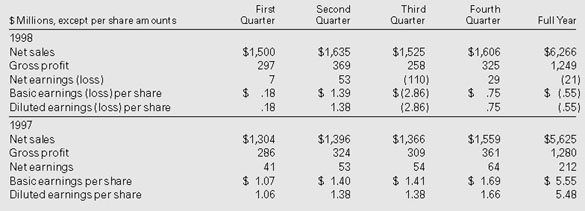
Note 17. Quarterly Financial Data
(unaudited):
Earnings per share for the
first three quarters of 1997 have been restated to reflect
the adoption of SFAS No. 128 as disclosed in Note
1.
Top
of page
Responsibility
for Financial Statements
Management is responsible
for the preparation of the Company's consolidated financial
statements and all related information appearing in this
Report. The statements and notes have been prepared in
conformity with generally accepted accounting principles and
include some amounts which are estimates based upon
currently available information and management's judgment of
current conditions and circumstances. The Company engaged
Arthur Andersen llp, independent public accountants, to
examine the consolidated financial statements. Their report
appears on this page.
To provide reasonable
assurance that assets are safeguarded against loss from
unauthorized use or disposition and that accounting records
are reliable for preparing financial statements, management
maintains a system of accounting and controls, including an
internal audit program. The system of accounting and
controls is improved and modified in response to changes in
business conditions and operations and recommendations made
by the independent public accountants and the internal
auditors.
The Board of Directors has
an Audit Committee whose members are not employees of the
Company. The committee meets periodically with management,
internal auditors and representatives of the Company's
independent public accountants to review the Company's
program of internal controls, audit plans and results, and
the recommendations of the internal and external auditors
and management's responses to those
recommendations.
Top
of page
Report
of Independent Public Accountants
To the Shareholders and
Board of Directors of Cummins Engine Company,
Inc.:
We have audited the
accompanying consolidated statement of financial position of
Cummins Engine Company, Inc., (an Indiana corporation) and
subsidiaries as of December 31, 1998 and 1997, and the
related consolidated statements of earnings, cash flows and
shareholders' investment for each of the three years in the
period ended December 31, 1998. These financial statements
are the responsibility of the Company's management. Our
responsibility is to express an opinion on these financial
statements based on our audits.
We conducted our audits in
accordance with generally accepted auditing standards. Those
standards require that we plan and perform the audit to
obtain reasonable assurance about whether the financial
statements are free of material misstatement. An audit
includes examining, on a test basis, evidence supporting the
amounts and disclosures in the financial statements. An
audit also includes assessing the accounting principles used
and significant estimates made by management, as well as
evaluating the overall financial statement presentation. We
believe that our audits provide a reasonable basis for our
opinion.
In our opinion, the
financial statements referred to above present fairly, in
all material respects, the financial position of Cummins
Engine Company, Inc., and subsidiaries as of December 31,
1998 and 1997, and the results of their operations and their
cash flows for each of the three years in the period ended
December 31, 1998, in conformity with generally accepted
accounting principles.

Chicago, Illinois
January 26, 1999
Top
of page
Cummins
Engine Company, Inc.
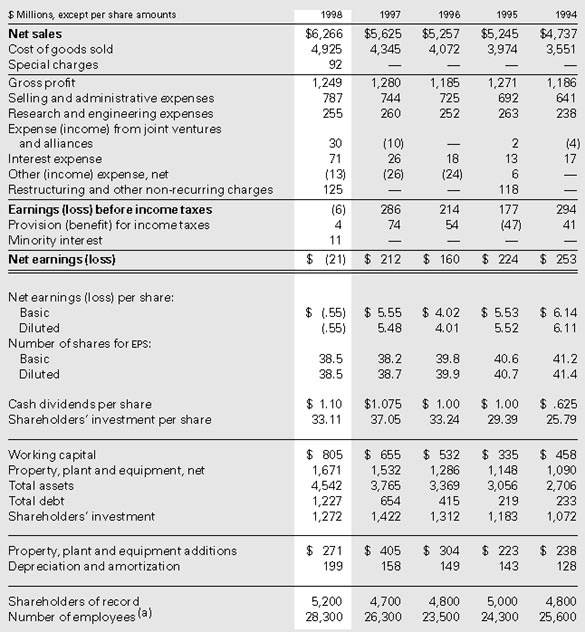
Five-Year Supplemental Data
(a) Represents the number of
employees at year-end. At December 31, 1998, number of
employees included 2,600 employees of Nelson Industries,
Inc., which was acquired in January 1998. At December 31,
1997, number of employees included 2,800 employees of
Cummins India Limited, which was consolidated in the fourth
quarter of 1997.
Earnings per share for 1994
through 1996 have been restated to reflect the adoption of
SFAS No. 128 as disclosed in Note 1 to the Consolidated
Financial Statements.
Top
of page
|