 |
In addition to revenue growth in the Full-line Stores, Specialty Store revenues increased slightly to $7.29 billion in 1998 from $7.25 billion in 1997. The strong revenue performance in Hardware and Dealer Stores was offset by a decline in Auto Stores revenues. The revenue increase in Hardware and Dealer Stores in 1998 resulted from the addition of new stores and strong comparable store sales increases. During 1998, the Company opened 10 net new Hardware Stores and 77 net new Dealer Stores. The Commercial Sales business also produced strong revenue gains as the Company continued to expand this business. In 1998, HomeLife revenues decreased slightly and the HomeLife business ended 1998 with one less store than in 1997. The Auto Stores 1998 revenues declined from 1997 levels as comparable store sales decreased. Both Sears Auto Centers and NTB sales were adversely affected by the relatively mild winter weather experienced in 1998. Results were also affected by the sale of the Parts Group on November 2, 1998, which caused 1998 revenues to reflect only 10 months of Parts Group sales versus 12 months in the prior year. Throughout 1998, the Company worked to build name recognition for the new NTB format. As of year end, the Company operated 789 Sears Auto Centers and 347 NTB stores. Retail revenues increased 8.0% in 1997 to $30.09 billion from $27.86 billion in 1996. Revenues in 1997 included 53 weeks compared to 52 weeks in 1996. Full-line Stores revenues increased 5.8% in 1997 as the Company opened 21 and closed 9 Full-line Stores. The addition of the 53rd week in 1997 also contributed to the revenue growth. In 1997, apparel sales gains were led by increases in women's ready-to-wear, children's and men's fashions and footwear. Hardlines merchandise had a solid revenue increase in 1997 led by strong sales growth in home appliances and electronics merchandise, partially offset by a decline in home improvement merchandise sales. Specialty Store revenues increased to $7.25 billion in 1997 from $6.28 billion in 1996. The increase primarily resulted from a full year of sales from the Orchard Supply Hardware Stores in 1997, compared to 1996, which included only fourth quarter sales; and the 53rd week in 1997. Dealer Stores revenues increased as the Company added 107 net new stores in 1997. The HomeLife business closed 23 locations in 1997 to focus better on high concentration markets and cost management.
In addition to revenue performance, gross margin, selling and administrative expenses and depreciation and amortization are important elements in determining Retail operating income. The following discussion of Retail gross margin, selling and administrative expense and depreciation and amortization excludes the effect of noncomparable items to provide a more meaningful comparison between years. The noncomparable items that affected the Retail segment operating income were the impairment losses related to the sales of Western Auto and HomeLife in 1998, and the Parts America conversion and the postretirement life insurance curtailment in 1997. Retail gross margin as a percentage of Retail revenues declined 90 basis points in 1998 from 1997. In 1997, Retail gross margin as a percentage of Retail revenues declined 40 basis points from 1996. Both years declined due to higher promotional activity driven by a competitive retail environment. Retail selling and administrative expense as a percentage of Retail revenues improved 40 basis points in 1998 from 1997. In 1997, Retail selling and administrative expense as a percentage of Retail revenues improved 70 basis points from 1996. Both years improved primarily due to leveraging payroll and other employee-related costs. Retail depreciation and amortization expense increased 6.4% in 1998 from 1997 and 15.2% in 1997 compared to 1996. These increases reflect the continuation of the Company's store remodeling program and the growth in the number of Specialty Stores in operation.
Services Services revenues, generated primarily by the Home Services business, increased 1.3% in 1998. Home Services revenues were flat due to a slight decline in the home improvement business and the 53rd week included in the prior year. The Company plans future growth in the Home Services business through market expansion, improved marketing effectiveness and strengthening of the Company's licensees. Sears Direct revenues increased 8.5% in 1998 from 1997 levels due to continued strength of its marketing programs in targeting customers at home for its various merchandise and services. All categories of Sears Direct products showed improved revenue results, including clubs and services, insurance and specialty catalogs. In 1997, Services revenues improved 9.0% primarily due to increased Home Services revenues, led by increases in in-home repair services and growth in home improvement services. Revenues in 1997 also included the effect of the 53rd week. Sears Direct revenues increased substantially in 1997 from 1996 levels due to continued strength of its insurance programs. Services gross margin as a percentage of Services revenues increased 100 basis points in 1998 from 1997. The margin rate increased due to the continued effort to improve the profitability of the service contracts portfolio within the Home Services business. In 1997, Services gross margin as a percentage of revenues improved 370 basis points from 1996, primarily due to improved profitability of the service contracts portfolio. Services selling and administrative expense as a percentage of Services revenues increased 50 basis points in 1998 from 1997. The increase was due to increased infrastructure investments in the businesses to support planned growth. In 1997, Services selling and administrative expense as a percentage of Services revenues increased 240 basis points from 1996 due to increased marketing costs. Services depreciation and amortization expense increased 14.1% in 1998 from 1997 and 11.8% in 1997 compared to 1996. These increases reflect both the internal growth of the business and growth through acquisition. Overall, Services operating income as a percentage of Services revenue was relatively flat in 1998 compared to 1997. A slight increase in the Home Services operating margin was offset by a decline in the Sears Direct operating margin. Even with a decline in operating margin in 1998, the Sears Direct business continued to provide a significant portion of the operating income for the Services segment.
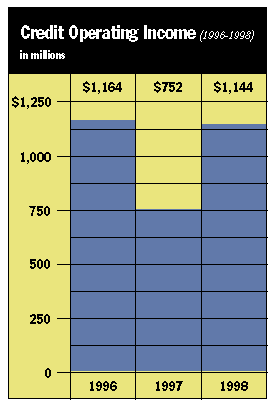
Credit 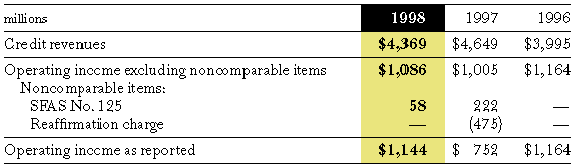 The primary reason for the $392 million increase in 1998 reported operating income in the Credit segment compared to 1997 is the $475 million reaffirmation charge which adversely affected 1997 results. Other factors affecting reported Credit operating results are discussed below. In 1998, Credit revenues decreased 6.0% to $4.37 billion. The decrease in Credit revenues was attributable to a lower level of owned credit card receivables and the 53rd week included in the prior year. In 1997, Credit revenues increased 16.4% to $4.65 billion, reflecting higher average owned receivable balances, increased late fees and the benefit of the 53rd week of revenues. Excluding the effect from the change in accounting related to SFAS No. 125 in 1997, Credit revenues would have increased 24.4% over 1996 levels. A summary of Credit information for the managed portfolio is as follows: 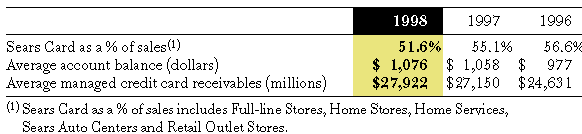 The percentage of merchandise sales and services transacted with the Sears Card in 1998 declined to 51.6% compared to 55.1% in 1997, due to a greater preference for other payment methods, including cash, check and third-party credit cards.
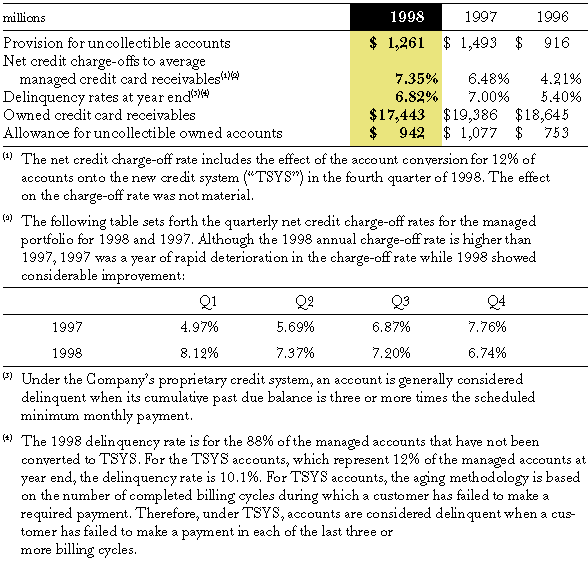 In 1998, the provision for uncollectible accounts decreased 15.5% from 1997. The decrease is primarily attributable to favorable trends in delinquency rates, charge-off experience and bankruptcy filings, as well as lower owned credit card receivable balances and one less week of provision expense in 1998 compared to 1997 due to the effect of the 53rd week. As of January 2, 1999, the allowance balance was $942 million compared to $1.08 billion at January 3, 1998. The $135 million decrease in the allowance for uncollectible accounts relates to the improvement in portfolio quality and the reduction in owned credit card receivable balances. The owned credit card receivables decreased $1.94 billion during 1998 primarily due to the transfer of credit card receivables from Sears to a securitization Master Trust to provide receivable balances for future securitizations. Receivables transferred to the securitization Master Trust in 1998 are classified as retained interest in transferred credit card receivables in the balance sheet, and a $106 million allowance for uncollectible accounts relating to the transferred receivables is included as a reduction of retained interest in transferred credit card receivables at the end of 1998. The provision for uncollectible accounts in 1997 was 63.0% above 1996, reflecting increased delinquencies, charge-offs and bankruptcies, growth in the owned credit card receivables portfolio, and a reduced rate of credit reaffirmations. If 1997 were adjusted to a comparable basis with 1996 by excluding the effect on the provision for SFAS No. 125 accounting, the provision would have been $1.91 billion, a 108.6% increase over 1996. |
 Auto Stores revenues declined slightly in 1997 from 1996 as comparable store sales decreased
from prior year levels. Results were adversely affected by the store conversions in both the
Sears Tire Group and Parts Group.As of year-end 1997, the Company had substantially completed both conversion plans and
operated 780 Sears Auto Centers, 326 NTB stores and 576 Parts America stores.
Auto Stores revenues declined slightly in 1997 from 1996 as comparable store sales decreased
from prior year levels. Results were adversely affected by the store conversions in both the
Sears Tire Group and Parts Group.As of year-end 1997, the Company had substantially completed both conversion plans and
operated 780 Sears Auto Centers, 326 NTB stores and 576 Parts America stores.

 Credit selling and administrative expense increased 7.7% in 1998 from the 1997 amount. This
increase was primarily attributable to increased investment in collection and risk management
activities and litigation costs. In 1997, selling and administrative expense decreased 7.4%
from the 1996 level primarily due to the implementation of SFAS No. 125 accounting. Excluding
the effect from the change in accounting method, selling and administrative expense increased
10.4% while adjusted Credit revenues increased 24.4%, and therefore, the ratio of selling and
administrative expense to Credit revenue improved 200 basis points in 1997 compared to 1996.
Credit selling and administrative expense increased 7.7% in 1998 from the 1997 amount. This
increase was primarily attributable to increased investment in collection and risk management
activities and litigation costs. In 1997, selling and administrative expense decreased 7.4%
from the 1996 level primarily due to the implementation of SFAS No. 125 accounting. Excluding
the effect from the change in accounting method, selling and administrative expense increased
10.4% while adjusted Credit revenues increased 24.4%, and therefore, the ratio of selling and
administrative expense to Credit revenue improved 200 basis points in 1997 compared to 1996.
Annual Report Contents | Previous | Next |
|