 |
|
Interest expense from the domestic segments is included in the Credit segment discussion since the majority of the Company's domestic interest expense is allocated to the Credit segment. Generally, the domestic interest expense that is not allocated to the Credit segment is allocated to the Retail segment and is not a significant cost relative to costs of sales, buying and occupancy, selling and administrative expense and depreciation and amortization expense in the Retail segment. Domestic interest expense is combined with the funding cost on receivables sold through securitizations to represent total funding costs. The Company uses credit card receivable securitizations as a significant funding source and therefore, for purposes of this analysis, the interest paid on securitizations is considered a funding cost. The total domestic funding costs are as follows: 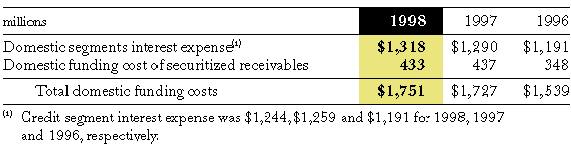 Total domestic funding costs increased 1.4% in 1998 to $1.75 billion. The increase in funding costs reflects additional debt needed to support a larger managed credit card receivable portfolio, higher inventory levels, capital spending and share repurchases, partially offset by a lower funding rate environment. While the managed credit card receivables and inventory levels were higher on average throughout 1998 than in 1997, the managed credit card receivable balances and inventory balances at the end of 1998 were actually lower than at the end of 1997, as noted in management's analysis of consolidated financial condition. In 1997, the increase in funding costs reflects higher funding requirements due to a larger managed credit card receivable portfolio and the redemption of the Preferred Shares in the fourth quarter of 1996, partially offset by lower effective funding rates resulting from the refinancing of higher rate debt.
Corporate
International 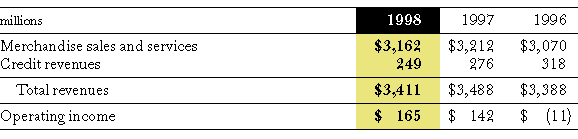 International operations include the results of Sears Canada for all periods presented and the results of Sears Mexico through the first quarter of 1997, when the Company sold its majority interest.
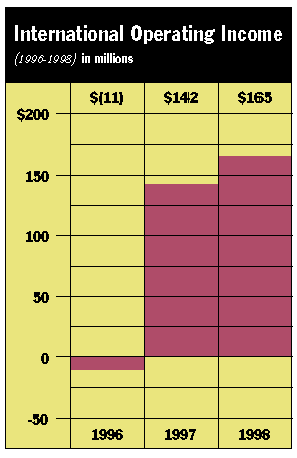
International gross margin as a percentage of International merchandise sales and services decreased 30 basis points in 1998 from 1997. Sears Canada gross margin rate declined primarily due to increased buying costs. In 1997, International gross margin as a percentage of International merchandise sales and services increased 200 basis points from 1996. Sears Canada gross margin rate improved substantially due to savings realized from merchandise sourcing initiatives. International selling and administrative expense as a percentage of total International revenues improved 100 basis points in 1998 from 1997. Sears Canada selling and administrative expense rate improvement was primarily due to leveraging payroll and other employee related costs. In 1997, International selling and administrative expense as a percentage of total International revenues improved 110 basis points from 1996. Sears Canada selling and administrative rate improvement was primarily due to cost containment initiatives coupled with revenue growth and a favorable comparison to 1996, which included a restructuring charge. International operating income improved $23 million in 1998 compared to 1997. The improvement is due to revenue growth resulting from the aggressive growth strategy in the furniture and dealer store networks and renovations of full-line stores; as well as strong expense leverage and less interest expense, partially offset by a lower exchange rate. Operating income improved $153 million in 1997 compared to 1996 as Sears Canada benefited from the improving economic environment in 1997, as well as the favorable response to the remodeling of its full-line stores and expansion of its furniture and dealer networks. OTHER INCOME 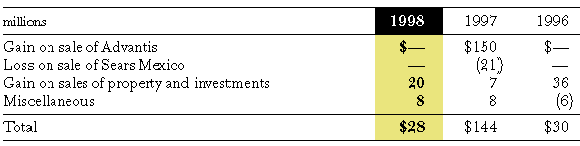
INCOME TAX EXPENSE
SUPPLEMENTAL DOMESTIC OPERATIONS INFORMATION
|
 International revenues were $3.41 billion in 1998, a 2.2% decrease from revenues of $3.49
billion in 1997. The decrease resulted from the inclusion of $100 million of revenues related
to Sears Mexico in the prior year. Excluding the effect of Sears Mexico, Sears Canada had
strong retail and catalog sales performance in 1998 which was partially offset by the
negative effects of a weaker Canadian dollar. In 1997, revenues increased 3.0% from 1996 due
to Sears Canada revenues increasing 13.5% on strong retail store and catalog performance,
partially offset by the loss of revenues due to the sale of Sears Mexico.
International revenues were $3.41 billion in 1998, a 2.2% decrease from revenues of $3.49
billion in 1997. The decrease resulted from the inclusion of $100 million of revenues related
to Sears Mexico in the prior year. Excluding the effect of Sears Mexico, Sears Canada had
strong retail and catalog sales performance in 1998 which was partially offset by the
negative effects of a weaker Canadian dollar. In 1997, revenues increased 3.0% from 1996 due
to Sears Canada revenues increasing 13.5% on strong retail store and catalog performance,
partially offset by the loss of revenues due to the sale of Sears Mexico.
Annual Report Contents | Previous | Next |
|
|
|