 |
  |

The Company and its subsidiaries lease retail stores,
warehouse facilities and office facilities under noncancelable operating leases over periods
ranging from 5 to 20 years, and generally have options to renew such terms over periods
ranging from 5 to 15 years.
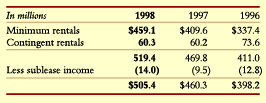
Following is a summary of the Company’s net rental expense for operating leases for the
years ended December 31:
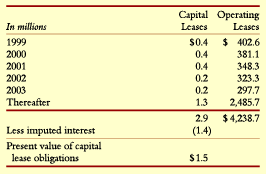
Following is a summary of the future minimum lease
payments under capital and operating leases, excluding
lease obligations for closed stores, at December 31, 1998:
As of December 31, 1998, the Company had the following stock incentive plans (including the
pre-merger plans of Arbor and Revco). Effective with the Mergers, outstanding Arbor and Revco
stock options were exchanged for options to purchase CVS common stock.
1997 Incentive Compensation Plan
As of December 31, 1998, the 1997 ICP provided for the granting of up to 23,321,821 shares of
common stock in the form of stock options, stock appreciation rights ("SARs"),
restricted shares, deferred shares and performance-based awards to selected officers,
employees and directors of the Company. All grants under the 1997 ICP are awarded at fair
market value on the date of grant. The right to exercise or receive these awards generally
commences between one and five years from the date of the grant and expires not more than
ten years after the date of the grant, provided that the holder continues to be employed by
the Company. As of December 31, 1998, there were 19,730,690 shares available for grant under
the 1997 ICP.
Restricted shares issued under the 1997 ICP may not exceed 3.6 million shares. In 1998, 1997
and 1996, 155,400, 44,610 and 633,100 shares of restricted stock were granted at a weighted
average grant date fair value of $37.80, $23.02 and $13.14, respectively. Participants are
entitled to vote and receive dividends on their restricted shares, although they are subject
to certain transfer restrictions. Performance-based awards, which are subject to the achievement
of certain business performance goals, totaled 56,346 at a weighted average grant date fair value of
$36.70 in 1998. No awards were granted in 1997 and 1996. Compensation cost, which is based
on the fair value at the date of grant, is recognized over the restricted or performance
period. This cost totaled $3.1 million in 1998, $3.5 million in 1997 and $3.9 million in 1996.
The 1996 Directors Stock Plan
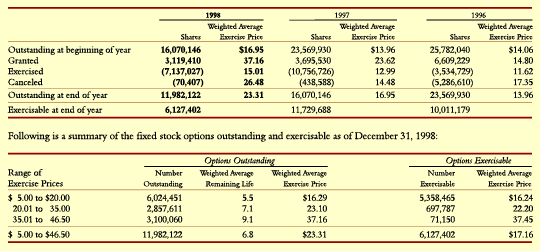
Following is a summary of the fixed stock option activity under the 1997 ICP, the Preexisting
Plans and the pre-merger plans of Arbor and Revco for the years ended December 31:
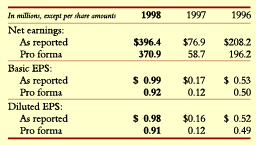
The Company applies APB Opinion No. 25 to account
for its stock incentive plans. Accordingly, no compensation cost has been recognized for
stock options granted. Had compensation cost been recognized based on the fair value of
stock options granted consistent with SFAS No. 123, net earnings and net earnings per
common share ("EPS") would approximate the pro forma amounts shown below for the years
ended December 31.
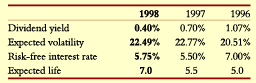
Beginning with grants made on or after January 1, 1995,
the fair value of each stock option grant was estimated
using the Black-Scholes Option Pricing Model with the
following assumptions:
The Company sponsors various retirement programs, including defined benefit, defined
contribution and other plans that cover most full-time employees.
Defined Benefit Plans
Pursuant to various labor agreements, the Company is required to make contributions to certain
union-administered pension plans that totaled $1.5 million in 1998, $1.6 million in 1997 and
$1.2 million in 1996. The Company may be liable for its share of the plans’ unfunded
liabilities if the plans are terminated. The Company also has non-qualified supplemental
executive retirement plans ("SERPs") in place for certain key employees for whom it has
purchased cost recovery variable life insurance.
Defined Contribution Plans
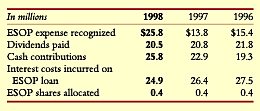
The Company also sponsors an Employee Stock Ownership Plan. See Note 9 for further information
about this plan.
Other Postretirement Benefits
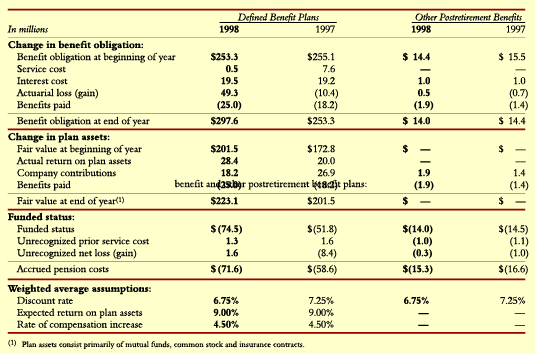
Following is a reconciliation of the benefit obligation fair value of plan assets and funded status
of the company's defined benefit and other postretirement benefit plans:
(1) Plan assets consist primarily of mutual funds, common stock and insurance contracts.
For measurement purposes, future healthcare costs are assumed to increase at an annual rate
of 6.5% during 1999, decreasing to an annual growth rate of 5.0% in 2002 and thereafter. A one
percent change in the assumed healthcare cost trend rate would
change the accumulated postretirement benefit obligation by $1.0 million and total service and
interest costs by $0.1 million.
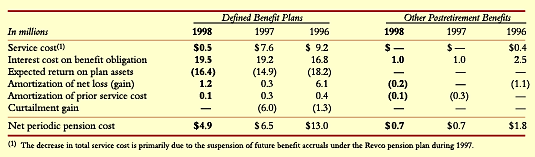
Following is a summary of the net periodic pension cost for the defined benefit and other
postretirement benefit plans:
(1) The decrease in total service cost is primarily due to the suspension of future benefit
accruals under the Revco pension plan during 1997.


The 1997 Incentive Compensation Plan (the "1997 ICP"), superseded the 1990 Omnibus Stock
Incentive Plan, the 1987 Stock Option Plan and the 1973 Stock Option Plan (collectively, the
"Preexisting Plans"). Upon approval of the 1997 ICP, authority to make future grants under the
Preexisting Plans was terminated, although previously
granted awards remain outstanding in accordance with their terms and the terms of the Preexisting
Plans.
The 1996 Directors Stock Plan (the "1996 DSP"), provides for the granting of up to 346,460
shares of common stock to the Company’s non-employee directors (the "Eligible Directors").
The 1996 DSP allows the Eligible Directors to elect to receive shares of common stock in lieu
of cash compensation. Eligible Directors may also elect to defer compensation payable in
common stock until their service as a director concludes. The 1996 DSP replaced the Company’s
1989 Directors Stock Option Plan. As of December 31, 1998, there were 263,554 shares available
for grant under the 1996 DSP.

The Company sponsors a non-contributory defined benefit pension plan that covers certain
full-time employees of Revco who are not covered by collective bargaining agreements. On
September 20, 1997, the Company suspended future benefit accruals under this plan. As a
result of the plan’s suspension, the Company realized a $6.0 million curtailment gain in 1997.
Benefits paid to retirees are based upon age at retirement, years of credited service and
average compensation during the
five-year period ending September 20, 1997. It is the Company’s policy to fund this plan
based on actuarial calculations and applicable federal regulations.
The Company sponsors a Profit Sharing Plan and a 401(k) Savings Plan that cover substantially
all employees who meet plan eligibility requirements. The Company also maintains a non-qualified,
unfunded Deferred Compensation Plan for certain key employees. The Company’s contributions under
the above defined contribution plans totaled $26.4 million in 1998, $24.1 million in 1997 and
$19.5 million in 1996.
The Company provides postretirement healthcare and life insurance benefits to retirees who meet
eligibility requirements. The Company’s funding policy is generally
to pay covered expenses as they are incurred.



|
copyright
©1998 CVS/pharmacy, Inc.
|