 |
 |

Deferred income taxes reflect the net tax effects of the
temporary differences between the carrying amounts of assets and liabilities for
financial reporting purposes and the amounts used for income tax purposes.
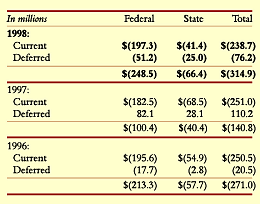
The Company’s income tax (provision) benefit for continuing operations for the years ended
December 31 consisted of the following:
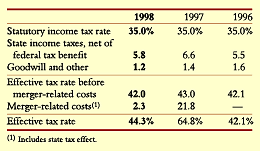
Following is a reconciliation of the statutory income tax rate to the Company’s effective
tax rate for the years ended December 31:
Income taxes paid (refunded) were $102.6 million, $258.9 million and $(33.8) million during the
years ended December 31, 1998, 1997 and 1996, respectively.
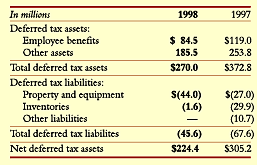
Following is a summary of the significant components of
the Company’s deferred tax assets and liabilities as of December 31:
Based on historical pre-tax earnings, the Company believes it is more likely than not that
the deferred tax assets will be realized.
As of December 31, 1998, the Company had federal net operating loss carryforwards ("NOLs")
of $3.7 million that are attributable to Revco for periods prior to its emergence from
Chapter 11. The benefits realized from these NOLs should reduce reorganization goodwill.
Accordingly, the tax benefit of such NOLs utilized during the three years ended December 31,
1998, $7.2 million, $69.4 million and $15.3 million for 1998, 1997 and 1996, respectively,
has not been included in the computation of the Company’s income tax provision, but instead
has been reflected as reductions of reorganization goodwill.
On October 12, 1996, the Company completed the Footstar Distribution which is believed to be
tax-free to the Company and its shareholders based on a legal opinion provided by outside
counsel. However, since opinions of counsel are not binding on the Internal Revenue Service
or the courts, it could ultimately be determined that the Footstar Distribution does not
qualify as a tax-free distribution. If such occurred, the Company would be required to
recognize a capital gain for tax purposes equal to the difference between the fair market
value of the shares of Footstar stock distributed and the Company’s basis in such shares. The
Company, however, believes the likelihood of the Footstar Distribution not
qualifying as a tax-free distribution to be remote.
The Company currently operates a Retail segment and a Pharmacy Benefit Management ("PBM")
segment. The Company’s business segments are operating units that
offer different products and services, and require distinct technology and marketing strategies.
The Retail segment, which is described in Note 1, is the Company’s only reportable segment.
The PBM segment provides a full range of prescription
benefit management services to managed care and other organizations. These services include
plan design and administration, formulary management, mail order pharmacy services, claims
processing and generic substitution.
The accounting policies of the segments are substantially the same as those described in Note 1.
The Company evaluates segment performance based on operating profit, before the effect of
nonrecurring charges and gains and intersegment profits.
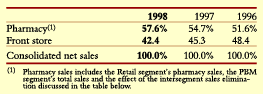
Following is a reconciliation of the significant components of each segment’s sales to
consolidated net sales for the years ended December 31:
(1) Pharmacy sales includes the Retail segment’s pharmacy sales, the PBM segment’s total
sales and the effect of the intersegment sales elimination discussed in the table below.
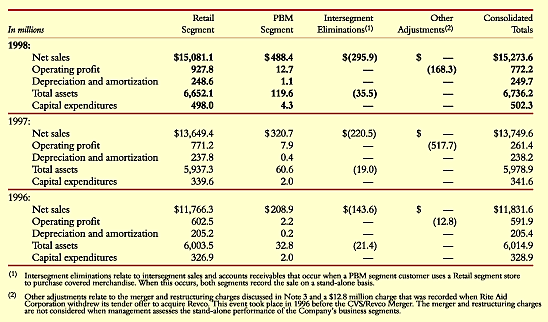
Following is a reconciliation of the Company’s business segments to the consolidated financial
statements:
(1) Intersegment eliminations relate to intersegment sales and accounts receivables that occur
when a PBM segment customer uses a Retail segment store to purchase covered merchandise.
When this occurs, both segments record the sale on a stand-alone basis.
(2) Other adjustments relate to the merger and restructuring charges discussed in Note 3
and a $12.8 million charge that was recorded when Rite Aid Corporation withdrew its tender
offer to acquire Revco. This event took place in 1996 before the CVS/Revco Merger. The merger
and restructuring charges are not considered when management assesses the stand-alone
performance of the Company’s business segments.

(1) Includes state tax effect.

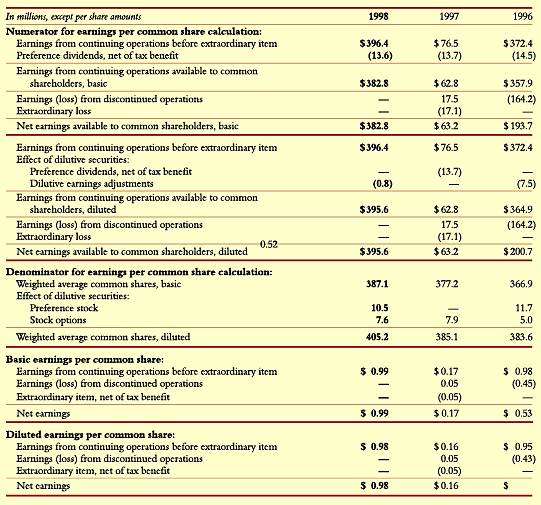
 Following is a reconciliation of basic and diluted earnings per common share for the years
ended December 31:
Following is a reconciliation of basic and diluted earnings per common share for the years
ended December 31:



|
copyright
©1998 CVS/pharmacy, Inc.
|