




Dealing with the immediate challenges posed by the current business environment is only one task facing automotive suppliers. In addition to managing costs, successful companies must maintain and strengthen their capabilities in preparation for a future recovery.
Tenneco continued to lay the groundwork in 2008 for long-term growth. That preparation included targeted investments in the technologies and capabilities needed to help customers meet stricter emissions regulations as well as demands for improved ride comfort and safety. Tenneco also strengthened its global footprint, expanded business with growing customers — especially in some of the fastest growing automotive markets — and continued its strategic expansion into adjacent markets.
Adjacent Markets
Tenneco bolstered its expansion into the commercial vehicle on and off-road market last summer when it announced that it had become a global diesel emission control system integration supplier to Caterpillar Inc., the world's leading manufacturer of construction and mining equipment, and diesel engines. Tenneco is working with Caterpillar to develop and produce diesel engine aftertreatment systems for Caterpillar engines. These aftertreatment systems, along with Caterpillar’s leading engine emissions reduction technology, will be used globally to meet stricter diesel emissions regulations that phase in beginning early in the next decade.
Our European team is using advanced design tools to develop selective catalytic reduction (SCR) systems for light and heavy duty trucks under global contracts, including with Daimler-Benz, Volkswagen, and Mahindra. Frank Terres, director, hot-end engineering for emission control Europe, says: “Continuous improvement of our engineering tools for SCR systems development helped us win significant new business at greatly reduced time and cost for Tenneco and our customers. The combination of simulation tools, CFD (computational fluid dynamics) analysis for uniformity, hot vibration testing, verification in the flow laboratory, and engine dynamometer validation, all combined to create an optimized SCR system design.”
Tenneco is partnering with General Electric’s Transportation unit to leverage the respective expertise of each company. The joint research is aimed at developing hydrocarbon-selective catalytic reduction (HC-SCR) to reduce nitrogen oxide emissions from diesel engines as required by future emissions regulations. GE has done extensive development of catalysts and substrates, while Tenneco brings its knowledge of emission control technology and system integration.
Tenneco has its own ELIM-NOx™ SCR system that uses urea. The effort with GE is aimed at developing and producing a hydrocarbon-selective catalytic reduction technology that will use diesel fuel in place of urea.
“The systems are complementary in that they have different applications,” says Adam Kotrba, chief engineer, advanced engineering emission control North America. “The hydrocarbon-selective catalytic reduction technology is useful for vehicles where it is impractical to carry an additional fluid or there is a lack of infrastructure to support urea.”
Applications include a range of construction vehicles from small bulldozers to large cranes, as well as locomotives, which represent additional adjacent markets for Tenneco. The system could also be used in future passenger car applications.
Tenneco has teamed with other suppliers to expand its technology offering. A joint effort with Woodward Governor Co., a manufacturer of components for the aerospace, transportation and other industries, is helping perfect Tenneco’s T.R.U.E.-Clean™ diesel particulate filter product. Woodward’s experience in developing combustion devices complements Tenneco’s extensive knowledge of emission control systems.
The T.R.U.E-Clean device is a new product that provides a means for regenerating diesel particulate filters that must periodically burn off accumulated exhaust soot. Vehicles that extensively idle engines or make frequent stops, such as buses or waste-collection trucks, do not reach sufficient running temperatures to accomplish this task – a problem that T.R.U.E-Clean addresses by using diesel fuel to sufficiently raise exhaust temperatures.
“We are also discussing with potential customers the use of the T.R.U.E.-Clean system for large construction equipment and in conjunction with diesel aftertreatment systems on locomotives,” says Hank Sullivan, director, advanced engineering emission control North America.
Tenneco’s ride control business made a major adjacent market move with the acquisition of the suspension business of Gruppo Marzocchi. This leading supplier of suspension parts for two-wheeled vehicles throughout the world includes such well-known names as BMW and Ducati in its customer roster.
“Acquiring the Marzocchi suspension business further diversifies our business by expanding our presence in the two-wheeler specialty market,” says Sandro Paparelli, vice president and deputy general manager, ride control Europe. “This purchase brings together strong brands, leading products and advanced technology capabilities that allow us to provide customers with integrated suspension systems for motorcycles and other applications.”
 Traditional Markets
While adding to future growth through acquisitions and expanding the scope of applications for its technology, Tenneco’s advanced engineering also continued to attract business in traditional vehicle markets last year.
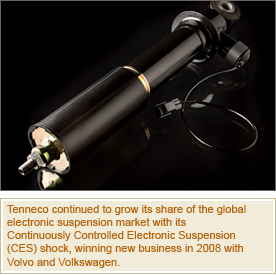
New business awarded during 2008 included awards from Volvo and Volkswagen for our advanced Continuously Controlled Electronic Suspension (CES). The CES shock absorber is a component of Volkswagen’s Adaptive Chassis Control DCC on the new Volkswagen Passat CC, as well as offered as an option on the Volvo SC60, continuing a relationship that dates back to 2003. Since that time, CES has also won business from Ford, Audi and Mercedes-Benz for a number of vehicle models.
“A vehicle’s ride and handling performance are among the top influences in consumer buying decisions,” says Rudi Schurmans, engineering director, ride control Europe. “Our reputation for helping vehicle manufacturers deliver enhanced ride and handling has driven greater demand for high-performance suspension systems like our CES shock absorbers.”
By 2011, the company anticipates expanding its share of the global electronic suspension market by four times.
In North America, the company expanded its relationship with Toyota with the launch of new emission control business on the 2008 Toyota Sequoia. Tenneco also grew its relationship with Ford. The company announced it will supply components (including catalytic converters) that make up the “hot end” of the exhaust system for the Ford F-150 light-duty truck, Ford Expedition, Lincoln Navigator and the Ford Econoline vehicles. Tenneco already had the cold-end (mufflers and pipes) business for these models. For the 2010 model-year, Tenneco was awarded emission control business for some of Ford’s mid and upper mid-size passenger vehicle lines. This represents growth in the car segment with Ford and supports Tenneco’s global strategy to increase its share of passenger car business in North America.
 Growth Customers and Markets
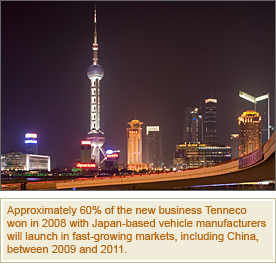
Tenneco’s global footprint helped the company attract new business despite difficult industry conditions. This new business included contracts with several Japan-based manufacturers for 13 different vehicle platforms, launching between late 2009 and 2011. Most of this business will be produced in the expanding markets of Brazil, Russia, India, China and Thailand, enabling Tenneco to expand operations in these fast-growing emerging markets. In 2007 and 2008, the company has won more than $265 million annualized in new business with Japanese OEMs.
“We continued to move forward on our strategy to grow our business with the Japan-based OEMs in 2008,” said Jeff Jarrell, Tenneco’s managing director for Japan and vice president of global Japanese OEM business. “Tenneco’s worldwide annual revenues generated with Japanese customers have doubled over the last seven years as a result of our global capabilities and commitment to building long-term business relationships with our Japan-based customers.”
In China, Tenneco is working towards finalizing an emission control joint venture with Beijing Automotive Industry (Holding) Corp. (BAIC), Tenneco already operates a ride control joint venture with BAIC in Beijing, and the expanded relationship with BAIC will result in Tenneco’s first-ever ride control and emission control business with Hyundai Motor Company.
“Our commitment to growing with and supporting our customers in markets around the world remains as strong as ever, regardless of the current environment,” says Hari Nair, president of Tenneco International. “We have been able to address today’s challenges and maintain our strategic focus thanks to the hard work, dedication and teamwork of our people worldwide.”






