
 Developing
smarter ways to process materials inventory.
Developing
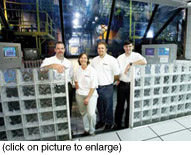
smarter ways to process materials inventory.Team members,left to right: Bryan Woody, Marsha Wilson, Erik Stringfellow, and Jeff Dickinson
In 2004, Duratek experienced a large price increase for disposal. We were, however, able to absorb this cost increase through more innovative approaches to waste processing. Since Duratek sorts all waste to ensure adherence to disposal sites’ waste acceptance criteria, our sorting crew devised and implemented a new process to more efficiently process metals. These innovative thinkers led efforts to relocate and redesign the metals sorting process and facility to include a Green Is Clean(2) assay system in the same sorting area where metals are separated from dry active waste(3) (DAW).
 Finding new revenue streams is one key to improving
the bottom line
Finding new revenue streams is one key to improving
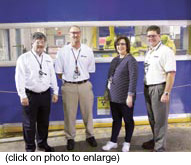
the bottom lineTeam members, left to right: Phil Gianutsos, Greg Lawson, Leigh Sweeney, and Troy Eshleman (not pictured: Bill Garland and Kimberlie Cole)
This group was recognized for developing a new graded approach to license, permit, train, construct, and monitor the handling of suspect Beryllium(1) waste sorting projects. This innovation allowed us to do additional work for DOE that we had not previously pursued.
 New technology, new revenues
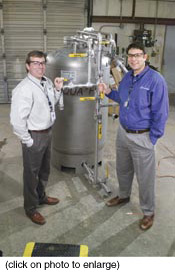
Team members, left to right: Darold Morris and Alex Zarraby
This team was recognized for coming up with a processing methodology that broke down a problem wastestream, ethylene glycol(1), into two ions that can be removed with resin(2). The process consisted of ultraviolet light treatment with hydrogen peroxide injection, followed by a Duratek liquid waste processing system. Duratek met the needs of this customer with a new technology that has a great deal of potential for future opportunities.
 Saving on shipping and treatment
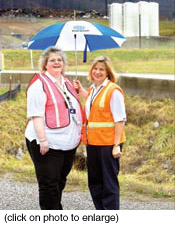
Team members, left to right: Robin Crabtree and Sarah Schaefer
By working closely with our DOE customer and regulator, this team developed storm water discharge criteria so that the contact water generated at the DOE’s Oak Ridge, Tennessee, Environmental Management Waste Management Facility could be safely discharged to the environment instead of being transported to a treatment facility.