|
|||||||||||||||||||||||||||
We see particular promise in sugar, which benefits from growing global demand, a strong overlap with our operations in Brazil and an economically compelling connection to energy. We have announced our desire to become a world leader in the sugar market, and in 2007 we took steps toward that goal. We continued to build our marketing and trading business, and we purchased our first sugarcane mill in Brazil. Our plan is to expand that mill and to build and acquire additional assets. Our strategy also calls for greater integration of energy, financial services and logistics activities into our operations. Due to increasing market interrelations, a strong risk management presence in these value chains is essential for ensuring better performance in our core businesses.
Lastly, we plan to grow our food business by entering, primarily through mergers and acquisitions, additional downstream markets, which could include new, higher-value products.
ENHANCE EFFFFICIENCY AND CUSTOMER FOCUS TO COMPETE AT THE HIGHEST LEVEL Optimization is not just about expansion. It involves a balance of new investments and the retirement of outdated or inefficient assets. Some of our recent activities in Europe provide an example of our approach. We have been expanding our oilseed processing plant in Martfu, Hungary, so it can supply oil to our food products businesses throughout Southern Europe. By doing so, we are consolidating production in an efficient and well-located facility. This enables us to close older, less-efficient plants that we had acquired during the creation of our branded oil business in the region. The end result is a smaller, but more efficient asset base serving the same geographic area. Of course, these decisions are taken with an eye toward improving customer service and in consideration of the impact on employees. A large part of our efforts to improve efficiency involves enhancing internal processes and systems. We have made progress in our global productivity effort. In 2007, we exceeded our goal of $90 million in cost savings. These savings constitute a notable portion of our efforts to combat the effects of a strengthening real on local costs in Brazil, as well as a hedge against the growing headwind of inflation. In 2007, we gained momentum in our LeanSigma activities, running kaizen events to improve productivity at individual locations, and in our global logistics initiative. We also made strides in our procurement effort, which is beginning to consolidate our purchasing of key supplies and corporate services. The procurement program will be aided by our global IT initiative. Clearly, managing a global business requires an excellent information technology backbone, and we have launched an SAP program to update our systems in three key areas: trade management, supply chain and procurement. The first element of the trade management system was launched in 2007 in North America. When complete, these systems will enhance the visibility of information along our production chain, eliminate inefficient processes and enable greater integration. We are also pursuing innovation. 2007 was the first full year for the Bunge Mathematical Institute (BMI), located in Warsaw, Poland. The team of mathematicians at the BMI is designing quantitative systems to help Bunge managers analyze risk and interpret changes in commodity markets. Improving customer focus goes hand-in-hand with innovation. Our technology alliances with DuPont, the work of our Oil Center of Excellence and our introduction of nutritionally enhanced edible oils, such as the recent launch in Ukraine of Oleina Intelektum, a blend of sunflower and linseed oils that is rich in healthy Omega 3 fatty acids, are all good examples of innovation enhancing Bunge's customer offerings.
|
|||||||||||||||||||||||||||

![[HOME]](images/nav/home.gif)

![[FINANCIAL HIGHLIGHTS]](images/nav/fin_highlights.gif)
![[LETTER TO SHAREHOLDERS]](images/nav/ltr_shareholders.gif)
![[FORM 10K]](images/nav/form10k.gif)
![[SHAREHOLDER INFO]](images/nav/shareholder_info.gif)


 EXPAND INTO COMPLEMENTARY VALUE CHAINS
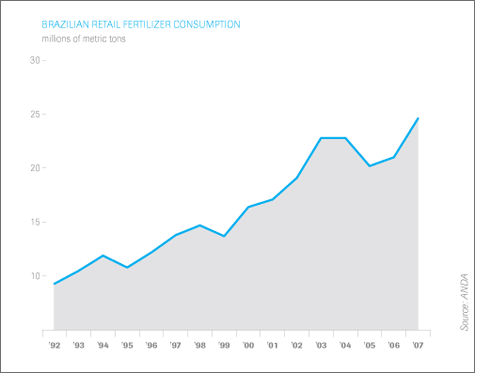 We are building a new fertilizer business in Argentina, a market with a growing agricultural sector and rising fertilizer demand. Because Argentina relies on fertilizer imports, we can leverage our domestic agribusiness infrastructure,
as well as our international logistics network, to achieve greater efficiency. We are currently building a phosphate fertilizer production facility at our port terminal in the town of Ramallo, Buenos Aires. Moving forward, we will apply the same lens to potential opportunities in other markets.
We are building a new fertilizer business in Argentina, a market with a growing agricultural sector and rising fertilizer demand. Because Argentina relies on fertilizer imports, we can leverage our domestic agribusiness infrastructure,
as well as our international logistics network, to achieve greater efficiency. We are currently building a phosphate fertilizer production facility at our port terminal in the town of Ramallo, Buenos Aires. Moving forward, we will apply the same lens to potential opportunities in other markets.