| - Environmental commitments - |
PPC’s business has the potential to impact the environment and the lives of communities surrounding its operations. Whilst PPC’s environmental framework supports the company’s growth objectives by focusing on process efficiencies and resource optimisation, it also considers the importance of the wellbeing and safety of employees, impacted communities and the environment at large. PPC is committed to minimising negative impacts by implementing the following environmental management measures: |
- Optimising the use of non-renewable resources;
- Optimising the consumption of indirect and direct energy;
- Reducing greenhouse gas emissions per ton of product produced;
- Managing the impacts on land and biodiversity;
- Controlling, managing and minimising the footprint of the overburden waste;
- Optimising water consumption;
- Raising internal awareness of significant direct and indirect impacts;
- Complying with legal and regulatory requirements; and
- Improving transparency, understanding and engagement between the company, industry and other stakeholders.
|
| - Environmental management systems - |
PPC’s environmental management system (EMS) enables the company to monitor and manage environmental performance throughout the business. The EMS is designed to monitor environmental aspects that are both directly within a factory’s control as well as those external to its control but within its sphere of influence. The organisation strives to continually enhance its systems to improve overall environmental performance in line with the company’s sustainability policy. Regular EMS audits enable PPC to determine conformance with ISO 14001 specifications. All findings identified during the annual audit are addressed by developing action plans. Corrective actions, as required, are implemented to ensure ongoing compliance with all regulatory requirements.
All of PPC’s South African cement operations, with the exception of Jupiter, have achieved full ISO 14001:2004 certification. The Jupiter operation is currently undergoing a phased assessment in preparation for ISO 14001, and is set to receive formal certification in early 2008. The sales and marketing offices and depots have a single ISO 14001 umbrella listing for all operations. PPC’s lime operation is ISO 14001 certified while the aggregate and readymix quarries are all managed using the ASPASA system.
PPC is a member of ASPASA and has embraced an ethos of responsible environmental management. ASPASA has initiated the ‘About Face RSA’ programme, which is orientated towards the overall management of sound environmental performance, with a particular focus on quarries’ working environment. At the end of their life cycle, the quarry areas will be rehabilitated back into the environment without the necessity for complex maintenance programmes. |
| |
| - Environmental accountability - |
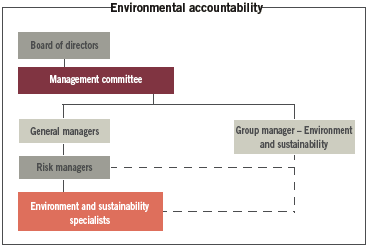
Responsibility for monitoring sustainability issues is assigned to designated managers who advise on necessary actions to be taken, as per the reporting structure shown alongside. Ultimate responsibility for sustainability issues resides with the board of directors. Designated managers receive assistance from the Association of Cementitious Materials Producers (ACMP), the umbrella industry association in South Africa dealing with common interests affecting the cement industry. PPC managers serve on those committees that deal with sustainability issues. Designated managers include respective on-site environmental specialists and risk managers, reporting to the general manager of the factory. |
| |
 |
| |
| - Reporting structure for environmental accountability - |
Management is responsible for the following environmental issues: |
- Advising the board on the development and implementation of the environmental policy;
- Monitoring and evaluating the environmental performance of PPC’s operations, contractors, suppliers and employees;
- Implementing procedures to ensure that the required permits, licences and other regulatory approvals are identified during the project development process;
- Addressing environmental issues throughout PPC’s planning and management processes and setting targets and goals for sustainability;
- Ensuring that environmental risks are identified and mitigated or minimised;
- Identifying environmental aspects, and those that have the potential to significantly impact the environment;
- Setting and monitoring the results of environmental objectives, targets and programmes;
- Ensuring practical actions are taken on stakeholder feedback;
- Identifying the required environmental training needs;
- Maintaining and developing PPC’s environmental framework; and
- Ensuring legal compliance with relevant legislation.
|
| - Environmental performance - |
|
| - Climate change - |
PPC is cognisant of the scientific evidence pointing to adverse impacts of human activity on the planet, particularly with respect to climate change. In an effort to address those factors contributing to climate change that are within the business’ sphere of control, PPC is committed to: |
- Understanding how manufacturing activities may contribute towards climate change;
- Continually monitoring and managing air pollution and greenhouse gas emissions;
- Monitoring the consumption of non-renewable energy and fossil fuels; and
- Maintaining PPC’s value-based management philosophy which aims to evaluate and curb the company’s contribution to climate change.
|
| - Carbon footprint - |
An essential consideration in addressing climate change is an understanding of an organisation’s carbon footprint. The geographic dispersion of PPC’s factories and operations pose numerous challenges in determining this footprint. However, PPC has successfully overcome these challenges by working in line with the World Business Council for Sustainable Development (WBCSD) initiative on carbon dioxide Emission Inventory Protocol Version 2.0. This protocol serves as a carbon monitoring and reporting tool for companies worldwide and provides a common methodology for calculating carbon dioxide emissions, with a view to more accurate reporting. It addresses all direct and the main indirect sources of carbon dioxide emissions related to the cement-manufacturing process.
This protocol has been designed as a flexible tool that facilitates reporting under various schemes, such as: |
- The European Greenhouse Gas Emissions Trading Scheme;
- The Climate Leaders Programme of the United States Environmental Protection Agency;
- The draft greenhouse gas reporting guidelines of the Japanese Government; and
- The Greenhouse Challenge Programme of the Australian Greenhouse Office.
|
|
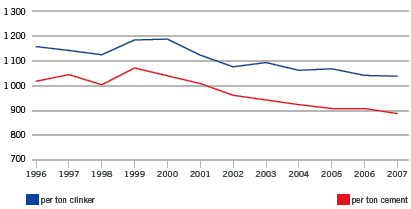
The organisational boundary for PPC’s carbon footprint includes PPC’s seven cement factories, its lime factory and the slag milling facility at Saldanha. The carbon dioxide emitted from the calcination of the limestone, from the combustion of coal and from consumption of diesel is included (as per WBCSD guidelines). The base year is 1996. The carbon dioxide is measured per ton of cement and lime sold. PPC restricted the carbon footprint boundary in 2007 to include the South African operations only. However, in future the company intends to extend this boundary beyond South African borders to include Botswana and Zimbabwe. |
| |
PPC’s CO2 emissions
CO2kg/ton |
|
 |
|
| |
| - Management of carbon dioxide - |
In previous years, PPC has commented on the emission of carbon dioxide arising from the combustion of coal in the manufacture of cement clinker, burnt lime and burnt dolomite. The emission of carbon dioxide varies with production, which is in turn dependent on economic growth. Therefore, the reporting of absolute tons of carbon dioxide does not automatically enable the company to measure efficiencies. Therefore, the absolute tons of carbon dioxide are divided by the tons of product (cement + burnt lime + burnt dolomite) to establish a ‘relative efficiency’, which can be compared from year to year.
The target for carbon dioxide per ton (of cement) for 2008 is 900 kg/ton.
The reduction trend displayed in the carbon dioxide performance graph above is as a result of reduced clinker content in the cement produced in the periods (1996 – 2007). The levelling out in 2005 and 2006 was due to market demand for products that contain more clinker. This was coupled with the re-commissioning of old technology kilns necessitating higher coal consumption.
The commissioning of a new technology kiln in 2008 at Dwaalboom will reduce carbon dioxide from coal consumption by approximately 4%. Similarly, the planned expansion of clinker capacity in the Western Cape should reduce carbon dioxide from coal combustion by a further 4% in three to five years.
PPC is committed to reducing clinker content in its cement in future. This reduction will become evident in reported figures for 2008 and 2009. However, PPC is also committed to supplying products that satisfy consumer needs, which typically involves increased clinker contents. The company is therefore cognisant of the fine balance between delivering on market demand whilst operating in an environmentally responsible way. |
| |
| - Clean development mechanisms - |
PPC recognises that climate change poses a serious threat to sustainable development. The company values the importance of the United Nations’ Framework Convention on Climate Change Kyoto protocol. This protocol aims to stabilise atmospheric concentrations of greenhouse gases (GHGs) by committing signatory countries to reduce their GHG emissions. The clean development mechanism (CDM) is a flexible mechanism, from the Kyoto Protocol, used to stabilise GHG atmospheric concentrations. PPC is committed to supporting the development of CDM projects in South Africa and is currently reviewing the viability of CDM projects within its own operations. |