Downloads     Annual Report Home    
Annual Report search


Sustainability Review  
Environmental Report Risk Report Social Report
Sustainability Review
1 2 3 4 5 6
Decrease font size   Increase font size   E-mail page   Print page
Environmental report  cont.
 
PPC has ensured adequate
planning and provision for the
closure of its mines
 
 
CASE STUDY
Following many years of mining the clay quarry in Port Elizabeth, PPC elected to close it in 2003. PPC engaged in extensive consultation with all stakeholders, including the municipality, surrounding communities and the Department of Minerals and Energy. As a prerequisite for its closure, PPC had to rehabilitate the area as follows:
  • Shaping back-filled areas by means of dozing and covering these areas with topsoil;
  • Dozing material that was unsuitable for cement manufacturing in the pit against the sidewall and levelling it off to the satisfaction of the City Engineer;
  • Adjusting a culvert below the railway line and grading the floor of the quarry to the correct drainage angle;
  • Tidying up the working faces and leaving them at an angle agreed to by the City Engineer; and
  • Constructing perimeter beams to prevent illegal tipping and access.
This has been completed to the satisfaction of all stakeholders confirming that all the requirements for permanent closure have been met.


- Remediation and rehabilitation of land -
PPC manages the environmental footprint of its mines by ensuring that the programme of concurrent rehabilitation is adhered to. Annual targets are set for each operation and progress on concurrent rehabilitation is measured annually by means of aerial photography.

PPC has ensured adequate planning and provision for the closure of its mines and has incorporated the end-use objectives into all concurrent rehabilitation programmes. Concurrent rehabilitation is defined as rehabilitation activities, as specified in the approved environmental management programmes, that can occur concurrently with the mining activities required for the production of raw materials. Mine closure plans are continually monitored, managed and regularly reviewed in conjunction with allocated financial provisions for their closure.
 
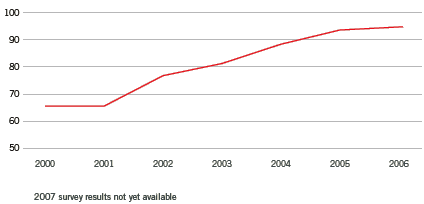
During September 2000, PPC identified that a backlog in concurrent rehabilitation had occurred over a number of years. At that stage, only 65% of the concurrent rehabilitation, which was feasible at all PPC operations, had actually been completed. As reflected in the diagram above, PPC’s concurrent rehabilitation has increased to 95% in the past six years. This translates to a decrease in the backlog from about 600ha to 48ha.

The calculation is based on findings from the annual aerial survey and the overall mining and infrastructural areas are classified as follows:
 
PPC’s concurrent rehabilitation performance
%
 
- Resources optimisation -
At the Jupiter factory, the requirement for natural sand is replaced by sand recovered from old mine dumps. This not only preserves natural resources but also provides a solution for sand removal from a gold mining operation located in the vicinity of the factory. In the year under review, PPC recovered 22 000 tons of sand for use at Jupiter.

The volumes of raw materials consumed by all PPC operations for the period 2006/07 are as follows:
  • Shale: 234 000 tons
  • Limestone: 9,8 million tons
  • Synthetic gypsum: 29 790 tons
  PPC intends to report the above consumptions in future annual reports with 2006/07 as the base year.
 
- Water optimisation -
- Water usage -
Whilst the process of cement and lime production is not water intensive, all PPC factories take a responsible approach towards water management. The cement operations draw water from various water sources such as utility water, boreholes, dams and the Berg River in the Western Cape. Lime Acres in the Northern Cape draws water from underground aquifers for both operational usage and the requirements of local residential communities. No water is discharged from the cement manufacturing process. PPC has continued with the installation of necessary infrastructure to measure water usage adequately.
 
- Water recycling -
At Dwaalboom the sewage is treated and recycled for garden maintenance. The Batsweledi project has included the recycling of water as an integral part of its planning and all new plant designs consider the use of equipment that requires relatively low quantities of water for gas cooling.
 
- Water optimisation programme -
PPC is working on water optimisation programmes at each of its operations; lessons learnt from these programmes will be reported in the next annual report.
 
- Waste minimisation -
PPC does not generate any solid waste from the cement process. All off-specification material is re-worked or re-processed. However, any waste that is generated on site is managed through PPC’s IS0 14001:2004 certified environmental management systems.

PPC, in collaboration with the ACMP has developed a decision matrix to support the Exemption from Waste Applications, in terms of section 20 of the Environmental Conservation Act. This will assist in fast tracking authorisations for the storage of waste at cement plants, submitted for approval to the National Department of Environmental Affairs and Tourism.
 
- Waste recycling and re-use -
All operations are endeavouring to re-use or recycle waste. At some operations, waste materials from older waste dumps that were previously considered non-reusable, are being analysed for re-use. In this way PPC further reduces its reliance on non-renewable resources.

De Hoek and Riebeeck have optimised the recovery of screenings from the crushing process, thereby achieving significant synergies in resource usage. A portion of the screening material is transported from De Hoek to Riebeeck to be blended with the limestone from the Riebeeck quarry, producing the correct material mix for cement production, whilst simultaneously achieving PPC’s resource conservation objectives. At Mooiplaas the fine material recovered from the evaporation ponds is sold as agricultural lime. At Lime Acres the fine material is processed into briquettes and sold as usable product.

PPC generates waste oil and lubricants from maintenance activities. Much of this waste is internalised in the manufacturing process, and where this is not possible, the waste is disposed of at an external waste facility, using a registered waste disposal service provider. General waste from operations located in urban areas is disposed of at municipal general landfill sites by a contracted waste service provider. At the rural-based operations including the PPC villages, the general waste is disposed of in small domestic self-managed waste disposal sites.

Paper from PPC is recycled at the urban facilities and metal waste is sold to scrap metal merchants for recovery and re-use. PPC takes a responsible and proactive view on the disposal of used cement bags and provides clear and concise instructions to consumers on the best means to dispose of the bags.

PPC has a firm contract in place with an external service provider to manage all electronic waste as per the national waste management hierarchy of reduce, reuse, recycle, recover and disposal.
 
 
Sustainability Review > Environmental Report   Back to top  
1 2 3 4 5 6