| |
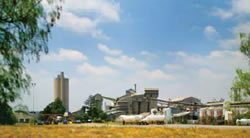
PPC continues to pursue the
reduction
of particulate emissions |
| |
|
|
 |
| CASE STUDY |
The vertical roller mill which is currently being constructed at the Hercules operation will result in improved energy efficiency, noise reduction and reduced water consumption. The power consumption of these mills is 25 – 35% less than that of a conventional ball mill. The grinding efficiency of the vertical roller mill, combined with its capability to dry, grind and classify within a single unit gives it an advantage over the ball mill system. |
|
| |
 |
|
| CASE STUDY |
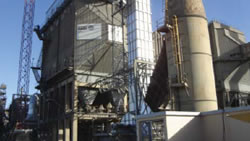
PPC recently completed a R7 million upgrade of the kiln ESP at its Port Elizabeth operation. The upgrade has significantly improved the efficiency of the unit, mainly by increasing dust collection. The ESP is not only more efficient in reducing ambient dust but it also aids in returning dust to the manufacturing process where it is re-processed. |
|
| |
 |
|
| CASE STUDY |
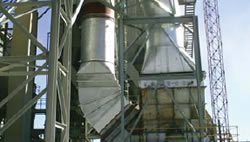
In a move to enhance its environmental performance, PPC Lime has successfully converted Lime Acres kiln 9 (LK9) from an ESP system to a bag-house operation. This R20 million project will significantly reduce the facility’s overall dust emissions to be well within permit stipulations and to meet international standards. In addition, the increased fan capacity will improve the kiln efficiency.
When kilns 6 to 9 were constructed between 1977 to 1983, it was standard industry practice to use electrostatic precipitators to remove dust from the kiln off-gas. However, the results were not comparable with modern international benchmarks. In 2002, PPC Lime embarked on a programme to reduce dust emissions when it converted its first electrostatic precipitator to a bag-house on LK7, a kiln with a capacity of 1 150 tons per day. Following the success of this conversion, and after a suitable evaluation period, PPC converted the LK9 electrostatic precipitator to a bag-house in 2006.
Of the four rotary kilns operated at Lime Acres, LK9 is the largest, with a capacity of 1 450 tons per day. The latest conversion has reduced the total amount of dust released from all kilns into the atmosphere by at least 50% from pre-2002 levels. |
|
| |
| CASE STUDY |
The Jupiter factory was commissioned in 1938. It was since decommissioned in 1998 due to reduced demand for cement and subsequently transformed into a despatch facility, supplying cement. The increased market demand for cement in the previous year resulted in the re-commissioning of the factory in 2006. The Jupiter plant is currently operating with improved air quality emissions and has instituted an environmental stakeholder forum as a platform for improved stakeholder communication. Environmental improvements include improving the air quality mitigation equipment by: |
- Upgrading the kiln ESP;
- Replacing the existing raw mill ESP with a new bag filter;
- Introducing additional dust control measures on the conveyors;
- Having contracts in place for the maintenance of the dust collectors; and
- Overhauling of bag filters.
|
|
|
|
| |
| |
| - Energy efficiency and supply - |
|
| - Energy efficiency - |
The cement and lime production processes are energy intensive and use significant quantities of ‘direct’ energy in the form of coal, to a lesser extent, diesel oil in the winning of limestone and ‘indirect’ energy in the form of electricity. PPC is dedicated to evaluating and deploying new technology to improve energy efficiency. Electrical energy efficiency forms an integral part of the planning and selection of plant and equipment for the company’s planned expansion and upgrade projects. These are the Dwaalboom (designated Batsweledi), Hercules (designated Ntshafatso) and Western Cape (designated Se Kïka) expansion projects. These have included energy efficient features, which will reduce the demand for electrical energy. |
| |
| - Energy Efficiency Accord - |
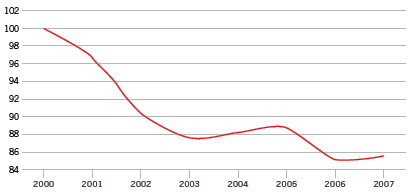
PPC is a signatory to the Energy Efficiency Accord as an organisation, as well as under the banner of the ACMP. PPC embraces the voluntary initiatives required by the membership, to improve energy efficiency. The purpose of the accord is to encourage investments in clean development mechanism (CDM) projects and promote efficient energy use – specifying a 15% reduction by 2015 (using 2000 as the base year). The company has been an active participant in the Energy Efficiency Technical Committee and has been tracking its own energy use per ton of cement. The well-publicised capacity expansion programme of Batsweledi, Se Kïka and Ntshafatso projects will help reduce PPC’s energy consumption through improved milling efficiency and reduced coal consumption per unit produced to the Energy Efficiency Accord targets.
Alongside is the progress since 2000, where coal, diesel, electricity and secondary materials have been used. |
| |
| - Energy demand-side management programme - |
During the year, PPC voluntarily participated in Eskom’s demand market participation project (DMP) in the Western Cape. As from April 2006, Riebeeck and De Hoek contractually agreed to voluntarily shed electricity load during peak periods, allowing reduced energy consumption. Riebeeck sheds at least 1MW in this way and De Hoek 2MW when requested by Eskom.
In the year ahead, the major focus will be on energy efficiency rather than load shedding, based on the current high demand for cement production and supply. By way of example, PPC Dwaalboom implemented lighting efficiency in February 2006, which resulted in a 177 kW reduction in energy consumption to August. |
| |
| - Alternate energy (secondary materials) - |
PPC’s environmental footprint is shaped in part by its choice of available energy sources. The company is currently considering a varied supply of energy resources, thereby minimising, as far as possible, its impact on the environment. To this end, Hercules, Slurry, Dwaalboom, Port Elizabeth and De Hoek have submitted Environmental Impact Assessments (EIA’s) for use of alternative materials to the relevant authorities and are awaiting the Records of Decision. PPC is also waiting for the relevant legislation to be enacted which will allow burning of used tyres as alternative fuel. The consumption of fossil fuels is a major source of greenhouse gas emissions and energy consumption is directly linked to these emissions. Replacing fossil fuel with renewable sources is essential for combating climate change and other environmental impacts. PPC will report on the secondary material co-processing targets and achievements in future reporting. |
| |
| - Diesel consumption - |
Diesel is used primarily in the winning of limestone from its quarries. Haul roads at several operations have been redesigned to improve gradients and reduce distances. Mine planning has been adapted so that waste material is back-filled into existing mines, which minimises the movement of the same material a second time during rehabilitation. In addition, in some areas the crusher has been strategically placed to reduce travel distance, resulting in lower diesel consumption. |
| |
PPC’s concurrent rehabilitation performance
% |
|
 |
|
| |
| - Emissions control and mitigation - |
PPC continues to pursue the reduction of particulate emissions and the quantification of the gases emitted during the cement and lime manufacturing processes. The company is currently refining its stack emission monitoring and reporting systems to improve overall air quality management of stack emissions at all factories. Further improvements are achieved by increasing the knowledge and awareness of stack performance beyond dust monitoring. PPC is committed to implementing a sustainable system for monitoring and reporting emissions, with trained personnel and qualified service providers.
The following projects and initiatives will be implemented in 2008 – 2010: |
- Air quality pilot project at Hercules using the mass balance approach;
- Performing a baseline analysis of dust, NOx to determine the baseline for future and SO2 monitoring;
- Drafting a monitoring proposal for analysing dust, NOx and SO2;
- Structuring a complete stack emissions profile;
- Developing a long-term compliance plan for managing emissions; and
- Developing a training and awareness module for air quality monitoring and reporting.
|
| - Point source (stack) emissions management - |
Electrostatic precipitator (ESP): PPC’s electrostatic precipitators use electric power to separate dust particles from gases, enabling plants to operate with very low dust emissions. The ESP is typically 99,5% efficient. |
| |
| - Innovation for dust suppression initiative - |
At PPC Slurry, members of PPC’s engineering and production teams are collaborating to develop new ways to assist with dust reduction. The team has installed two kiln back-end water injection systems to reduce dust emissions. The systems spray a fine water mist that changes the resistivity of the dust, so that the electrostatic filter works more efficiently, thereby further restricting emissions. |
| |
| - Fugitive emissions management - |
PPC continues its efforts to minimise dust arising from the use of haul roads, conveyor belts, stockpiling and related activities. High standards of plant housekeeping and the use of dust suppression mechanisms are essential to controlling the level of dust emissions. Fugitive emissions are of critical concern to the ambient plant environment and PPC is continually assessing the best ways to manage, control and suppress the impact of these emissions. Currently PPC controls ambient fugitive emissions with bag-house filter systems, paving programmes, covered conveyor systems and water dosing programmes.
Bag-house filtering system: An alternative to ESPs for dust collection is the use of bag filters, where gas is cleaned similarly to the operation of a vacuum cleaner. PPC’s bag filters are extremely efficient, with the dust concentration in the cleaned gas seldom exceeding 20mg per cubic metre.
Water spraying: Wet dust suppression systems moisten transported material or road systems so that less dust is generated. Water is also used in some crushing plants (Dwaalboom and De Hoek) to reduce dust.
Paved areas: Certain plant areas have been paved and grassed, contributing significantly to dust control. Mechanical sweeping of paved areas has also contributed to dust reduction in the plant environments.
Conveyor belt: Significant dust is caused by wind and material handling at transfer points. One solution has been to enclose PPC’s belt conveyors where necessary. This resulted in a reduction in dust emissions during the Jupiter refurbishment, when several belt conveyors were enclosed and transfer chutes were refurbished or replaced. |
| |
|
|
|
| |
|