 |
|||||||||||||
 |
 |
 |
 |
 |
 |
 |
 |
 |
|
||||

|
||||||||
 |
||||||||
|
||||||||
 Thank
you for your investment in TRW Automotive, the world’s preeminent
supplier of active and passive automotive safety systems. Thank
you for your investment in TRW Automotive, the world’s preeminent
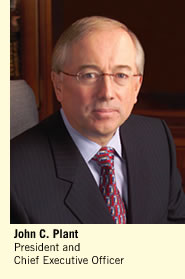
supplier of active and passive automotive safety systems.Calendar year 2004 was a formative year for TRW Automotive, marked by our initial public offering (“IPO”) in early February. The IPO was an important step in the Company’s logical progression from a business unit of a multi-faceted conglomerate to its emergence last year as an independent, publicly traded automotive supplier. We are now positioned as a safety product-focused independent company, with a clear mandate to implement business initiatives that will strengthen our leadership positions and increase our efficiency and our effectiveness for the benefit of our stakeholders. The year was also marked by an unrelenting automotive industry environment that drew heavily on the Company’s operating strengths at every turn. Despite this challenging environment, I am pleased to say we accomplished every important operational and financial objective we committed to at the beginning of the year. Our achievements include solid sales and earnings growth, new business wins with the world’s major vehicle manufacturers at a level that supports our growth prospects, and significant capital structure improvements that reduced outstanding debt and increased our financial flexibility. While elevated customer pricing pressures and declining vehicle production volumes at our major North American customers tested us during the year, the most significant challenge came directly from the steep rise in ferrous metals pricing that began during the first quarter and steadily worsened throughout the year. Achieving our objectives in this difficult operating environment resulted mainly from the strong performance of our highly diversified portfolio of leading safety technologies across a broad geographic range, together with the ability of our businesses to deliver on the many cost reduction initiatives demanded of them throughout the year. The cost savings generated by these initiatives, which include value engineering, six sigma, supply base management and restructuring activities, are fundamental to our efforts in counteracting the profit pressures we experience each year, and they served us particularly well in 2004. We also benefited from the organization’s swift response to the ferrous metals pricing issue, which enabled the Company to implement cost reduction initiatives and actively manage the supply base at an early stage. These actions, along with positive benefits from other areas of cost reduction within our businesses, allowed us to mitigate the impact of higher material costs on our bottom line. I believe that our achievements in such an adverse operating environment speak volumes about our ability to thrive and create value for our shareholders over the long term. These achievements also demonstrate the effectiveness of the strategic priorities that we strive to integrate into everything we do: best quality, lowest cost, global reach and innovative technology. Based on these priorities, we have built a business model that we believe offers resiliency and strength when times are difficult, with the potential for accelerating performance when we have the wind at our backs. Our commitment to these priorities, in combination with a highly skilled and motivated work force and our extensive customer relationships, helps TRW stand out as a leading supplier to the automotive industry. 2004 Financial Highlights We reported full-year 2004 sales of $12.0 billion, an increase of 6 percent compared to the prior year pro forma period. During the year we benefited from currency translation due to the weak dollar, new product growth and higher vehicle production volumes by our European customers. Sales were negatively impacted by annual price reductions provided to our customers, lower North American vehicle production volumes and loss of sales due to two business divestitures. We reported operating income and EBITDA (earnings before interest, losses on the sale of receivables and retirement of debt, taxes, depreciation and amortization) of $583 million and $1,080 million,1 respectively, which in both cases represents an increase over the prior year pro forma period. In 2004, the Company reduced net interest related expense by $75 million compared to the prior year pro forma level. This improvement resulted from our significant progress in reducing the high level of debt incurred at the time of the February 2003 acquisition of the Company by The Blackstone Group L.P. from Northrop Grumman Corporation. During the year, we completed a series of capital transactions including our IPO, the repurchase of some of our public bonds, two bank debt refinancings, a voluntary debt pay-down with internally generated cash flow and the repurchase of our acquisition-related seller note. In addition to lowering our interest expense, these transactions reduced our total gross debt by more than $600 million and provided greater financial flexibility through increased liquidity and more beneficial borrowing terms. At the bottom line, we posted net earnings for the year of $29 million or $0.29 per diluted share. These results include expenses related to the debt retirement and refinancing transactions which negatively impacted our 2004 pre-tax earnings by $173 million.2 Excluding the effects of these expenses from our results, net of the assumed tax impact, net earnings were $173 million or $1.72 per diluted share,2 a substantial increase over the prior year period pro forma net earnings of $93 million or $1.03 per diluted share.3 Overall, the increased earnings level in 2004 when compared to the prior year can be attributed primarily to new business growth, reduced interest expense and lower taxes. We had a strong year of cash flow generation, with net cash provided by operations of $787 million. Capital expenditures totaled $493 million in 2004, up from $416 million the prior year, with the increase primarily due to the impact of foreign exchange and the continued investment required to support our business growth. During the year we made progress in areas that not only improved performance but also will serve us well in the future. We had an outstanding year for new business wins, with a net sales outcome in line with our planning levels for the year. We received new business awards from the world’s major vehicle manufacturers dispersed broadly among all of our primary products. In total, the mix of the new business wins strengthens the breadth and diversity of our customer portfolio and reinforces our long-term growth prospects. Finally, the trend toward added safety content in vehicles strengthened considerably in 2004 when a number of the world’s leading vehicle manufacturers announced their intent to include safety products such as side curtain airbags and electronic stability control as standard features on future programs. This trend supports the Company’s safety-related focus and strategies, and gives us confidence that we have the right approach to winning new business. Global Reach Global reach remains a critical success element for TRW as the pace of integration across world markets continues to rapidly reshape today’s automotive industry. We are committed to a strategy that embraces this integration and turns it to our advantage as we strategically map our global footprint to serve customers anywhere in the world. Our commitment is already evident from the 63 percent of sales that are generated outside of North America and the approximately 7,500 employees and more than 40 facilities we have in Asia Pacific and South America alone. We have implemented a strategy that requires us to think globally about every aspect of our business – from component sourcing to customer sales awards, product development and manufacturing. Our continued efforts have brought us broad access to all markets and a competitive cost structure with world-class customer service capabilities. In our view, these capabilities provide resiliency in volatile global markets and establish a framework for us to efficiently supply our customers with high-quality, low-cost innovative products wherever and whenever they need them. Prime examples of our global strategy include the establishment of two new joint ventures in China in the first quarter of 2004, one for the manufacture of airbag modules and steering wheels, and the other for steering gears for the commercial bus and truck markets. We also opened four new facilities in low-cost countries including our first steering wheel plant in Romania. We expect to continue our growth in Asia and in other emerging economies by leveraging the infrastructure we have already established and by working with experienced joint venture partners. Highly Diversified Portfolio The breadth and diversification of our product and customer base are a key component to the strength of TRW’s operating model. We support all of the world’s major automotive companies, with our largest customer representing just 17 percent of sales. Our industry-leading diversification is further evidenced when you consider that our largest single vehicle platform represents only 4 percent of sales and our largest product category is just 17 percent of sales. We have the widest range of safety products among today’s vehicle component manufacturers and maintain leadership positions in most of our primary products. Our products cover all aspects of the growing markets of active vehicle safety such as steering and braking systems and passive vehicle safety including seat belts, airbags and safety electronics. This ensures our customers have access to the widest range of safety-related products from a single source and provides TRW with greater flexibility in times of fluctuating market demand. Passionate About Safety – Driving Innovation to the Next Generation TRW Automotive is passionate about vehicle safety. In recent decades, we’ve seen dramatic changes in the safety content of vehicles, from the original seat belt to airbags to latest generation safety features. Safety continues to be one of the key themes shaping vehicle design, brand positioning and consumer demand. A heightened focus on automotive safety is being driven by a number of factors, including increased government regulation, breakthroughs in the integration of intelligent electronics, the need for auto manufacturers to distinguish their products and consumer demand for safety-enhanced vehicles. Meeting the demands for increased safety content requires significant investment in technology and constant innovation. To support our development efforts, we have established a global engineering network with approximately 4,800 engineers, researchers and technical personnel located in 24 countries. With this network in place, we are committed to providing our customers with next generation products that meet their growing needs for quality, cost and innovation. 2005 Business Outlook Going forward, we expect economic growth to continue in most of the major business regions in which we conduct operations. We also believe that the long-term market trend toward added safety content will continue to fuel our new business growth. Even so, the automotive industry is bracing itself for another difficult year as the prevailing issues that were center stage in 2004 are expected to continue, and in some cases worsen significantly, further pressuring profits in 2005. These issues include heightened commodity pricing, market share losses by our major North American customers, rising interest rates and inflating health care costs. The combination of these pressures together with our expectation of flat global industry production volumes sets this year’s operating environment apart as one of the most difficult the automotive supply base has faced in recent years. With this backdrop, the operational and financial objectives we have committed to this year will again greatly challenge our strengths and resourcefulness. We have instituted an aggressive business plan that we believe will help mitigate the financial impact that this environment represents to our bottom line. Sincerely,  John C. Plant President and Chief Executive Officer TRW Automotive This letter contains forward-looking statements, which involve risks and uncertainties. Such risk and uncertainties, which could cause our actual results to differ materially from those contained in the forward-looking statements made in this letter, are set forth in “Management’s Discussion and Analysis of Financial Condition and Results of Operations” under “Forward Looking Statements” and “Risk Factors” in the accompanying Annual Report on Form 10-K. We do not intend or assume any obligation to update any of these forward-looking statements. |
||||||||
|
||||||||
Back to top |
 |
 |
 |
