
1998 Annual Report - Consolidated Financial Statements
Annual Report Contents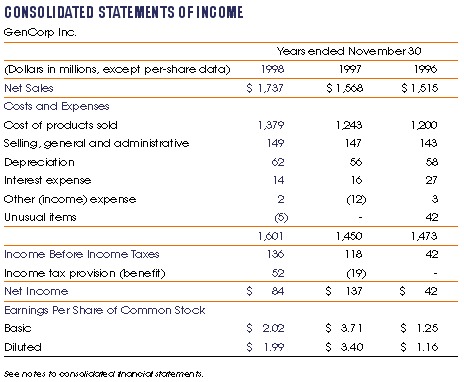
NOTES TO CONSOLIDATED FINANCIAL STATEMENTS
Note A - Summary of Significant Accounting Policies
Organization - The Company is a multinational manufacturing company operating primarily in the United States. Information on the Company's operations by segment and geographic area is provided in Note S - Business Segment Information.
Consolidation - The consolidated financial statements of the Company include the accounts of the parent company and its wholly-owned subsidiaries. Significant intercompany accounts and transactions have been eliminated.
Revenue Recognition - Generally, sales are recorded when products are shipped or services are rendered. Sales and income under most government fixed-price and fixed-price-incentive production type contracts are recorded as deliveries are made. For contracts where relatively few deliverable units are produced over a period of more than two years, revenue and income are recognized at the completion of measurable tasks rather than upon delivery of the individual units. Sales under cost reimbursement contracts are recorded as costs are incurred and include estimated earned fees in the proportion that costs incurred to date bear to total estimated costs. Certain government contracts contain cost or performance incentive provisions which provide for increased or decreased fees or profits based upon actual performance against established targets or other criteria. Penalties and cost incentives are considered in estimated sales and profit rates. Performance incentives are recorded when measurable or when awards are made. Provisions for estimated losses on contracts are recorded when such losses become evident.
Use of Estimates - The preparation of the consolidated financial statements in conformity with generally accepted accounting principles requires management to make estimates and assumptions that affect the amounts reported in the consolidated financial statements and accompanying notes. Actual results could differ from those estimates.
Environmental Costs - The Company expenses, on a current basis, recurring costs associated with managing hazardous substances and pollution in ongoing operations. The Company accrues for costs associated with the remediation of environmental pollution when it becomes probable that a liability has been incurred and its proportionate share of the amount can be reasonably estimated. The Company recognizes amounts recoverable from insurance carriers, the U.S. Government or other third parties, when the collection of such amounts is probable. Pursuant to U.S. Government agreements or regulations, the Company will recover a substantial portion of its environmental costs for its aerospace and defense business segment through the establishment of prices of the Company's products and services sold to the U.S. Government. With the exception of applicable amounts representing current assets and liabilities, recoverable amounts and accrued costs are included in other assets and other long-term liabilities.
Fair Value of Financial Instruments - The Company's cash equivalents and short and long-term bank debt bear interest at market rates and therefore their carrying values approximate their fair values.
Inventories - Inventories are stated at the lower of cost or market. The automotive and polymer products segments use the last-in, first-out method. The aerospace and defense segment uses the average cost method. Foreign operations use the first-in, first-out method.
Work-in-process on fixed-price contracts includes direct costs and overhead less the estimated average cost of deliveries. Appropriate general and administrative costs are allocated to government contracts.
Long-Lived Assets - Property, plant and equipment are recorded at cost. Refurbishment costs are capitalized in the property accounts whereas ordinary maintenance and repair costs are expensed as incurred. Depreciation is computed principally by accelerated methods for the aerospace and defense business segment and by the straight-line method for the remainder of the Company. Depreciable lives on buildings and improvements and machinery and equipment range from 10 years to 40 years and 3 years to 20 years, respectively.
Goodwill represents the excess of purchase price over the estimated fair value of net assets acquired and is amortized on a straight-line basis over periods ranging from 15 to 40 years. Identifiable intangible assets, such as patents, trademarks and licenses, are recorded at cost or when acquired as part of a business combination at estimated fair value. Identifiable intangible assets are amortized over their estimated useful life using the straight-line method over periods ranging from 3 to 15 years. Accumulated amortization of goodwill and identifiable intangible assets at November 30, 1998 and 1997 was $8 million and $3 million, respectively.
Impairment of long-lived assets is recognized when events or changes in circumstances indicate that the carrying amount of the asset, or related groups of assets, may not be recoverable. Measurement of the amount of impairment may be based on appraisal, market values of similar assets or estimated discounted future cash flows resulting from the use and ultimate disposition of the asset.
Income Taxes - Deferred income taxes are provided for temporary differences between the carrying amount of assets and liabilities for financial reporting and income tax purposes.
Statements of Cash Flows - For purposes of the statements of cash flows, all highly liquid debt instruments purchased with an original maturity of three months or less are considered to be cash equivalents.
Reclassifications - Certain reclassifications have been made to conform prior year's data to the current presentation.
Note B - Unusual Items
During 1998, the Company incurred unusual items resulting in income of $5 million. Unusual items included charges of $8 million primarily related to exiting the plastic extrusions appliance gasket and residential wallcovering businesses offset by a gain of $13 million from the sale of surplus land in Nevada by Aerojet.
During 1996, the Company recognized net unusual charges of $42 million. These charges included a provision of $15 million for an early retirement program at the Company's headquarters and technology center, a net loss on the sale of divested businesses of $10 million (see Note D - Acquisitions, Divestitures and Subsequent Events), a provision for environmental remediation costs associated with the Company's Lawrence, Massachusetts facility of $8 million (see Note R - Contingencies), a restructuring charge of $3 million for the Company's Vehicle Sealing business unit, a charge of $2 million to reduce fixed assets to net realizable value and a provision of $4 million related to pension and other related matters.
Note C - New Accounting Pronouncements
In June 1998, the Financial Accounting Standards Board (FASB) issued Statement No. 133, "Accounting for Derivative Instruments and Hedging Activities" (SFAS 133), which is required to be adopted in fiscal year 2000. Because of the Company's minimal use of derivatives, management does not anticipate that the adoption of the new Statement will have a significant effect on earnings or the financial position of the Company.
In April 1998, the American Institute of Certified Public Accountants (AICPA) issued Statement of Position (SOP) 98-5, "Reporting the Costs of Start-up Activities" (SOP 98-5). SOP 98-5 is effective beginning on December 1, 1999, and requires that start-up costs capitalized prior to December 1, 1999 be written off and any future start-up costs to be expensed as incurred. The unamortized balance of start-up costs will be written off as a cumulative effect of an accounting change as of December 1, 1999. The Company has not yet assessed what the impact of SOP 98-5 will be on the Company's future earnings or financial position.
In March 1998, the AICPA issued SOP 98-1, "Accounting For the Costs of Computer Software Developed For or Obtained For Internal Use" (SOP 98-1). SOP 98-1 is effective for the Company beginning on December 1, 1999. SOP 98-1 will require the capitalization of certain costs incurred after the date of adoption in connection with developing or obtaining software for internal use. The Company believes it is in compliance with the standards established by SOP 98-1 and as such SOP 98-1 will not impact the Company's future earnings or financial position.
In June 1997, the FASB issued Statement No. 130, "Reporting Comprehensive Income" (SFAS 130) and Statement No. 131, "Disclosures about Segments of an Enterprise and Related Information" (SFAS 131). Both statements are required to be adopted in fiscal year 1999. Currently, the Company's only elements of comprehensive income are cumulative translation adjustments and minimum pension liability adjustments. Once adopted, the Company plans to provide the SFAS 130 required disclosures in its Consolidated Statements of Shareholders' Equity and related footnotes. SFAS 131 requires that annual and interim financial and descriptive information about reportable operating segments be reported on the same basis used internally for evaluating segment performance and the allocation of resources. While the Company has not yet determined the impact of adopting SFAS 131 on its financial statement disclosures, GenCorp does not expect any change to its primary financial statements.
Note D - Acquisitions, Divestitures and Subsequent Events
Acquisitions
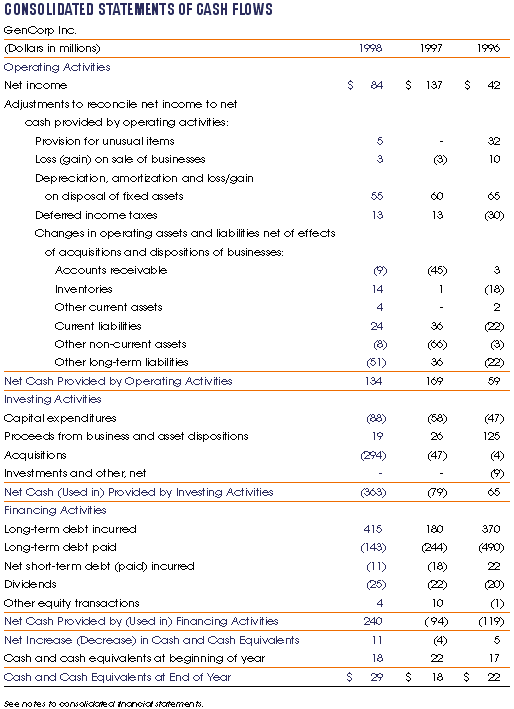
On October 29, 1998, the Company acquired certain net assets of Sequa Chemicals, the specialty chemicals unit of Sequa Corporation, for $108 million in cash. This acquisition provided increased capacity for an array of emulsion polymers and polymer hybrids including acrylics and vinyl acetate. The preliminary purchase price allocation resulted in goodwill and other intangible assets of approximately $61 million which are being amortized over periods ranging from 5 to 40 years.
On August 14, 1998, the Company acquired the commercial wallcovering business of Walker Greenbank PLC, which is based in the United Kingdom, for $112 million in cash. The preliminary purchase price allocation resulted in goodwill and other intangible assets of approximately $80 million which are being amortized over periods ranging from 5 to 40 years.
On March 1, 1998, the Company acquired The Goodyear Tire & Rubber Company's Calhoun, Georgia latex facility for an aggregate consideration of $78 million, of which $74 million was paid in cash and $4 million was paid through the retention of receivables. The acquisition resulted in goodwill and other intangible assets of $59 million which are being amortized over periods ranging from 3 to 40 years.
On May 7, 1997, the Company acquired certain net assets of Printworld from Technographics, Inc. for $47 million in cash. The acquisition resulted in goodwill and other intangible assets of $32 million which are being amortized over periods ranging from 3 to 30 years.
On August 23, 1996, the Company purchased the Lytronš polystyrene latex plastic pigment business from Morton International for approximately $4 million. The acquisition resulted in intangible assets of $3 million which are being amortized over 15 years.
All of the acquisitions were accounted for using the purchase method and were included in the results of operations for the Company from the date of the acquisition.
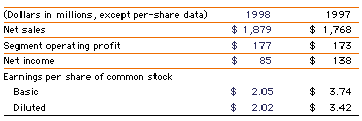
The following unaudited pro forma information presents a summary of the consolidated results of operations of the Company and its 1998 acquisitions as if the acquisitions had occurred at the beginning of 1997, with pro forma adjustments to reflect the amortization of goodwill and other intangible assets and interest expense on acquisition debt together with the related income tax effects. The pro forma financial information is not necessarily indicative of the results of operations if the acquisitions had actually occurred at the beginning of 1997.
Divestitures
On June 30, 1998, the Company sold its plastic extrusions appliance gasket business to ILPEA, Inc. for an aggregate consideration of approximately $3 million.
On November 19, 1996, the Company completed the sale of substantially all of the assets and certain liabilities of its structural urethane adhesives business to Ashland Inc. for an aggregate consideration of approximately $4 million.
On June 21, 1996, the Company completed the sale of substantially all of the assets and certain liabilities of its Automotive Occupant Sensor business to the Robert Bosch Corporation for an aggregate consideration of approximately $3 million.
On March 1, 1996, the Company completed the sale of substantially all of the assets and certain liabilities of its Reinforced Plastics business unit to Cambridge Industries, Inc. of Madison Heights, Michigan for an aggregate consideration of approximately $42 million.
On February 15, 1996, the Company completed the sale of substantially all of the assets and certain liabilities of its Vibration Control business unit to BTR Antivibration Systems, Inc., a subsidiary of BTR PLC, for an aggregate consideration of approximately $84 million.
Subsequent Events
On December 17, 1998, the Company announced a plan to spin off its Performance Chemicals (formerly Specialty Polymers) and Decorative & Building Products businesses to GenCorp shareholders as a separate publicly traded polymer products company. Following the spin-off, GenCorp would continue
to operate Aerojet, its aerospace, defense and fine chemicals segment, and its automotive Vehicle Sealing business unit. Implementation of the plan is subject to approval by GenCorp shareholders, the receipt of a favorable ruling from the Internal Revenue Service, as well as market conditions at the time
of the proposed spin-off. See Note S for financial information related to the Company's polymer products segment, which consists of Performance Chemicals, Decorative & Building Products and Penn Racquet Sports businesses.
On December 2, 1998, the Company acquired the U.S. acrylic emulsion polymers business of PolymerLatex, located in Fitchburg, Massachusetts, for $9 million.
On December 14, 1998, the Company sold its residential wallcovering business to Blue Mountain Wallcoverings, Inc. for an aggregate consideration of approximately $9 million. The loss on the sale of this business was reflected in 1998 results of operations. Also on December 14, 1998, the Company announced it had initiated the process for divesting its Penn Racquet Sports division for which the Company expects to realize a gain.
Note E - Earnings Per Share
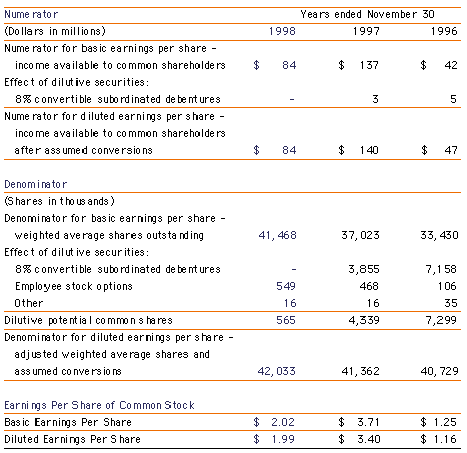
In 1998, the Company adopted FASB Statement No. 128 "Earnings Per Share" (SFAS 128), which replaced the computation of primary and fully diluted earnings per share with basic and diluted earnings per share. Earnings per share for all prior periods have been restated to conform with the new standard.
A reconciliation of the numerator and denominator used in the basic and diluted earnings per share computations is as follows:
Note F - Research and Development Expense
Company-sponsored research and development (R&D) expense was $29 million in 1998, $28 million in 1997 and $31 million in 1996. Company-sponsored R&D expense includes the costs of technical activities that are useful in developing new products, services, processes or techniques, as well as those expenses for technical activities that may significantly improve existing products or processes.
Customer-sponsored R&D expenditures which are funded under government contracts totaled $207 million in 1998, $175 million in 1997 and $102 million in 1996.
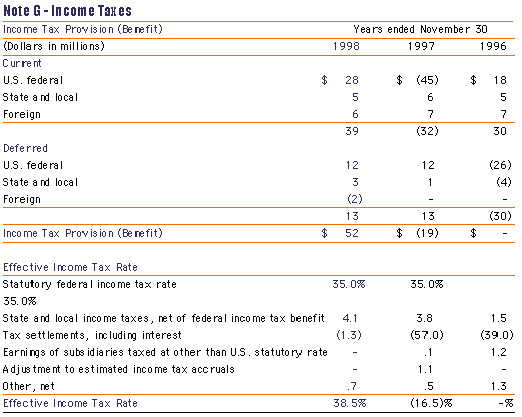
The Company reduced its 1998, 1997 and 1996 income tax expense by $2 million, $67 million and $16 million, respectively, due to the receipt of federal income tax settlements for tax credits and related interest.
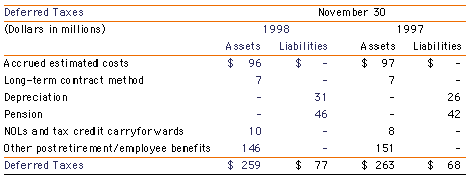
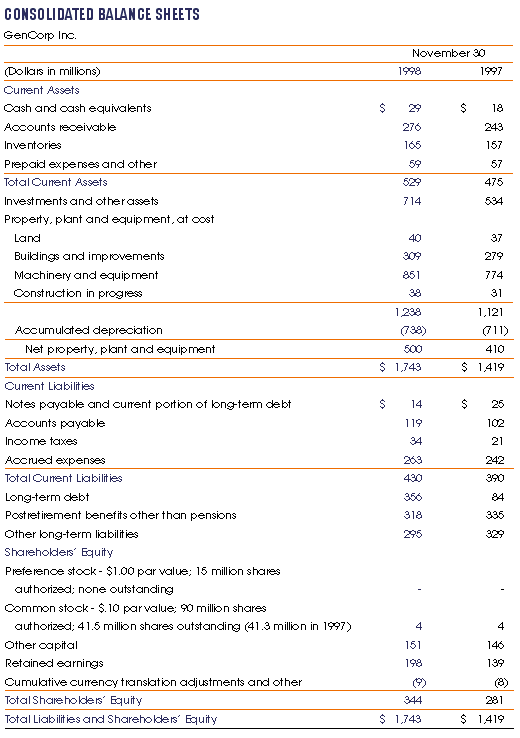
The consolidated balance sheets reflect deferred income taxes of $45 million and $44 million in prepaid expenses and other at November 30, 1998 and 1997, respectively. Included in other long-term assets for 1998 and 1997 are deferred income taxes of $137 million and $151 million, respectively. The majority of net operating loss (NOLs) and tax credit carryforwards have an indefinite carryforward period with the remaining portion expiring in years through 2007. Pretax income of foreign subsidiaries was $11 million in 1998, $21 million in 1997 and $18 million in 1996. Cash paid during the year for income taxes was $33 million in 1998, $70 million in 1997 and $29 million in 1996.
Note H - Accounts Receivable
At November 30, the amount of commercial receivables was $202 million and $149 million for 1998 and 1997, respectively. Receivables for the automotive segment of $52 million and $54 million in 1998 and 1997, respectively, are due primarily from General Motors and Ford. The amount of U.S. Government receivables was $74 million and $94 million for 1998 and 1997, respectively. Included in the 1998 and 1997 U.S. Government receivables is $16 million and $12 million, respectively, for environmental remediation recovery (see Note R - Contingencies). The Company's receivables are generally unsecured and are not backed by collateral from its customers.
Also included in accounts receivable from the U.S. Government are unbilled receivables of $11 million and $12 million at November 30, 1998 and 1997, respectively, relating to long-term government contracts. Such amounts are billed either upon delivery of completed units or settlements of contracts. The unbilled receivables amount at November 30, 1998 includes $1 million expected to be collected in fiscal year 1999, and $10 million expected to be collected in subsequent years.
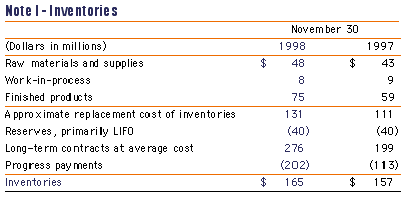
Aerojet's inventories applicable to government contracts include general and administrative costs. The total of such costs incurred in 1998 and 1997 was $79 million and $72 million, respectively, and the amount in inventory at the end of those years is estimated at $29 million and $24 million, respectively.
Inventories using the LIFO method represented 68 percent of inventories at replacement cost at November 30, 1998 and 1997.
Note J - Employee Benefit Plans
In February 1998, the FASB issued Statement No. 132, "Employers' Disclosures about Pensions and Other Postretirement Benefits" (SFAS 132). SFAS 132 supersedes the disclosure requirements in Statements No. 87, "Employers' Accounting for Pensions", No. 88, "Accounting for Settlements and Curtailments of Defined Benefit Pension Plans and for Termination Benefits", and No. 106, "Employers' Accounting for Postretirement Benefits Other Than Pensions." SFAS 132 addresses disclosure issues only and did not change the measurement or recognition provisions specified in those Statements.
Pension Plans - The Company has a number of defined benefit pension plans which cover substantially all salaried and hourly employees. Normal retirement age is generally 65, but certain plan provisions allow for earlier retirement. The Company's funding policy is consistent with the funding requirements of federal law. The pension plans provide for pension benefits, the amounts of which are calculated under formulas principally based on average earnings and length of service for salaried employees and under negotiated non-wage based formulas for hourly employees. The majority of the pension plans' assets are invested in short-term investments, listed stocks and bonds.
Health Care Plans - In addition to providing pension benefits, the Company currently provides certain health care and life insurance benefits to most retired employees in the United States with varied coverage by employee groups. The health care plans generally provide for cost sharing in the form of employee contributions, deductibles and coinsurance between the Company and its retirees. Retirees in certain other countries are provided similar benefits by plans sponsored by their governments.
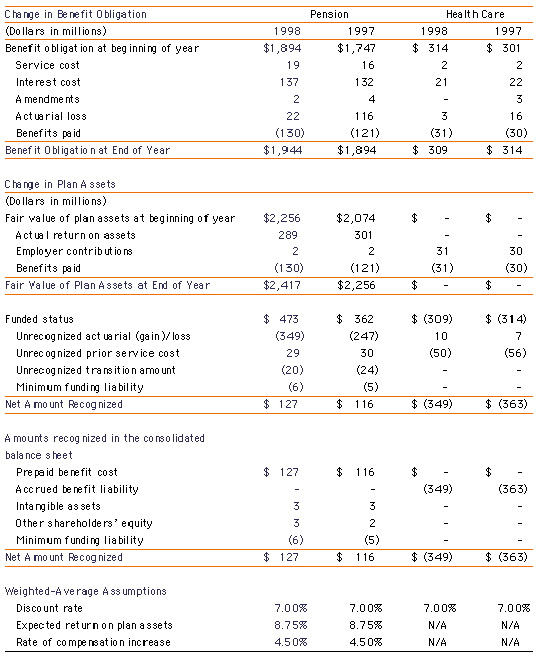
The projected benefit obligation, accumulated benefit obligation and fair value of plan assets for the pension plans with accumulated benefit obligations in excess of plan assets were $30 million, $27 million, and $9 million, respectively, as of November 30, 1998, and $17 million, $15 million, and $0, respectively, as of November 30, 1997.
For measurement purposes, a 9 percent annual rate of increase in the per capita cost of retiree health care benefits was assumed for 1999. The rate was assumed to decrease gradually to 6 percent for 2002 and remain at that level thereafter.
Because most employer benefits are capped, assumed health care cost trend rates have a minimal effect on the amounts reported for the health care plans. A one-percentage point increase/decrease in assumed health care cost trend rates would increase/decrease the benefit obligation at November 30, 1998 by $4 million and increase/decrease the aggregate of the service and interest components of net periodic cost by $0.3 million.
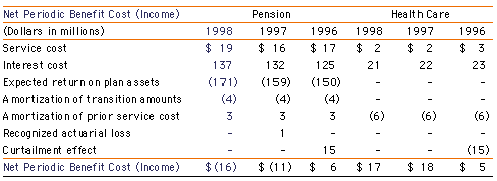
The Company also sponsors a number of defined contribution pension plans. Participation in these plans is available to substantially all salaried employees and to certain groups of hourly employees. Company contributions to these plans are based on either a percentage of employee contributions or on a specified amount per hour based on the provisions of each plan. The cost of these plans was $11 million in 1998 and $10 million in 1997 and 1996. The Company funds its contribution to the salaried plan with either GenCorp common stock or cash.
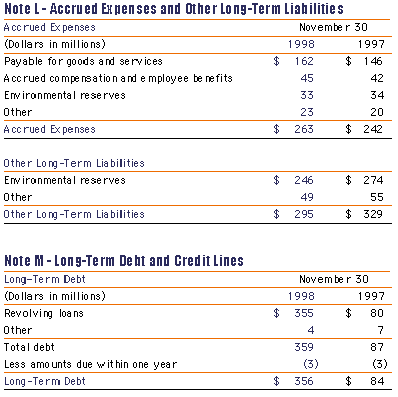
On May 17, 1996, the Company entered into a five-year unsecured $400 million revolving credit facility (Facility) which expires in May 2001. At November 30, 1998, the unused and available balance under this Facility was $120 million. The Company pays a variable commitment fee, which was 1/5 of one percent, on the unused balance. Interest rates were variable, primarily based on LIBOR, and were at an average rate of 5.8 percent at November 30, 1998. The Facility contains various debt restrictions and provisions relating to net worth, interest coverage and debt to earnings before interest, taxes, depreciation and amortization (Debt/EBITDA) ratios. As of November 30, 1998, the Company was required to maintain consolidated net worth of at least $192 million.
On September 30, 1998, the Company entered into a new $75 million revolving credit facility for the purchase of certain assets of Sequa Chemicals, the specialty chemicals unit of Sequa Corporation. This facility is available through April 29, 1999, and it contains various debt restrictions and other provisions which are the same as those in the Facility described above. The rate is 75 basis points over LIBOR. The Company pays a commitment fee of approximately 1/4 of one percent on the unused balance. The Company intends to convert the $75 million revolving credit facility into the Facility at or before the date of expiration. At that time, the unused and available revolving lines of credit on the Facility will be reduced accordingly.
At November 30, 1998, the Company had unsecured, uncommitted lines of credit with several banks for short-term borrowings aggregating $43 million, of which $11 million was outstanding. Interest rates for these lines of credit were variable and were at an average rate of 4.3 percent on November 30, 1998. Borrowings under such lines are payable on demand. The Company also had outstanding letters of credit totaling $22 million at November 30, 1998.
Cash paid during the year for interest was $13 million in 1998, $17 million in 1997 and $28 million in 1996.
Note N - Preferred Share Purchase Rights
In January 1997, the Board of Directors extended for ten additional years GenCorp's Shareholder Rights Plan, as amended (Plan). When the Plan was originally adopted in 1987, the Directors declared a dividend of one Preferred Share Purchase Right (Right) on each outstanding share of common stock, payable to shareholders of record on February 27, 1987. Rights outstanding at November 30, 1998 and 1997 were 41,535,524 and 41,325,459, respectively. The Plan provides that under certain circumstances each Right will entitle shareholders to buy one one-hundredth of a share of a new Series A Cumulative Preference Stock at an exercise price of $100. The Rights are exercisable only if a person or group acquires 20 percent or more of GenCorp's common stock or announces a tender or exchange offer that will result in such person or group acquiring 30 percent or more of the common stock. GenCorp is entitled to redeem the Rights at two cents per Right at any time until ten days after a 20 percent position has been acquired (unless the Board elects to extend such time period, which in no event may exceed thirty days). If the Company is involved in certain transactions after the Rights become exercisable, a holder of Rights (other than Rights beneficially owned by a shareholder who has acquired 20 percent or more of GenCorp's common stock, which Rights become void) is entitled to buy a number of the acquiring company's common shares, or GenCorp's common stock, as the case may be, having a market value
of twice the exercise price of each Right. A potential dilutive effect may exist upon the exercise of the Rights. The Rights under the extended Plan expire on February 18, 2007. Until a Right is exercised, the holder has no rights as a stockholder of the Company including, without limitation, the right to vote as
a stockholder or to receive dividends.
At November 30, 1998, 575,000 shares of $1 par value Series A Cumulative Preference Stock were reserved for issuance upon exercise of Preferred Share Purchase Rights.
Note O - Stock-Based Compensation Plans
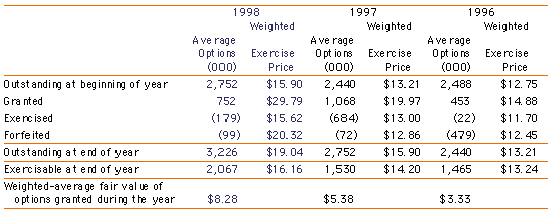
The Company has a 1997 Stock Option Plan and a 1993 Stock Option Plan. Each plan provides for an aggregate of 2,500,000 shares of the Company's common stock to be purchased pursuant to stock options or to be subject to stock appreciation rights (SARs) which may be granted to selected officers and key employees at prices equal to the market value of a share of common stock on the date of grant. In general, options are exercisable in 25 percent increments at six months, one year, two years and three years from date of grant. No stock appreciation rights have been granted.
The Company has elected to follow Accounting Principles Board Opinion No. 25, "Accounting for Stock Issued to Employees" (APB 25) and related Interpretations in accounting for its employee stock options. Under APB 25, because the exercise price of the stock options equals the market price of the underlying stock on the date of grant, no compensation expense is recognized.
If compensation cost for the stock options granted in 1998, 1997 and 1996 had been determined based on the fair value method of FASB Statement No. 123, "Accounting for Stock-Based Compensation" (SFAS 123), the Company's net income and diluted earnings per share would have been reduced by $3 million ($.06 per share), $2 million ($.05 per share) and $1 million ($.02 per share) in 1998, 1997 and 1996, respectively. The pro forma effect on net income for 1997 and 1996 is not representative of the pro forma effect on net income in future years because it does not take into consideration pro forma compensation expense related to grants made prior to 1996. The fair value was estimated at the date of grant using a Black-Scholes option pricing model with the following weighted-average assumptions: risk free interest rates of 4.25 percent for 1998 and 6.0 percent for 1997 and 1996; dividend yield of 2.4 percent for 1998 and 3.1 percent for 1997 and 1996; volatility factor of the expected market price of the Company's common stock of 32 percent for 1998 and 31 percent for 1997 and 1996; and a weighted-average expected life of the option of 5 years for 1998, 1997 and 1996.
A summary of the Company's stock option activity, and related information for the years ended November 30 are as follows:
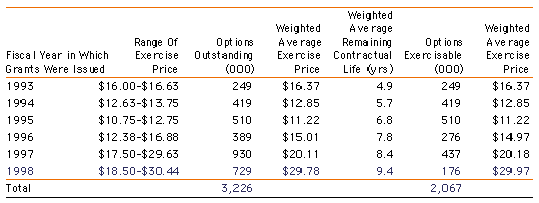
The following table summarizes the range of exercise prices and weighted-average exercise prices for options outstanding and exercisable at November 30, 1998 under the Company's stock option plans:
Note P - Common Stock
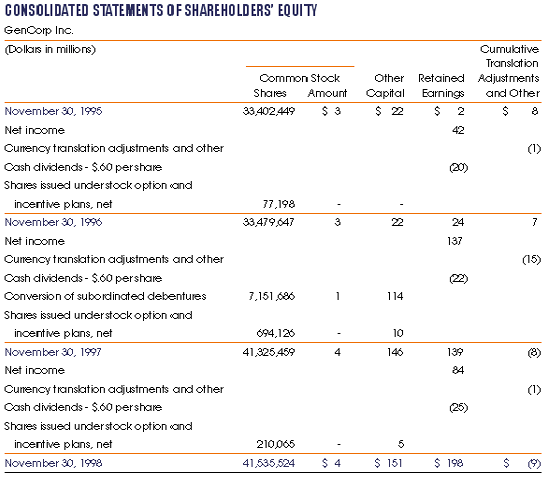
At November 30, 1998, 8,197,609 shares of $.10 par value common stock were reserved for future issuance for discretionary payments of the Company's portion of Retirement Savings Plan contributions, exercise of options and payments of awards under stock-based compensation plans.
Note Q - Lease Commitments
The Company and its subsidiaries lease certain facilities, machinery and equipment and office buildings under long-term, noncancelable leases. The leases generally provide for renewal options ranging from five to ten years and require the Company to pay for utilities, insurance, taxes and maintenance. Rent expense was $9 million in each of 1998, 1997 and 1996. Future minimum commitments at November 30, 1998 for existing operating leases were $34 million with annual amounts declining from $10 million in 1999 to $2 million in 2003. The Company's obligation for leases after 2003 is $6 million.
Note R - Contingencies
Environmental Matters
Sacramento, California - In 1989, the United States District Court approved a Partial Consent Decree (Decree) requiring Aerojet to conduct a Remedial Investigation/Feasibility Study (RI/FS) of Aerojet's Sacramento, California site and to prepare a RI/FS report on specific environmental conditions present at the site and alternatives available to remedy such conditions. Aerojet also is required to pay for certain governmental oversight costs associated with compliance with the Decree. The State of California recently expanded surveillance of perchlorate and nitrosodimethylamine (NDMA) under the RI/FS because these chemicals were detected in public water supply wells near Aerojet's property at previously undetectable levels using new testing protocols.
Aerojet has substantially completed its efforts under the Decree to determine the nature and extent of contamination at the facility and to identify the technologies that will likely be used to remediate the site. The remediation costs are principally for design, construction, enhancement and operation of groundwater and soil treatment facilities, ongoing project management and regulatory oversight, and are expected to be incurred over a period of approximately 15 years. Aerojet is also addressing groundwater contamination off of its facility.
San Gabriel Valley Basin, California - Aerojet, through its Azusa facility, has been named by the U.S. Environmental Protection Agency (EPA) as a potentially responsible party (PRP) in the portion of the San Gabriel Valley Superfund Site known as the Baldwin Park Operable Unit (BPOU). Regulatory action involves requiring site specific investigation, possible cleanup, issuance of a Record of Decision (ROD) regarding regional groundwater remediation and issuance to Aerojet and 18 other PRPs Special Notice letters requiring groundwater remediation.
Aerojet's investigation demonstrated that the principal groundwater contamination, volatile organic compounds (VOC), is upgradient of Aerojet's property and that lower concentrations of VOC contaminants are present in the soils of Aerojet's presently and historically owned properties. The EPA contends that Aerojet is one of the four largest sources of groundwater contamination at the BPOU of the nineteen PRPs identified by the EPA. Aerojet contests the EPA's position regarding the source of contamination and the number of responsible PRPs. Aerojet is participating in a Steering Committee comprised of nineteen of the PRPs.
The ROD and Special Notice letters issued by the EPA require groundwater remediation for the BPOU, estimated to cost $47 million in non-recurring costs and $4 million to $5 million in annual operating expense. Aerojet, as part of the Steering Committee, is participating in an effort to develop an alternative "consensus" plan in which certain water supply entities would integrate the remedial requirements into a water supply project. If implemented, the consensus plan approach would allow the project to be eligible for federal funding for 25 percent of the non-recurring costs and additional funding from water supply entities receiving benefit from the project, thus reducing the PRPs' costs.
Soon after the EPA issued the Special Notice letter, the State of California also detected perchlorate in water wells in Southern California, including the San Gabriel Valley, at previously undetectable levels using new testing protocols. As a result of the recent finding of perchlorate, the EPA has required investigation for and studies regarding treatability of perchlorate contaminated water. Consequently, the EPA has allowed time extensions for submittal by the PRPs of a good faith offer and negotiation of a consent decree in response to the Special Notice letter. More recently, NDMA has been detected in water supply wells, also at previously undetectable levels. The extent of NDMA in the groundwater is being studied. Treatment technology is established. The perchlorate and NDMA investigations and studies are underway, primarily funded by Aerojet. The final perchlorate and NDMA cleanup standards (which have not yet been determined) could impact total cleanup cost, allocation among the PRPs, and implementation of the proposed consensus plan.
Muskegon, Michigan - In a lawsuit filed by the EPA, the United States District Court ruled in 1992 that Aerojet and its two inactive Cordova Chemical subsidiaries (Cordova) are liable for remediation of Cordova's Muskegon, Michigan site, along with a former owner/operator of an earlier chemical plant at the site, who is the other potentially responsible party (PRP). That decision was appealed to the United States Court of Appeals.
In May 1997, the United States Court of Appeals for the Sixth Circuit issued an en banc decision reversing Aerojet's and the other PRP's liability under the CERCLA statute. Petitions for certiorari to the United States Supreme Court for its review of the appellate decision were filed on behalf of the State of Michigan and the EPA and were granted in December 1997. On June 8, 1998, the U.S. Supreme Court issued its opinion. The Court held that a parent corporation could be directly liable as an operator under CERCLA if it can be shown that the parent corporation operated the facility. The Supreme Court vacated the Sixth Circuit's 1997 ruling and remanded the case back to the U.S. District Court in Michigan for retrial. Aerojet does not expect that it will be found liable on remand. Aerojet is involved in settlement discussions with the EPA and expects the filing of a proposed consent decree which, if approved by the District Court, would allow Aerojet and Cordova to be dismissed.
In a separate action, Aerojet and Cordova won indemnification for the Muskegon site investigation and remediation costs from the State of Michigan in the state Court of Claims. The Michigan Court of Appeals affirmed on appeal, and the Michigan Supreme Court refused to hear the case. Further, the Michigan Supreme Court also denied the State's motion for reconsideration. As a result, the Company believes that most of the $50 million to $100 million in anticipated remediation costs will be paid by the State of Michigan and the former owner/operator of the site. A settlement agreement with the State of Michigan, related to the proposed consent decree discussed above, is also being finalized and will be executed contingent on the U.S. consent decree being approved. In addition, Aerojet believes it has insurance coverage for the site.
Aerojet's Reserve and Recovery Balances - On January 12, 1999, having finally received all necessary Government approvals, Aerojet and the U.S. Government implemented, with effect retroactive to December 1, 1998, the October 1997 Agreement in Principle resolving certain prior environmental and facility disagreements between the parties. Under this Agreement, a "global" settlement covering all environmental contamination (including perchlorate) at the Sacramento and Azusa sites was achieved; the Government/Aerojet environmental cost sharing ratio was raised to 88 percent/12 percent from the previous 65 percent/35 percent (with both Aerojet and the Government retaining the right to opt out of this sharing ratio for Azusa only, after at least $40 million in allowable environmental remediation costs at Azusa have been recognized); the cost allocation base for these costs was expanded to include all of Aerojet (in lieu of the prior limitation to the Sacramento business base); and Aerojet obtained title to all of the remaining Government facilities on its Sacramento property, together with an advance agreement recognizing the allowability of certain facility demolition costs.
At November 30, 1998, Aerojet had total reserves of $241 million for costs to remediate the above sites and has recognized $165 million for probable future recoveries. These estimates are subject to change as work progresses, additional experience is gained and environmental standards are revised. Legal proceedings to obtain reimbursements of environmental costs from insurers are continuing.
Lawrence, Massachusetts - The Company has studied remediation alternatives for its closed Lawrence, Massachusetts facility, which was contaminated with PCBs, and has begun site remediation and off-site disposal of debris. The Company has a reserve of $18 million for estimated decontamination and long-term operating and maintenance costs of this site. The reserve represents the Company's best estimate for the remaining remediation costs. Estimates of future remediation costs could range as high as $39 million depending on the results of future testing and the ultimate remediation alternatives undertaken at the site. The time frame for remediation is currently estimated to range from 5 to 10 years.
Other Sites - The Company is also currently involved, together with other companies, in 37 other Superfund and non-superfund remediation sites. In many instances, the Company's liability and proportionate share of costs have not been determined largely due to uncertainties as to the nature and extent of site conditions and the Company's involvement. While government agencies frequently claim PRPs are jointly and severally liable at such sites, in the Company's experience, interim and final allocations of liability costs are generally made based on relative contributions of waste. Based on the Company's previous experience, its allocated share has frequently been minimal, and in many instances, has been less than 1 percent. The Company has reserves of approximately $20 million as of November 30, 1998 which it believes are sufficient to cover its best estimate of its share of the environmental remediation costs at these other sites. Also, the Company is seeking recovery of its costs from its insurers.
Environmental Summary
In regard to the sites discussed above, management believes, on the basis of presently available information, that resolution of these matters will not materially affect liquidity, capital resources or the consolidated financial condition of the Company. The effect of resolution of these matters on results
of operations cannot be predicted due to the uncertainty concerning both the amount and timing of future expenditures and future results of operations.
Other Legal Matters
Olin Corporation - In August 1991, Olin Corporation (Olin) advised GenCorp that Olin believed GenCorp to be jointly and severally liable for certain Superfund remediation costs, estimated by Olin to be $70 million, associated with a former Olin manufacturing facility and waste disposal sites in Ashtabula County, Ohio. In 1993, GenCorp sought declaratory judgment in the United States District Court for the Northern District of Ohio that the Company is not responsible for such environmental remediation costs. Olin counterclaimed seeking a judgment that GenCorp is jointly and severally liable for a share of remediation costs. In late 1995, the Court hearing on the issue of joint and several liability was completed, and in August 1996 the Court held hearings relative to allocation. The Court has not yet rendered a decision and, at its request, in 1998, it received an additional briefing regarding the impact of the recent Best Foods Supreme Court decision which the Company believes definitively addresses many issues in this case in its favor. Another hearing relative to liability and allocation was held on January 11, 1999.
The parties argued their respective positions based on recent case law. The judge indicated that a decision may be forthcoming in the next several months. If the Court finds GenCorp is liable, subsequent trial phases will address damages.
The Company continues to vigorously litigate this matter and believes that it has meritorious defenses to Olin's claims. While there can be no certainty regarding the outcome of any litigation, in the opinion of management, after reviewing the information currently available with respect to this matter and consulting with the Company's counsel, any liability which may ultimately be incurred will not materially affect the consolidated financial condition of the Company.
Other Matters - The Company and its subsidiaries are subject to various other legal actions, governmental investigations, and proceedings relating to a wide range of matters in addition to those discussed above. In the opinion of management, after reviewing the information which is currently available with respect to such matters and consulting with the Company's counsel, any liability which may ultimately be incurred with respect to these additional matters will not materially affect the consolidated financial condition of the Company. The effect of resolution of these matters on results of operations cannot be predicted because any such effect depends on both future results of operations and the amount and timing of the resolution of such matters.
Note S - Business Segment Information
The aerospace and defense business segment designs, develops and manufactures propulsion systems and electronic sensor systems for the Department of Defense and National Aeronautics and Space Administration. Its primary businesses are Propulsion, Electronic Systems and Fine Chemicals (formerly Custom Chemicals).
The automotive business segment, the Company's Vehicle Sealing business unit, designs and produces extruded rubber for vehicle body and window sealing systems for the domestic, transplant and foreign automotive manufacturers.
The polymer products business segment designs and manufactures performance chemicals and decorative and building products for consumers and industry. The segment is a leading producer of polymer-based products and operates three businesses: Decorative & Building Products, Penn Racquet Sports and Performance Chemicals. The principal markets include the paper industry, residential and commercial construction and the sporting goods industry, as well as varied consumer and industrial markets that demand a broad range of thermoplastic products. On December 14, 1998, the Company announced it had initiated the process for divesting the Penn Racquet Sports division and sold its residential wallcovering business.
Sales in 1998, 1997 and 1996 to the U.S. Government and its agencies (principally the Department of Defense) totaled $596 million, $516 million and $466 million, respectively, and were generated almost entirely by the aerospace and defense business segment. Sales to General Motors, primarily by the automotive business segment, were $172 million in 1998, $174 million in 1997 and $170 million in 1996. Intersegment sales were not material.
Segment operating profit represents net sales less applicable costs, expenses and provisions for restructuring and unusual items relating to operations. Segment operating profit excludes corporate income and expenses, provisions for nonoperating unusual items, interest expense and income taxes.
In 1998, the Company recognized unusual income of $5 million related to the Company's reportable segments. The unusual income consisted of a charge of $8 million primarily related to exiting the plastic extrusions appliance gasket and residential wallcovering businesses offset by a gain of $13 million from the sale of surplus land in Nevada by Aerojet.
In 1996, the Company recognized an unusual loss of $42 million of which $13 million related to the Company's reportable segments. The unusual loss from reportable segments consisted of $14 million from the divestiture of the Vibration Control and Reinforced Plastics businesses and a provision of $3 million for the restructuring of the Vehicle Sealing business unit offset by a gain of $4 million from the sale of the structural urethane adhesives business. The Vibration Control and Reinforced Plastics businesses were part of the automotive business segment. The structural urethane adhesives business was part of the polymer products business segment.