OPERATING RESULTS
Westar
Energy Consolidated
2002
compared to 2001
We reported
a loss of $11.06 per share in 2002 compared
to a loss of $0.31 per share in 2001.
This greater loss per share was due
primarily to the 2002 impairment charges
related to monitored services goodwill
and customer accounts. A decline in
monitored services revenues also contributed
to the loss. Improved results from utility
operations and declines in cost of sales
and operating expenses and increases
in other income from monitored services
partially offset these items. For additional
information, see the segment discussions
below.
2001
compared to 2000
We reported
a loss of $0.31 per share in 2001 compared
to earnings of $1.96 per share in 2000.
This decrease resulted from decreased
electricity sales caused by milder weather,
the decrease in electric rates in accordance
with the July 25, 2001 KCC rate order,
higher operating losses in our monitored
services segment, and the fourth quarter
charge related to a work force reduction.
Additionally, investment earnings and
extraordinary gains on the retirement
of debt were lower in 2001 than in 2000.
Segments of
Business
Our business
is segmented based on differences in
products and services, production processes
and management responsibility. We have
identified three reportable segments:
Electric Utility, Monitored Services
and Other.
- Electric
Utility consists of our integrated
electric utility operations, including
the generation, transmission and
distribution of power to our retail
customers in Kansas and to wholesale
customers, and our power marketing
activities.
- Monitored
Services, including the net effect
of minority interests, is composed
of our security alarm monitoring
businesses in the United States
and Europe.
- Other includes
our approximate 45% ownership
interest in ONEOK at December
31, 2002, (which was reduced to
a 27.5% interest on February 5,
2003), and other investments in
the aggregate not material to
our business or results of operations.
We
manage our business segments’ performance based on their earnings
(losses) before interest and taxes (EBIT) because EBIT is the primary
measurement used by our management to evaluate segment performance.
Our business managers have direct control over the items that affect
the EBIT of their segments and we therefore believe EBIT is an appropriate
measure of segment performance. EBIT does not represent cash flow
from operations as defined by GAAP, should not be construed as an
alternative to operating income and is indicative neither of operating
|
|
performance nor cash flows available
to fund our cash needs. Items excluded from EBIT are significant
components in understanding and assessing our financial performance.
Interest expense, income taxes, discontinued operations, cumulative
effects of accounting changes and preferred dividends are items
that are excluded from the calculation of EBIT. Our computation
of EBIT may not be comparable to other similarly titled measures
of other companies. We provide a reconciliation of EBIT to GAAP
income measurements in Note 32 of the Notes to Consolidated Financial
Statements, “Segments of Business.”
Electric
Utility
We supply electric
energy at retail to approximately 647,000
customers in Kansas including the communities
of Wichita, Topeka, Lawrence, Manhattan,
Salina and Hutchinson. We classify our
customers as residential, commercial
and industrial as defined in our tariffs.
We also supply electric energy at wholesale
to the electric distribution systems
of 62 Kansas cities and four rural electric
cooperatives. We have contracts for
the sale, purchase or exchange of wholesale
electricity with other utilities. In
addition, we have power marketing operations
that purchase and sell electricity in
areas outside our historical service
territory.
Regulated electric
utility sales are significantly impacted
by such things as regulation (including
rate regulation), customer conservation
efforts, wholesale demand, the overall
economy of our service area, the weather
and competitive forces. Our wholesale
sales are impacted by demand outside
our service territory, the cost of fuel
and purchased power, price volatility
and available generation capacity.
Our electric sales
for the three years ended December 31
were as follows:
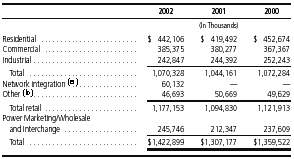
(a)Network Integration:
Reflects a new network transmission tariff that requires us to pay
to the Southwest Power Pool (SPP) all expenses associated with transporting
power from our generating stations. The SPP then pays us for transmitting
power to the point of delivery into our retail distribution system.
These receipts from the SPP are reflected in revenues under the
network integration classification. For further information, see
“— Other Information — Electric Utility — Network Integration Transmission
Service” below.
(b)Other:
Includes public street and highway lighting and miscellaneous electric
revenues.
|


