|
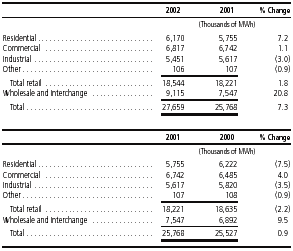
The following tables show changes in electric sales volumes, as
measured by thousands of megawatt hours (MWh) of electricity we
generate, for the three years ended December 31. No sales volumes
are shown for network integration or power marketing because these
activities are not related to electricity we generate.
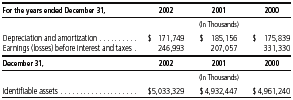
Details concerning EBIT and assets attributable
to our electric utility segment are
summarized in the tables below:
2002 compared
to 2001: Energy sales increased $115.7 million, or 9%, due
primarily to the $60.1 million in new network integration tariff
revenues (see “— Other Information — Electric Utility — Network
Integration Transmission Service”), a $33.4 million increase in
power marketing, wholesale and interchange revenues and a $27.7
million increase in residential and commercial electric sales revenues.
Power marketing, wholesale and interchange revenues increased primarily
as a result of increased sales volumes, offset by lower wholesale
prices. Favorable weather conditions and a slight increase in the
number of utility customers contributed to the increase in residential
and commercial electric sales revenues, which were offset by lower
retail rates and decreased industrial revenues related to weak economic
conditions.
Cost of sales
decreased $15.4 million, or 4%, due
primarily to a $14.6 million decrease
in purchased power expense. Purchased
power expense decreased due primarily
to the increased availability of our
generating units and lower prices.
Gross profit increased
$131.2 million, or 14%, for the reasons
discussed above. This increase in gross
profit also reflects the impact of the
adoption of SFAS No. 133 on January
1, 2001.
|
|
This new standard
required that we report a $31.0 million
gain in 2001 on certain derivative contracts
(derivatives) as a cumulative effect
of a change in accounting principle
rather than include the gain in gross
profit. All gains and losses after January
1, 2001 on our derivatives that are
not designated as hedges are reflected
in gross profit. Had we included the
$31.0 million gain in revenues in 2001,
gross profit would have increased $100.1
million rather than $131.2 million.
Operating expenses
increased $69.0 million, or 10%, due
primarily to the charges associated
with the network integration transmission
tariff, reserve for potential liabilities
to Mr. Wittig and Mr. Lake, employee
severance costs related to the work
force reduction and the compensation
expense associated with an exchange
of previously granted restricted share
units as discussed in Note 15 of the
Notes to Consolidated Financial Statements,
“Employee Benefit Plans — Stock Based
Compensation Plans.” These increases
were partially offset by a $13.4 million
decrease in depreciation expense related
to the change in depreciation rates
as discussed above in “— Critical Accounting
Policies — Depreciation.” In addition,
our maintenance expense declined $22.6
million, or 19%, due primarily to the
lower forced outage rates of our generating
units.
Due to the above
factors, income from utility operations
increased $62.2 million, or 29%. A decrease
in other expense of $22.3 million was
due primarily to recording a non-cash
mark-to-market charge on the call option
of the putable/callable notes as discussed
in “— Liquidity and Capital Resources”
below. EBIT increased $39.9 million
as a result.
2001
compared to 2000: Energy sales
decreased $52.3 million, or 4%. Residential
sales declined 7% and power marketing,
wholesale and interchange sales declined
11%. Residential sales decreased due
to weather conditions and our rate decrease,
while power marketing, wholesale and
interchange sales decreased because
of lower prices and more power available
in the market. Cost of sales increased
$13.7 million, or 4%, which was due
principally to an increase in our natural
gas fuel expenses resulting from the
purchase of fuel for new generating
units that began operating during 2001.
As a result of
the decline in sales and the increase
in cost of sales, gross profit decreased
$66.0 million, or 7%. This decline in
gross profit also reflects the impact
of the adoption of SFAS No. 133 on January
1, 2001. This new standard required
that we report a $31.0 million gain
on certain derivatives as a cumulative
effect of a change in accounting principle
rather than include the gain in gross
profit. Had we been permitted to classify
this accounting change as an increase
to revenues, gross profit would have
declined by $35.0 million rather than
$66.0 million.
Operating expenses
increased $45.7 million due primarily
to recording approximately $8.7 million
of costs associated with the terminated
Public Service Company of New Mexico
merger transaction, approximately $14.3
million in employee-severance costs
related to the 2001 work force reductions,
an increase in our pension and benefit
expenses and an increase in general
maintenance expenses.
|


