       |
               |
|
|
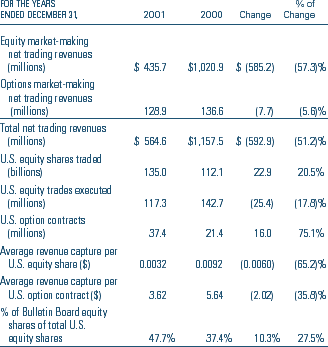
Revenues Net trading revenue from equity security market-making decreased 57.3% to $435.7 million in 2001, from $1,020.9 million in 2000. Equity trading revenues are almost entirely comprised of revenues from U.S. equity market-making. This decrease in equity trading revenue was primarily due to the 65.2% decrease in average revenue capture per share. Average revenue capture per share was impacted by a reduction in spreads due to decimalization in 2001 and the reduction in the average market price of shares traded.The decrease in net trading revenues due to average revenue capture per share was offset, in part, by a 20.5% increase in U.S. equity share volume. However, the majority of the increase in U.S. equity share volume was due to higher share volume in low-priced Bulletin Board and Pink Sheet stocks, which have a lower revenue capture per share. Net trading revenue from options market-making decreased 5.6% to $128.9 million in 2001, from $136.6 million in 2000.The decrease was primarily due to a 35.8% decrease in the average revenue capture per contract, partially offset by a 75.1% increase in U.S. option contract volume. Our U.S. option contract volume was positively impacted by KFP’s purchases of additional exchange posts during 2001, which increased our overall options market-making coverage. |
 |
|
| Commissions and fees increased 47.3% to $47.9 million in 2001, from
$32.5 million in 2000.This increase is primarily due to commissions
received by our professional option execution services business, Knight
Execution Partners LLC (“KEP”), for directing order executions,
as well as higher U.S. equity share volumes from institutions in listed
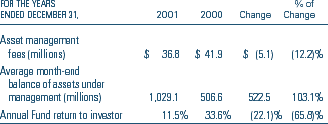
securities. Asset management fees decreased 12.2% to $36.8 million in 2001 from $41.9 million in 2000. The decrease in fees was primarily due to a decrease in fund returns from 33.6% in 2000 to 11.5% in 2001. The decrease was offset, in part, by the increase in the average month-end balance of funds under management in the Deephaven Fund, which increased to $1.0 billion during 2001, from $507 million during 2000. |
|
 |
|
| Interest income, net of interest expense, increased 54.6% to $24.9
million in 2001, from $16.1 million in 2000.This increase was primarily
due to changes in the composition of our market-making positions. Investment income and other income increased 13.1% to $10.4 million in 2001, from $9.2 million in 2000. This increase was primarily due to an increase in benefits received from a state employment incentive grant. Expenses Employee compensation and benefits expense decreased 40.6% to $250.0 million in 2001, from $421.2 million in 2000. The decrease was primarily due to decreased incentive compensation as a result of the 51.2% decrease in net trading revenue. Due to a decrease in revenues and our profitability, employee headcount was reduced during 2001. Our number of full time employees decreased to 1,307 at December 31, 2001, from 1,364 full time employees at December 31, 2000. |
|
 |
