|
|
Holding the Line in Derivative Markets
Knight's Derivative Markets business segment returned to operating
profitability and maintained market share in 2003 despite industrywide
challenges. In the course of our thorough review of this segment we lowered expenses, principally through staff cuts, and
reduced rebates. We diversified our revenue stream by expanding
our fixed income derivative market making and building a commodity
derivative market-making business. To help our broker-dealer
clients ensure best execution, we enhanced our proprietary
order routing and management technology. At the same time, we
increased our offering to our equity derivative clients by establishing
an institutional options and exchange traded fund sales trading desk.
Our review of Derivative Markets will continue in 2004. Today's
heightened market structure dynamics, greater investment
demands for technology innovation and increasingly competitive
margins continue to test our ability to produce attractive returns.
For the short term, we will navigate our course by leveraging our
technology investment and trading expertise into a wider array of
asset classes, continuing to offer unique services to our clients and
controlling the marginal costs of clearing and execution.
Establishing Long-Term Plans For Asset Management
The most important event in 2003 in our Asset Management
segment, Deephaven Capital Management, was the signing of
long-term employment contracts with key members of that
business' executive management. Deephaven and its market
neutral funds have been a major contributor to our operating
income, particularly in 2002 and 2003. Deephaven provides a
diverse revenue stream compared to more market-sensitive
equities and options. In addition, Knight's investment in the
funds — which reached $201.1 million at the end of 2003 — generates
solid returns for the company. Since Deephaven represents a
clear value as part of Knight, and because traditional hedge fund
investors are extremely sensitive to management stability, we
believe these contracts work in everyone's favor.
The Deephaven management team's goal in 2004, in addition to
maintaining its strong fund performance record, is to expand its
offerings and to grow assets under management by articulating its
strengths and strategy to a broader client base than it has in the past.
Moving From Foundation To Future
Knight's effort to rebuild the company's foundation — all of the
hard work I described — was helped by market conditions in 2003.
Major indices finished higher through a year that saw investors
begin to put more money back into the market.
In 2004, we expect that there will be some interesting and potentially
positive market structure developments. In late February the SEC
asked for comment on a series of market structure proposals, due
in late May 2004. The staff is considering changes to the tradethrough
rule, the elimination of trading in sub-penny increments,
caps on access fees, and adjustments to market data revenue distribution.
Knight has always advocated a more level playing field and
a competitive environment for the various participants in the market,
and we are looking forward to contributing to this dialogue.
As we manage through these market structure and other developments,
seen and unseen, we look to our board of directors for
continued insight and leadership. Over the last year, Knight's
board has actively pursued best practices in corporate governance,
adding two new independent directors as part of its efforts.
Veteran news executive William L. Bolster was named a director
in November 2003 after his retirement from CNBC, and former
audit partner Thomas C. Lockburner joined the board in February
2004 after more than 40 years at Deloitte & Touche.
If 2002 was a year of crisis and change for Knight, 2003 was a
year of repair and transition. While hard work turned the company
around and the market provided good reinforcement, it was the
dedication, trust and loyalty of our employees, clients and shareholders
that sustained us through the difficulties of the last few
years. With their support, Knight not only produced strong 2003
financial results, but our market capitalization surpassed $1 billion.
A company's reputation is, by all means, a hard thing to measure.
But a survey from a respected third party indicated that Knight
made significant progress. The company received higher scores for
three attributes — quality of management, reputation and investment
potential. We also know we are making headway because we've
expanded our institutional client base and grown our institutional
share ownership. These two groups are increasingly converging as
our institutional shareholders learn more about Knight's execution
capabilities, and our institutional clients recognize Knight's value
as an investment.
In 2004, we will build on the progress we've made. We also will
better define Knight's value — to our clients, and to the marketplace.
We will be a significant, long-term player.
We believe we have what it takes.
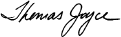
Thomas M. Joyce
Chief Executive Officer & President
Knight Trading Group, Inc.
March 31, 2004
|
|
|
|