| |
QUANTITATIVE AND QUALITATIVE
DISCLOSURES ABOUT MARKET RISK
Our market-making and trading activities expose our capital to significant
risks. These risks include, but are not limited to, absolute and relative
price movements, price volatility and changes in liquidity, over which we
have virtually no control.
We employ automated proprietary trading and risk management systems which
provide real-time risk management and inventory control. We monitor our
risks by a constant review of trading positions and their appropriate risk
measures. We have established a system whereby
transactions are monitored by senior management on a real-time basis as
are individual and aggregate dollar and inventory position totals, appropriate
risk measures and real-time profits and losses. The management of trading
positions is enhanced by review of mark-to-market valuations and position
summaries on a daily basis.
In the normal course of our equities market-making business, we maintain
inventories of exchange-listed and OTC equity securities. The fair value
of these securities at December 31, 2001 and 2000 was $152.8 million and
$256.4 million, respectively, in long positions and
$153.6 million and $70.0 million, respectively, in short positions. Additionally,
at December 31, 2001, we have $137.5 million in long positions and $70.5
million in short positions in accounts managed by Deephaven. The potential
change in fair value, using a hypothetical
10.0% decline in prices, is estimated to be a $6.6 million loss and a $18.6
million loss as of December 31, 2001 and 2000, respectively, due to the
offset of losses in long positions with gains in short positions. The following
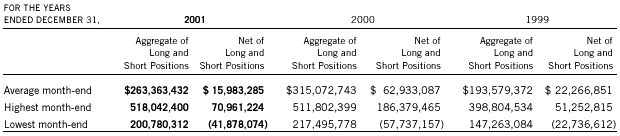
table illustrates, for the period indicated, our average,
highest and lowest month-end inventory at market value (based on both the
aggregate and the net of the long and short positions of trading securities
from our OTC and exchange-listed market making business).
In the normal course of our options market-making business, we maintain
inventories of options, futures and equities. Our main exposure is from
equity price and volatility risk. We manage these exposures by constantly
monitoring and diversifying our exposures and position sizes and establishing
offsetting hedges. Our marketmaking staff and trading room managers continuously
manage our positions and our risk exposures. Our systems incorporate trades
and update our risk profile using options pricing models on a real-time
basis. Our proprietary options risk
management system allows us to stress test our portfolio on a real-time
basis. On a daily basis, risk reports are distributed to senior management
and the firm's risk managers who incorporate this information in our daily
market-making decisions. These reports identify potential exposures in
terms of options and futures on individual securities and index contracts,
organized in different ways such as industry sectors, under extreme price
and volatility movements. At December 31, 2001, 10% movements in volatility
and stock prices on our entire equity options and equity index options
portfolios, which contain the majority of our market risk, would have
resulted in approximately the following gains (losses) in our options
market making portfolio:
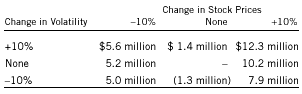
This stress analysis covers positions in options and futures, underlying
securities and related hedges. The 10% changes in stock prices and volatility
in the chart to the left make the assumption of a universal 10% movement
in all of our underlying positions. The analysis also includes a number
of estimates that we believe to be reasonable, but cannot assure that
they produce an accurate measure of future risk.
For working capital purposes, we invest in money market funds, commercial
paper, government securities or maintain interest-bearing balances in
our trading accounts with clearing brokers, which are classified as cash
equivalents and receivable from clearing brokers, respectively, in the
Consolidated Statements of Financial Condition. These other amounts do
not have maturity dates or present a material market risk, as the balances
are shortterm in nature and subject to daily repricing. Our cash
and cash equivalents held in foreign currencies are subject to the exposure
of foreign currency fluctuations. These balances are monitored daily,
and are not material to the Company's overall cash position.
|
|
 |
|