|
Henkel-Ecolab
Prior to November 30, 2001, the company operated cleaning and
sanitizing businesses in Europe through a 50 percent economic
interest in the Henkel-Ecolab joint venture. On November 30, 2001,
Ecolab purchased the remaining 50 percent interest of Henkel-Ecolab
it did not previously own from Henkel KGaA. Additional details
related to this purchase are included in Note 4 of the notes to
consolidated financial statements.
The company included the results of Henkel-Ecolab operations in
its financial statements using the equity method of accounting
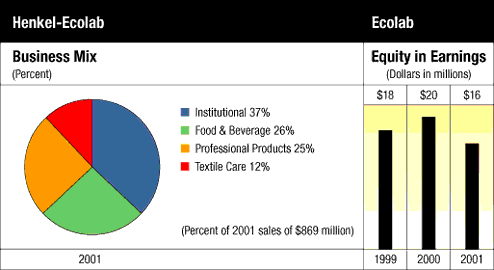
through November 30, 2001. The company’s equity in earnings of
Henkel-Ecolab, which includes royalty income and goodwill amortization,
was $16 million in 2001, a decrease of 19 percent when compared
to $20 million in 2000. When measured in euros, net income of
Henkel-Ecolab for 2001 decreased 13 percent and reflected lower
sales volumes driven by slowing economies and increasing raw material,
energy and other costs, which were partially offset by price increases.
Henkel-Ecolab
sales, although not consolidated in Ecolab’s financial statements,
increased 4 percent when measured in euros. Sales reflected the
impact of Europe’s slowing economies and reduced orders from distributors
as they lowered inventory levels. When measured in U.S. dollars,
Henkel-Ecolab sales were flat when compared to the prior year
due to the negative effects of a stronger U.S. dollar.
Ecolab consolidated Henkel-Ecolab’s operations effective with
the November 30, 2001 acquisition date and end of Henkel-Ecolab’s
fiscal year for 2001. Because the company consolidates its International
operations on the basis of their November 30 fiscal year ends,
Henkel-Ecolab’s balance sheet has been consolidated with Ecolab’s
balance sheet as of year-end 2001. The income statement for the
European operations will be consolidated with Ecolab’s operations
beginning in 2002.
2000 compared with 1999
The
company’s equity in earnings of Henkel-Ecolab increased 7 percent
to $20 million in 2000 from $18 million in 1999. When measured
in euros, earnings of Henkel-Ecolab increased 18 percent and reflected
the benefits of good sales growth, improved income margins, a
lower effective income tax rate and tight cost controls, which
more than offset investments in the sales-and-service force.
Sales of Henkel-Ecolab increased 7 percent when measured in euros.
All major business lines contributed to the overall sales growth
for 2000. Sales continued to benefit from expansion of global
contracts, new product introductions and acquisitions. Henkel-Ecolab
sales decreased 7 percent when measured in U.S. dollars due to
the negative effects of a stronger U.S. dollar.
Corporate
Corporate operating expense totaled $5 million in 2001, compared
with corporate operating income of $18 million in 2000 and corporate
operating expense of $5 million in 1999. Historically, corporate
operating expense includes overhead costs directly related to
the Henkel-Ecolab joint venture. However, in 2000, corporate operating
income also included the $25.9 million gain on the sale of the
Jackson business, special charges of $7.1 million and income of
$4.4 million for net reductions in probable losses related to
certain environmental matters.
Interest and Income Taxes
Net interest expense for 2001 was $28 million, an increase of
16 percent over net interest expense of $25 million in 2000. This
increase reflected higher debt levels during the year, including
the additional debt incurred to purchase the remaining 50 percent
of Henkel-Ecolab.
Net interest expense of $25 million for 2000 increased 8 percent
over net interest expense of $23 million in 1999. This increase
reflected higher average debt levels during 2000 incurred to fund
stock repurchases and business acquisitions.
The company’s effective income tax rate was 40.5 percent for 2001,
a decrease from the effective income tax rates in 2000 and 1999
of 40.7 percent and 41.1 percent, respectively. Excluding the
effects of the sale of Jackson and special charges, the effective
income tax rate for 2000 was 40.5 percent. The decrease in the
2001 and 2000 effective tax rates from 1999 was principally due
to lower overall effective rates on earnings of International
operations. International’s effective income tax rate varies from
year-to-year with the pre-tax income mix of the various countries
in which the company operates. The 1999 effective income tax rate
also benefited slightly from a one-time gain of $1.5 million related
to the demutualization of an insurance company.
|