|
Financial
Position
The
company has maintained its long-term financial objective of an
investment-grade balance sheet since 1993. The company’s debt
continued to be rated within the “A” categories by the major rating
agencies during 2001. Significant changes in the company’s financial
position during 2001 and 2000 included the following:
-
Total assets reached $2.5 billion at December 31, 2001, an increase
of 47 percent over total assets of $1.7 billion at year-end
2000. At year-end 2001, the balance sheet of Henkel-Ecolab was
consolidated with the company’s balance sheet due to the acquisition
of the remaining 50 percent of Henkel-Ecolab from Henkel KGaA.
Total assets as of November 30, 2001 increased approximately
$0.7 billion as a result of this acquisition and the consolidation
of Henkel-Ecolab.
During
2000, total assets increased to $1.7 billion at year-end 2000
from $1.6 billion at year-end 1999. This increase reflects growth
in ongoing operations and assets added through business acquisitions
over the year. The increase in goodwill and other intangible
assets was primarily due to the acquisition of Spartan, Southwest
Sanitary Distributing Company and Facilitec in 2000. Accounts
receivable, inventories and property, plant and equipment were
also added in 2000 as a result of these acquisitions.
-
Working capital levels increased to $102 million at December
31, 2001 from $69 million at year-end 2000 reflecting lower
levels of current liabilities prior to the Henkel-Ecolab acquisition,
as well as increases in accounts receivable and inventory due
to the consolidation of Europe’s balance sheet for the first
time as of year-end 2001. During 2001, short-term debt increased
approximately $97 million due to the issuance of commercial
paper to finance the acquisition of Henkel-Ecolab. Working capital
levels at year-end 2000 of $69 million were down from $107 million
at year-end 1999 reflecting higher levels of short-term debt,
accounts payable and other current liabilities.
-
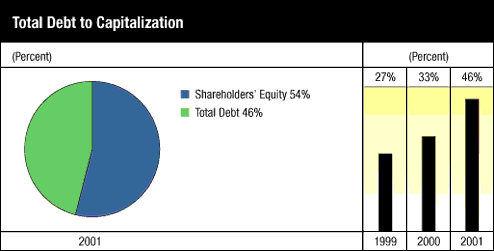
Total debt was $746 million at December 31, 2001 and increased
from total debt of $371 million at year-end 2000 and $281 million
at year-end 1999. Additional commercial paper borrowings were
incurred during 2001 to fund the acquisition of the remaining
50 percent of Henkel-Ecolab. At December 31, 2001, the company
classified $265.9 million of commercial paper borrowings as
long-term debt. In February 2002, the company refinanced $265.9
million of commercial paper borrowings through the issuance
of euro 300 million of Eurobonds. The company reduced debt under
its 9.68 percent Senior Notes through scheduled debt repayments
during both 2001 and 2000. As of December 31, 2001, the ratio
of total debt to capitalization rose to 46 percent, from 33
percent at year-end 2000 and 27 percent at year-end 1999. The
higher debt to capitalization ratio for 2001 was due to funding
for the company’s acquisition of Henkel-Ecolab. The increase
in the debt to capitalization ratio for 2000 was due to funding
for the company’s share repurchase program.
Cash
Flows
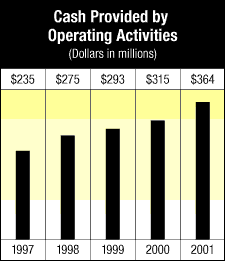
Cash
provided by operating activities reached a new record high of
$364 million for 2001, an increase from $315 million in 2000 and
$293 million in 1999. The operating cash flow for 2001 increased
due to a reduction in year-end accounts receivable and the additional
cash flows generated by business acquisitions. The operating cash
flow increase during 2000 benefited from strong earnings growth,
including additional earnings and cash flows from businesses acquired.
Changes in net operating asset levels positively affected the
operating cash flow by approximately $10 million in 2001 and negatively
affected it by approximately $2 million in 2000 and $16 million
in 1999.
 Cash
flows used for investing activities included capital expenditures
of $158 million in 2001, $150 million in 2000 and $146 million
in 1999. Worldwide additions of merchandising equipment, primarily
cleaning and sanitizing product dispensers, accounted for approximately
70 percent of each year’s capital expenditures. Merchandising
equipment is depreciated over 3 to 7 year lives. The company also
continued to invest in additional manufacturing facilities through
construction and business acquisitions in order to meet sales
requirements more efficiently. Cash used for businesses acquired
included Henkel-Ecolab in 2001, Spartan and Facilitec in 2000
and Blue Coral in 1999. Investing cash flow activity also included
the proceeds from the sale of the Jackson business in 2000 and
the sale of certain Gibson businesses and duplicate facilities
in 1999 which the company chose not to retain. Cash
flows used for investing activities included capital expenditures
of $158 million in 2001, $150 million in 2000 and $146 million
in 1999. Worldwide additions of merchandising equipment, primarily
cleaning and sanitizing product dispensers, accounted for approximately
70 percent of each year’s capital expenditures. Merchandising
equipment is depreciated over 3 to 7 year lives. The company also
continued to invest in additional manufacturing facilities through
construction and business acquisitions in order to meet sales
requirements more efficiently. Cash used for businesses acquired
included Henkel-Ecolab in 2001, Spartan and Facilitec in 2000
and Blue Coral in 1999. Investing cash flow activity also included
the proceeds from the sale of the Jackson business in 2000 and
the sale of certain Gibson businesses and duplicate facilities
in 1999 which the company chose not to retain.
Financing cash flow activity included cash used to reacquire shares
and pay dividends and cash provided and used through the company’s
debt arrangements. In May 2000, the company announced a program
to repurchase up to $200 million of its common stock. Share repurchases
totaled $32 million in 2001, $187 million in 2000 and $42 million
in 1999. These repurchases were funded with operating cash flows
and additional debt. In December 2000, the company announced an
authorization to repurchase up to 5 million additional shares
of common stock.
In
2001, the company increased its annual dividend rate for the tenth
consecutive year. The company has paid dividends on its common
stock for 65 consecutive years. Cash dividends declared per share
of common stock, by quarter, for each of the last three years
were as follows:
| |
First
Quarter |
Second
Quarter |
Third
Quarter |
Fourth
Quarter |
Year |
| 2001 |
$0.13 |
$0.13 |
$0.13 |
$0.135 |
$0.525 |
| 2000 |
0.12 |
0.12 |
0.12 |
0.13 |
0.49 |
| 1999 |
0.105 |
0.105 |
0.105 |
0.12 |
0.435 |
Liquidity
and Capital Resources
The
company currently expects to fund all of the requirements which
are reasonably foreseeable for 2002, including new program investments,
scheduled debt repayments, dividend payments, possible acquisitions,
and share repurchases from operating activities, including cash
flows from the recently acquired Henkel-Ecolab operations, and
funds raised through the February 2002 Eurobond issuance and commercial
paper issuance. Cash provided by operating activities reached
an all-time high of $364 million in 2001, despite the impact of
deteriorating economic conditions on key customer segments. While
cash flows could be negatively affected by a decrease in revenues,
the company does not believe that its revenues are highly susceptible,
over the short run, to rapid changes in technology within our
industry. The company has a $450 million U.S. commercial paper
program and a 200 million Australian dollar commercial paper program.
Both programs are rated A-1 by Standard & Poor’s and P-1 by
Moody’s. To support its commercial paper programs, the company
maintains a $275 million multi-year committed credit agreement
(terminating December 2005) and a $175 million 364-day committed
credit facility (terminating December 2002). The company can draw
directly on both credit facilities. As of February 14, 2002, approximately
$167.5 million of these credit facilities were committed to support
outstanding commercial paper, leaving $282.5 million available
for other uses. Additional details on the company’s credit facilities
are included in Note 6 of the notes to consolidated financial
statements.
The company does not have relationships with unconsolidated entities
or financial partnerships, such as entities often referred to
as structured finance or special purposes entities, which would
have been established for the purpose of facilitating off-balance
sheet financial arrangements or other contractually narrow or
limited purposes. As such, the company is not materially exposed
to any financing, liquidity, market or credit risk that could
arise if Ecolab had engaged in such relationships.
A schedule of the company’s obligations under various long-term
debt agreements and operating leases with noncancelable terms
in excess of one year are summarized in the following table:
| |
|
Payments
due by Period |
| Contractual
Obligations |
Total |
Less
than
1 Year |
2-3
Years |
4-5
Years |
After
5
Years |
| Long-term
debt |
$515,367 |
$
3,087 |
$12,790 |
$77,020 |
$422,470 |
| Operating
leases |
90,807 |
25,885 |
33,895 |
18,528 |
12,499 |
| |
|
|
|
|
|
Total
contractual
cash obligations |
$606,174 |
$28,972 |
$46,685 |
$95,548 |
$434,969 |
| |
|
|
|
|
|
The company does not have significant unconditional purchase obligations,
or significant other commercial commitments such as commitments
under lines of credit, standby letters of credit, guarantees,
standby repurchase obligations or other commercial commitments.
The company
is in compliance with all covenants and other requirements of
its credit agreements and indentures. Additionally, the company
does not have any rating triggers that would accelerate the maturity
dates of its debt.
However,
a downgrade in the company’s credit rating would limit or preclude
the company’s ability to issue commercial paper under its current
programs. A credit rating downgrade could also adversely affect
the company’s ability to renew existing, or negotiate new credit
facilities in the future and could increase the cost of such facilities.
Should this occur, the company could seek additional sources of
funding, including issuing term notes or bonds. In addition, the
company has the ability at its option to draw upon its $450 million
committed credit facilities prior to their termination.
|