
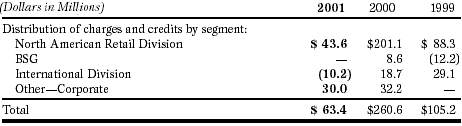
After considering the effect of income taxes, the impact of these net charges on our net earnings was $41.0 million, $172.9 million and $69.3 million for 2001, 2000, and 1999, respectively.
The components of segment operating profit presented below include the charges and credits outlined above. Additionally, certain expenses, primarily payroll-related, previously recorded in total company general and administrative expenses have been reclassified to determine segment operating profit beginning in 2001. Prior year amounts reflect the reclassification of these costs.
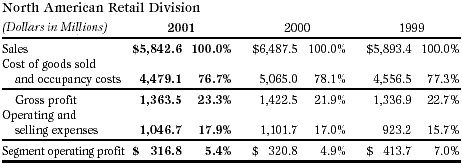
Sales in our North American Retail Division decreased 10% in 2001 and increased 10% in 2000. Adjusting fiscal 2000 results to remove the 53rd week, sales decreased 8% in 2001. The decrease was experienced across all regions of the country and reflects the adverse effect of the weak U.S. economy. Additionally, the sales decline during 2001 reflects the closing of 73 stores identified as under-performing stores as part of the comprehensive business review in late 2000. The sales increase in 2000 was primarily achieved through our store expansion program. For 2001, comparable sales in the 816 stores that had been open for more than one year were down 8%. In 2000, comparable sales were essentially even with 1999.
While sales decreased in 2001, gross profit expressed as a percent of sales increased. Sales shifted away from lower-margin computer hardware, software and office furniture and into products such as machine and office supplies, as well as additional copy center services. Sales of computer products declined 26% in 2001 compared with an increase of 3% in 2000, reflecting declines in both volume and average unit price. We are unable to predict when, and to what extent, this trend will reverse. During 1999, we offered low priced units and more aggressive promotional programs on computer products, including an instant rebate program when the customer contracted for Internet service, which resulted in strong sales for that year at lower margin percentages. The Internet service provider instant rebate program was in effect for portions of 2000 and 2001. The sale of business furniture declined 16% in 2001, after increasing 14% in 2000. The decrease in 2001 is consistent with the slowing economy and decisions to cancel or defer office-related purchases. The sale of business machine supplies increased in both periods.
Lower margins realized on paper and machine supplies contributed most notably to the decrease in gross profit in 2000 compared to 1999. Increased costs of these core products and decreased prices in response to competitive pressures negatively impacted gross profit. Also in 2000, sales increases in the North American Retail Division were not sufficient to leverage the additional fixed expenses incurred with the addition of new stores. Gross profit includes fixed costs such as occupancy and rental costs for equipment in our print and copy centers.
A significant portion of the comprehensive business review completed at the end of 2000 was focused on the North American Retail Division and, among other things, included a commitment to enhance the shoppers’ experience in our retail stores. To that end, we implemented a Division-wide re-merchandising campaign that included personnel training, improved signage and lighting, improved product adjacencies and additional private label merchandise. Also, as a result of the business review, we closed 70 underperforming stores in early 2001 and another three later in the year. The table above includes charges and credits reported in line items through segment operating profit. In 2000, these charges include $29.5 million to provide for sales returns and allowances, $10.1 million for inventory adjustments and $57.8 million relating to asset impairments and write-downs. Additional charges and credits relating to the North American Retail Division, such as facility closure costs, were reported on line items below segment operating profit and are discussed in the Charges and Credits section above. Fiscal year 2001 includes $35.2 million of charges relating to additional store closures and impairments from 13 additional under-performing stores, three of which were closed during the year.
In our North American Retail Division, the largest components of operatingand selling expenses are personnel, facility, advertising and credit card expenses. Each of these components declined in 2001; and total operating and selling expenses, excluding the charges outlined above, decreased 3% in 2001. Personnel costs, which represent over 50% of the total costs in this caption, showed the largest decline as payroll was adjusted down in response to declining sales and from a net reduction in stores. Personnel costs in 2000 were higher than in 1999, primarily because of competitive wage pressure and the need to attract more highly skilled employees in certain positions. Additionally, rent and depreciation expense decreased in 2001 from store closings, partially offset by adding 44 stores during the year. Lower sales in 2001 also contributed to lower credit card fees and reduced advertising. In 2000, we saw an increase in delivery orders as a percentage of total store sales. These orders are delivered by the warehousing operations in our BSG, which allocates a portion of their cost to cover the delivery expense. As explained in the BSG section below, warehouse expenses increased in 2000, which also negatively impacted operating and selling expenses. Delivery and transportation costs declined slightly in 2001.



