| |
The following table sets forth a
three year history of the annual and long-term compensation awarded
to, earned by or paid by the Company and its subsidiaries to each
person serving as Chief Executive Officer at any time during the
fiscal year ended September 27, 2002, and to each of the other
four highest paid executive officers of the Company (collectively,
the "Named Executive Officers") for the fiscal year ended
September 27, 2002.
Summary Compensation
Table
 |
|
|
|
|
|
|
|
|
|
|
|
|
| |
|
Annual
Compensation |
|
Long-term
Compen-
sation |
|
|
|
|
 |
|
|
|
|
Name and
Principal Position |
|
Year |
|
Salary
($) |
|
Bonus
($) |
|
Other
Annual
Compen-
sation(1)
($) |
|
Securities
Underlying
Options/
SARs (#) |
|
All
Other
Compen-
sation |
|
|
|
|
|
|
|
|
|
|
|
|
|
|
Joseph H. Moglia (2)
Chief Executive Officer
|
|
2002 |
|
600,000 |
|
1,068,930 |
|
7,775,000 |
|
- |
|
6,337 |
| 2001 |
350,769 |
1,533,320 |
4,515,890 |
1,816,132 |
141,360 |
|
|
J. Joe Ricketts
Chairman and
Founder
|
|
2002 |
|
650,000 |
|
1,008,755 |
|
4,697 |
|
753,443 |
|
- |
| 2001 |
631,251 |
353,749 |
30,000 |
- |
- |
| 2000 |
540,003 |
606,801 |
30,000 |
298,700 |
- |
|
|
Vincent Passione
President, Institutional Client Division
|
|
2002 |
|
350,000 |
|
- |
|
354,700 |
|
- |
|
- |
| 2001 |
329,135 |
125,000 |
617,500 |
350,000 |
- |
| 2000 |
300,000 |
425,000 |
- |
- |
- |
|
John R. MacDonald
Executive Vice President, Chief Financial
Officer and
Treasurer |
|
2002 |
|
327,346 |
|
182,630 |
|
187,330 |
|
119,866 |
|
- |
| 2001 |
311,250 |
87,500 |
262,500 |
100,000 |
- |
| 2000 |
155,770 |
58,414 |
175,241 |
87,200 |
23,895 |
| |
|
|
|
|
|
|
Phylis M. Esposito(4)
Executive Vice
President, Chief
Strategy Officer |
|
2002 |
|
300,000 |
|
313,080 |
|
- |
|
227,865 |
|
- |
| 2001 |
75,000 |
- |
75,000 |
50,000 |
23,318 |
| |
|
|
|
|
|
| |
|
|
|
|
|
|
|
|
|
|
|
|
|
|
|
|
|
|
____________
|
|
|
| (1) |
|
The amounts shown in this column
for Mr. Moglia represent deferred compensation earned
pursuant to his employment agreement. The amounts
in this column for Mr. J. Joe Ricketts represent
employer contributions to the Company's Profit Sharing
Plan in the form of Company Common Stock. In the
cases of Mr. Passione, Mr. MacDonald and Ms. Esposito,
the amounts shown include bonus payments that were
deferred by the employee into a trust that holds
shares of Common Stock pursuant to the Ameritrade
Holding Corporation Executive Deferred Compensation
Program and, in the cases of Mr. Passione and Mr.
MacDonald, also includes profit sharing contributions
in the form of Company Common Stock. |
|
| (2) |
|
Mr. Moglia became an employee of
the Company in March 2001. Amounts under Bonus for
fiscal 2001 include Mr. Moglia's signing bonus pursuant
to his employment agreement. Amounts under All Other
Compensation for Mr. Moglia represent imputed interest
resulting from payroll taxes paid on Mr. Moglia’s
behalf in fiscal 2002 and reimbursement of moving
expenses in fiscal 2001. |
|
| (3) |
|
Mr. MacDonald became an employee
of the Company in March 2000. The amount under All
Other Compensation for Mr. MacDonald represents
reimbursement of moving expenses. |
|
| (4) |
|
Ms. Esposito became an employee
of the Company in July 2001. The amount under All
Other Compensation for Ms. Esposito represents reimbursement
of moving expenses. |
|
Option Grants
in Last Fiscal Year
The following table sets forth information regarding stock options
granted to Named Executive Officers during fiscal 2002 pursuant
to the Ameritrade Holding Corporation 1996 Long-Term Incentive
Plan (the "Long-Term Incentive Plan"). No grants of Stock
Appreciation Rights were made to Named Executive Officers in fiscal
2002.
| |
|
Individual
Grants |
|
|
|
|
| |
|
|
|
|
|
|
| Name |
|
Number
of
Securities
Under-
lying
Options
Granted
(#) |
|
% of
Options
Granted
to
Employees
in Fiscal
Year(1)
|
|
Exercise
or Base
Price
($/share) |
|
Expira-
tion
Date |
|
Potential
Realizable
Value at Asumed
Annual Rates of Stock
appreciation for the
Option Term(2)
($) |
|
| 5% |
|
10% |
|
|
|
|
|
|
|
|
|
|
|
|
|
| Joseph H. Moglia |
|
- |
|
0.0% |
|
- |
|
- |
|
- |
|
- |
| J. Joe Ricketts |
|
753,443 |
|
2.9% |
|
5.50 |
|
10/24/11 |
|
2,606,099 |
|
6,604,368 |
| Vincent Passione |
|
- |
|
0.0% |
|
- |
|
- |
|
- |
|
- |
| John R. MacDonald |
|
119,866 |
|
0.5% |
|
5.50 |
|
10/24/11 |
|
414,607 |
|
1,050,695 |
| Phylis M. Esposito |
|
227,865 |
|
0.9% |
|
5.50 |
|
10/24/11 |
|
788,167 |
|
1,997,370 |
____________
|
|
|
| (1) |
|
Based on an aggregate of 26,407,500
options granted to employees during fiscal 2002,
including 23,797,908 options granted to employees
of Datek in connection with the Company’s merger
with Datek on September 9, 2002. |
|
|
|
| (2) |
|
Calculated on the assumption that
the market value of the underlying stock increases
at the stated values compounded annually for the
ten-year term of the option and that the option
is exercised and sold on the last day of its term
for the appreciated stock price. |
Aggregated
Option Exercises in Last Fiscal Year and Fiscal Year End Option
Values
The following table sets forth information with respect to
the Named Executive Officers concerning the exercise of options
during fiscal 2002 and unexercised options held as of the
end of fiscal 2002.
|
|
|
|
|
|
|
|
|
|
|
|
|
| Name |
|
Number
of Shares
Acquired
on
Exercise |
|
Value
Realized |
|
Number
of securities
underlying Unexercised
Options at Sept. 27 2002 |
|
Value
of Unexercised
in-the-Money Options
at Sept 27, 2002 (2) |
|
|
| Exercisable |
|
Unexercis-
able |
Exercisable |
|
Unexercis-
able |
|
|
|
|
|
|
|
|
|
|
|
|
|
| Joseph H. Moglia |
|
- |
|
- |
|
1,428,569 |
|
387,563 |
|
|
|
- |
| J. Joe Ricketts |
|
- |
|
- |
|
1,039,750 |
|
902,793 |
|
1,580,460 |
|
- |
| Vincent Passione |
|
- |
|
- |
|
218,750 |
|
131,250 |
|
|
|
- |
| John R. MacDonald |
|
- |
|
- |
|
307,066 |
|
- |
|
|
|
- |
| Phylis M. Esposito |
|
- |
|
- |
|
25,000 |
|
252,865 |
|
|
|
- |
____________
|
|
|
| (1) |
|
Based on the market price of $3.90
per share, which was the closing price per share
of the Company's Common Stock on the Nasdaq National
Market on the last day of fiscal 2002, less the
exercise price payable for such shares. |
Employment
and Severance Agreements
The Company currently has employment agreements with each of its
Named Executive Officers.
Joseph H. Moglia. Mr. Moglia’s employment agreement
was entered into as of March 1, 2001 and has a two-year initial
term. The agreement renews automatically for an additional two-year
term unless either party provides written notice of non-renewal
to the other at least 90 days before the last day of the initial
term. Either party also may terminate the employment agreement
with or without cause. Pursuant to the agreement, Mr. Moglia was
paid a signing bonus of $1.3 million and was reimbursed for relocation
costs. The agreement provides for the payment of a base salary
of $600,000 per year, an annual bonus of not less than $600,000
plus an annual performance-based bonus of not more than $300,000,
a one-time benefit of $15.6 million pursuant to a deferred compensation
plan that generally vests as of March 1, 2003 and is payable upon
his termination, and participation in other employee benefits under
the various benefit plans and programs maintained by the Company.
In addition, the agreement provides that, if Mr. Moglia is still
employed by the Company as of March 1, 2003, he will be awarded
stock options with respect to 2 percent of the then outstanding
shares of Company Common Stock. If Mr. Moglia is discharged from
employment by the Company without cause or terminates his employment
under circumstances that constitute constructive dismissal, all
of his stock options and amounts in the deferred compensation plan
will vest and the grant of options described in the preceding sentence
will be accelerated as described below. Under the deferred compensation
plan established in connection with the agreement, Mr. Moglia is
entitled to a deferred payment of cash compensation, as adjusted
for earnings and losses based on investment performance. The balance
in the deferred compensation account vests pro rata on a daily
basis over the initial two-year term. Payments of the deferred
compensation account balance begin as soon as practicable after
Mr. Moglia’s termination date and may be made in a lump sum
or installments over a period of not more than 10 years, as elected
by Mr. Moglia in accordance with the plan. If Mr. Moglia dies before
the vested balance in his deferred compensation account is paid
to him, the vested balance is paid in a lump sum to a beneficiary
named by him.
The agreement provides that, if a change in control of the Company
occurs, Mr. Moglia’s employment will automatically terminate
and he will be entitled to the payments and benefits to which he
would otherwise be entitled under the agreement had he continued
in employment with the Company through both the initial and additional
two-year terms. If, during the initial two-year term of the agreement,
a change of control occurs, Mr. Moglia’s employment is terminated
during that term by the Company without cause or if his employment
is terminated during that term under circumstances that constitute
a constructive dismissal, he will be awarded stock options that
would have been awarded to him at the beginning of the additional
two-year term, except that the options will be granted as of the
date of the change of control or termination date, as applicable,
with an exercise price equal to 80 percent of the fair market value
of a share of Common Stock on the date of grant. The agreement
contains covenants by Mr. Moglia not to compete with the Company
during the term of employment and for a specified period after
the term. He is generally entitled to receive noncompetition payments
during the period subsequent to his termination in which the covenant
not to compete is in effect.
The Company and Mr. Moglia entered into an addendum to the employment
agreement as of March 30, 2002. Under the addendum, the Company
and Mr. Moglia agreed that the merger with Datek would not constitute
a change in control for the purpose of the employment agreement
and Mr. Moglia waived the provisions of the agreement that would
have been triggered by the merger. The Company and Mr. Moglia further
agreed that if the Company terminates Mr. Moglia’s employment
within two years after the completion of the merger for any reason
other than cause, Mr. Moglia will be entitled to the payments and
benefits to which he would otherwise be entitled under the agreement
had he continued in the employ of the Company until the fourth
anniversary of the effective date of the employment agreement and
he will be entitled to the noncompetition payments. In addition,
if the Company terminates Mr. Moglia’s employment before March
1, 2003, for any reason other than cause, Mr. Moglia will be entitled
to the accelerated options, except that the grant date for the
options will be the date of the termination with an exercise price
equal to 80 percent of the fair market value of a share of Common
Stock on the date of grant, and his account under the deferred
compensation plan will become fully vested as of the termination
date.
Under an agreement between the Company and Mr. Moglia, dated September
13, 2001, the Company is required to lend Mr. Moglia the Medicare
tax amounts due from time to time resulting from his vesting in
benefits under the deferred compensation plan. Mr. Moglia is required
to repay the loan, which does not bear interest, at the time of
termination of his employment. The Company may set off the amount
of the loan against the amount that would otherwise be payable
to Mr. Moglia under the deferred compensation plan. For periods
prior to the termination of his employment, the Company will reimburse
Mr. Moglia annually for all taxes imposed on the interest imputed
to Mr. Moglia.
J. Joe Ricketts, Chairman and Founder.
Mr. Ricketts’ employment agreement was entered into as of
October 1, 2001 and has a seven-year term. Either party may terminate
the agreement with or without cause. The agreement provides for
the payment of a base salary of not less than $650,000 per year,
an annual bonus with a target level for each of fiscal years 2002
and 2003 of not less than 75% of his base salary, grants of stock
options pursuant to the Company’s long term incentive plan
with a target award value for each of fiscal years 2002 and 2003
of not less than $1,200,000, employee assistance program payments
and tax payments, fully equipped home offices, participation in
employee benefits plans and programs maintained by the Company,
and reimbursement for reasonable fees and expenses for legal, tax,
accounting, financial and estate planning counseling and services
and some insurance coverages. If the agreement is terminated due
to Mr. Ricketts’ disability, Mr. Ricketts is entitled to payment
of 50% of his base salary plus benefits until the earlier of the
end of the agreement term or the fifth anniversary of the date
of the disability. If Mr. Ricketts is discharged from employment
by the Company without cause or terminates his employment following
specified breaches of the agreement by the Company, he will be
entitled to receive payments of his base salary, bonus, option
awards and continuing benefits for the remainder of the agreement
term; provided, that in no event will his payments under these
circumstances be less than the sum of three times (1) his base
salary, determined as of October 1, 2001, and (2) his annual cash
bonus payable for 2002. If a termination described in the preceding
sentence occurs, Mr. Ricketts will also be entitled to recover
damages he incurs as a result of his inability to exercise his
outstanding stock options. The agreement contains covenants by
Mr. Ricketts not to compete with the Company during the term of
the agreement and for a specified period after the term.
Vincent Passione, President, Institutional
Client Division. Mr. Passione’s employment agreement
was entered into as of February 1, 2002 and has a term ending on
June 30, 2003 with provisions for renewal for an additional twelve
months. The agreement provides for the payment of a base salary
of $350,000, an annual bonus with a target of 100% of his base
salary, grants of stock options pursuant to the Company’s
long-term incentive plan, benefits pursuant to a deferred compensation
plan and participation in other employee benefits under the various
benefit plans and programs maintained by the Company. The agreement
provides that it may be terminated by either party at any time.
If Mr. Passione’s employment is terminated by the Company
for any reason other than cause or if he terminates his employment
for good reason, Mr. Passione is entitled to receive continued
payments of his base salary for a period of one year after termination
or until the end of the term of the agreement, whichever is longer.
Mr. Passione will also receive the amount of annual target bonus
to which he was entitled for the year in which the termination
occurs and he will be provided with continuing medical coverage,
subject to limitations, for the severance period at the Company’s
cost. If, following a change in control, Mr. Passione’s employment
is terminated by the Company without cause or his employment is
terminated for good reason, he is entitled to be paid a lump sum
equal to his salary and bonus as described above. The agreement
contains covenants by Mr. Passione not to compete with the Company
during the term of employment and for a specified period after
the term. All severance benefits payable under the agreement are
conditional on Mr. Passione's execution of a release of claims
and, if any payments under the agreement would subject Mr. Passione
to an excise tax on parachute payments, the payments under the
agreement will be reduced to the extent necessary to avoid the
tax. On July 15, 2002, Mr. Passione entered into an employment
agreement addendum with the Company, which specifies that the merger
with Datek does not constitute a change in control for purposes
of his employment agreement.
John R. MacDonald, Executive Vice
President, Chief Financial Officer and Treasurer. Mr. MacDonald’s
employment agreement was entered into as of September 9, 2002 and
has a three-year term. The agreement provides for the payment of
a base salary of $350,000, an annual bonus target of 100% of his
base salary, grants of stock options pursuant to the Company’s
long-term incentive plan, benefits pursuant to a deferred compensation
plan and participation in other employee benefits under the various
benefit plans and programs maintained by the Company. The agreement
provides that it may be terminated by either party at any time
and that if Mr. MacDonald is terminated by the Company for any
reason other than cause or if he terminates his employment for
good reason, he will be entitled to receive continued payments
of his base salary for a period of one year after termination or
until the end of the term of the agreement, whichever is longer.
Mr. MacDonald will also receive the amount of annual target bonus
to which he was entitled for the year in which the termination
occurs and he will be provided with continuing medical coverage,
subject to limitations, for the severance period at the Company’s
cost. If, following a change in control, Mr. MacDonald’s employment
is terminated by the Company without cause or his employment is
terminated for good reason, he will be entitled to be paid a lump
sum equal to his salary and bonus as described above. The agreement
contains covenants by Mr. MacDonald not to compete with the Company
during the term of employment and for a specified period after
the term. All severance benefits payable under the agreement are
conditional on Mr. MacDonald’s execution of a release of claims
and, if any payments under the agreement would subject Mr. MacDonald
to an excise tax on parachute payments, the payments under the
agreement will be reduced to the extent necessary to avoid the
tax.
Phylis M. Esposito, Executive Vice
President and Chief Strategy Officer. Ms. Esposito’s
employment agreement was entered into as of February 1, 2002 and
has a term ending on June 30, 2003 with provisions for renewal
for an additional twelve months. The agreement provides for the
payment of a base salary of $300,000, an annual bonus with a target
of 100% of her base salary, grants of stock options pursuant to
the Company’s long-term incentive plan, benefits pursuant
to a deferred compensation plan and participation in other employee
benefits under the various benefit plans and programs maintained
by the Company. The agreement provides that it may be terminated
by either party at any time. If Ms. Esposito is terminated by the
Company for any reason other than cause or if she terminates her
employment for good reason, Ms. Esposito is entitled to receive
continued payments of her base salary for a period of one year
after termination or until the end of the term of the agreement,
whichever is longer. Ms. Esposito will also receive the amount
of annual target bonus to which she was entitled for the year in
which the termination occurs and she will be provided with continuing
medical coverage, subject to limitations, for the severance period
at the Company’s cost. If, following a change in control,
Ms. Esposito’s employment is terminated by the Company without
cause or her employment is terminated for good reason, she is entitled
to be paid a lump sum equal to her salary and bonus as described
above. The agreement contains covenants by Ms. Esposito not to
compete with the Company during the term of employment and for
a specified period after the term. All severance benefits payable
under the agreement are conditional on Ms. Esposito’s execution
of a release of claims and, if any payments under the agreement
would subject Ms. Esposito to an excise tax on parachute payments,
the payments under the agreement will be reduced to the extent
necessary to avoid the tax. On June 25, 2002, Ms. Esposito entered
into an employment agreement addendum with the Company, which specifies
that the merger with Datek does not constitute a change in control
for purposes of her employment agreement.
Report of the
Compensation Committee on Executive Compensation
This report is not deemed to be
"soliciting material" or to be "filed" with
the SEC or subject to the SEC's proxy rules or to the liabilities
of Section 18 of the Securities Exchange Act of 1934 (the "1934
Act") and the report shall not be deemed to be incorporated
by reference into any prior or subsequent filing by the Company
under the Securities Act of 1933 (the "1933 Act") or
the 1934 Act.
The Compensation Committee (the "Committee") of the Board
of Directors establishes and administers the Company’s executive
compensation programs. The Committee is currently composed of three
non-employee directors of the Board, Messrs. Hutchins, Mitchell
and Pagliuca. No member of the Committee during fiscal year 2002
was an employee of the Company or any of its subsidiaries. Each
member qualifies as a "non-employee director" under rule
16b-3 of the Securities Exchange Act of 1934 and as an "outside
director" under Section 162(m) of the Internal Revenue Code
of 1986, as amended (the "Code").
Compensation Philosophy and Policy Overview
The Committee’s purpose is to develop and maintain compensation
programs and policies reflective of the Company’s strategy
to provide strong performance incentive for achieving goals to
maximize stockholder value. To accomplish this, the Committee constructs
compensation determinations based upon the following goals:
1. Align executive compensation with stockholder interests; and
2. Attract, retain and motivate an effective executive team.
The Company’s executive officers’ base salaries are determined
by comparing individual responsibilities with industry survey data
and responsibilities of the other Company executive officers. In
addition, a target annual incentive bonus award is based on a percentage
of salary and long-term incentive awards are based on a factor
of salary. Both the incentive bonus and long-term incentives are
at-risk pay, which serves to motivate the executive to perform,
and comprises a large portion of total executive compensation.
The Committee has utilized the services of an external executive
compensation consultant to provide the utmost objective and competitive
data to ensure stockholder-beneficial decision making consistent
with the Company’s compensation goals.
The Committee and the Company strongly believe in executive ownership
of Company stock. This benefits stockholders by meaningfully aligning
executive goals and decision-making to stockholder needs. Executives
are required to adhere to equity ownership guidelines that require
a specific percentage of stock ownership, ranging from 100 to 500
percent of annual base salary, depending on executive level.
Fiscal Year 2002 Results
Under Mr. Moglia’s leadership and the performance
of the Executive Management Team, the Company:
- Reported record net income from ongoing operations of
$26.2 million, or $0.12 per share;
- Added 284,000 new accounts opened and funded at an average
cost per account of $215;
- Reduced its debt-to-equity ratio to four percent as of
September 27, 2002;
- Increased operating margin 34 percent by controlling costs;
- Completed the acquisition of National Discount Brokers
Corporation;
- Merged with Datek to become the leading brokerage firm
in terms of number of online equity trades; and
- Initiated a stock repurchase program.
Base Salaries
In order to remain competitive with the market, the Committee reviews
executive salaries at least annually. Comparably sized general
industry, technology and financial services competitors are selected
for analysis and comparison. Executive officer salary adjustments
are determined by objective and subjective evaluation of individual
performance and by comparison with market data of external comparable
positions, internal comparison, and applicable terms of existing
employment agreements.
Annual Incentive Bonuses
Annual incentive bonuses are designed to promote strong Company
performance and achievement of the Company’s initiatives.
Target incentive percentages are set at the beginning of the fiscal
year and payout is earned according to achievement of Company goals.
The Company’s executive officers participate in the 2002 Management
Incentive Plan. This plan is based on the achievement of key corporate
performance metrics and is intended to be qualified under Section
162(m) of the Code in order to maximize tax deductibility for the
Company, while providing strong incentive for goal achievement
at the highest levels of the organization. For fiscal year 2002,
100 percent of annual incentive was based upon corporate performance.
Executives were able to defer all or part of annual incentive bonuses
under a deferred compensation program in the form of Company stock.
Long-Term Incentives
The Company strongly supports stock ownership at all levels and
maintains a broad based and executive stock option program. Long-term
incentives are awarded to foster forward-looking motivation and
long-term growth for stockholders.
Annual executive stock option awards were determined based on the
Company’s total stockholder return. This measurement compares
Company stock performance with the stock performance of a peer
group. The Company’s relative performance against the peer
group is applied to the target award level per individual executive.
The Committee also considers the award of stock options in specific
cases based on individual performance or for purposes of retaining
and attracting key executives.
Although the long-term incentive plan also permits the award of
stock appreciation rights, stock awards (including restricted stock)
and performance units, no such awards have been made under the
program. The Company granted replacement stock appreciation rights
in fiscal 2002 to former Datek employees in connection with the
Datek merger.
Deductibility of Compensation
Section 162(m) of the Code limits the Company’s deduction
for compensation paid to the executive officers named in the Summary
Compensation Table to $1 million unless certain requirements are
met. The policy of the Compensation Committee with respect to Section
162(m) is to establish and maintain a compensation program that
will optimize the deductibility of compensation. However, the Committee
must exercise its right to use judgment, where merited by the need
to respond to changing business conditions or by an executive officer’s
individual performance, to authorize compensation, which may not,
in a specific case, be fully deductible by the Company. For fiscal
year 2002, the only executive officers to exceed $1 million in
compensation for Section 162(m) purposes were Mr. J. Joe Ricketts
and Mr. Moglia, due to Mr. Ricketts’ bonus paid for the successful
expansion of the retail brokerage conducted by the Company and
the provisions of Mr. Moglia’s employment agreement. The Committee
has reviewed these arrangements and the related Section 162(m)
issues and given its approval.
Chief Executive Officer Compensation
In fiscal year 2002, Mr. Moglia served in the capacity of Chief
Executive Officer. The determination of the Chief Executive Officer’s
salary, annual incentive, and grants of stock options followed
the philosophy and policies set forth above for all other executive
compensation, subject to any individual terms in the executive’s
employment agreement.
Given the fiscal year results described above and Mr. Moglia’s
focus on increasing stockholder value and commitment to sustained
profitability, Mr. Moglia is a valuable asset to the Company. Mr.
Moglia’s vision, leadership and reputation are important to
the Company. His departure would negatively affect stockholder
value and his compensation has been designed to reflect this.
Glenn Hutchins
Mark L. Mitchell
Stephen G. Pagliuca
Compensation
Committee Interlocks and Insider Participation
During fiscal 2002, there were no Compensation Committee interlocks
and no insider participation in Compensation Committee decisions
that were required to be reported under the rules and regulations
of the 1934 Act.
Performance Graph
The Company performance information
is not deemed to be "soliciting material" or to be "filed"
with the SEC or subject to the SEC's proxy rules or to the liabilities
of Section 18 of the 1934 Act and the Company performance information
shall not be deemed to be incorporated by reference into any prior
or subsequent filing by the Company under the 1933 Act or the 1934
Act.
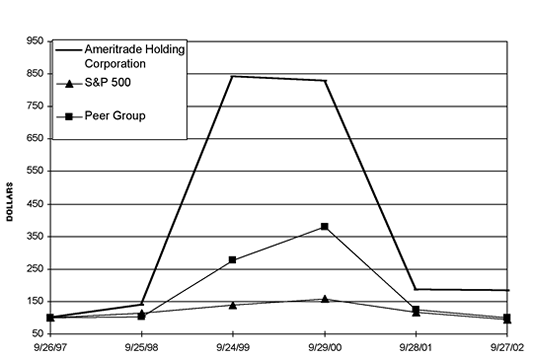
The following graph and table set forth information comparing the
cumulative total return from a $100 investment in the Company,
a broad-based stock index and the stocks making up an industry
peer group on September 26, 1997 through the end of the Company's
most recent fiscal year.
|
|
|
|
|
|
|
|
|
|
|
|
|
| |
|
Period
Ending |
|
|
|
| Index |
|
9/26/97 |
|
9/25/98 |
|
9/24/99 |
|
9/29/00 |
|
9/28/01 |
|
9/27/02 |
| |
|
|
|
|
|
|
|
|
|
|
|
|
| Ameritrade Holding
Corporation |
|
100.00 |
|
139.81 |
|
841.75 |
|
827.18 |
|
186.87 |
|
181.75 |
|
|
|
|
|
|
|
|
|
|
|
|
|
| S&P
500 |
|
100.00 |
|
112.48 |
|
139.47 |
|
159.35 |
|
116.81 |
|
94.21 |
|
|
|
|
|
|
|
|
|
|
|
|
|
| Peer Group |
|
100.00 |
|
103.53 |
|
277.10 |
|
379.40 |
|
124.90 |
|
98.77 |
|
|
|
|
|
|
|
|
|
|
|
|
|
The Peer Group is comprised of the following companies whose primary
business is online brokerage:
- The Charles Schwab Corporation
- E*TRADE Group, Inc.
- CSFBdirect (1)
- TD Waterhouse Group, Inc. (2)
____________
|
|
|
| (1) |
|
Included in peer group until August
21, 2001, when the stock was acquired by Credit
Suisse First Boston, Inc. |
|
|
|
| (2) |
|
Included in peer group until November
26, 2001, when the stock was acquired by The Toronto-Dominion
Bank. |
Certain Relationships
and Related Transactions
On September 6, 2001, the Company acquired from National Discount
Brokers Group, Inc. ("NDB Group") all the outstanding
stock of National Discount Brokers Corporation ("NDB").
Pursuant to the terms of the purchase agreement dated July 30,
2001, between the Company and NDB Group (the "Purchase Agreement"),
the Company paid aggregate consideration of $154 million, consisting
of 26,027,282 shares of its Common Stock issued to BT Investment
Partners Inc., an affiliate of NDB Group and a subsidiary of Taunus
Corporation ("Taunus"), a wholly owned subsidiary of
Deutsche Bank AG, and $20,000 in cash paid to NDB Group. Taunus,
primarily through its ownership of BT Investment Partners Inc.,
currently owns approximately 5.3% of the Company’s Common
Stock.
The Company entered into certain agreements with affiliates of
Taunus prior to Taunus becoming a beneficial owner of greater than
5% of the Company's Common Stock. In April 2001, the Company entered
into an agreement with Deutsche Banc Alex. Brown Inc. ("DB
Alex. Brown"), an affiliate of Taunus, to provide financial
advisory and investment banking services. The Company paid a one-time
retainer fee of $150,000 to DB Alex. Brown. Under the agreement,
the Company will pay additional fees if a merger with or acquisition
of another company is completed, based on the amount of consideration
paid, or if DB Alex. Brown renders a fairness opinion. In fiscal
2002, the Company paid fees of approximately $6.7 million to DB
Alex. Brown in connection with the Datek merger and $0.5 million
in connection with the acquisition of TradeCast Inc. In July 2001,
the Company entered into an equity index swap arrangement with
Deutsche Bank AG for the purpose of hedging the Company's obligation
under its deferred compensation plan for its Chief Executive Officer.
The Company paid interest and fees to Deutsche Bank AG of $0.7
million related to this arrangement. The swap arrangement was assigned
from Deutsche Bank AG to an unaffiliated counterparty in November
2001.
In October 2001, the Company entered into an agreement with NDB
Group, which in part amended the Purchase Agreement, relating to
the occupancy and surrender of certain premises by NDB. The agreement
provided, among other things, that NDB Group would purchase from
the Company certain furniture, fixtures and building equipment
for a price of $0.5 million. NDB Group completed the purchase in
December 2001.
During fiscal 2002, the Company executed a portion of its clients’
securities transactions through subsidiaries of Taunus. Revenues
earned by the Company related to such transactions totaled $0.2
million.
On September 9, 2002, the Company’s Board of Directors authorized
a program to repurchase up to 40 million shares of Company Common
Stock from time to time over a two-year period beginning September
19, 2002. The Company has utilized Deutsche Bank Securities Inc.,
an affiliate of Taunus, to implement the repurchase program. Through
September 27, 2002, the Company repurchased approximately 1.2 million
shares at a cost of approximately $4.8 million, including commissions,
through Deutsche Bank Securities Inc.
The Company believes that its transactions with affiliates of Taunus
have been negotiated on an arms-length basis and have been entered
into on terms no more or less favorable than those available in
similar transactions with other unaffiliated third parties.
Gartner, Inc. provided professional consulting services to the
Company under a two-year contract with an original term from October
2000 through October 2002. The Company renewed the contract for
another two years in October 2002. The Company pays $105,000 in
professional fees to Gartner, Inc. annually under the contract.
Michael D. Fleisher, a Director of the Company, is Chairman and
Chief Executive Officer of Gartner, Inc. Glenn H. Hutchins and
Stephen G. Pagliuca, Directors of the Company, are directors of
Gartner, Inc.
Certain Directors and executive officers, and members of their
immediate families, maintain margin trading accounts with the Company.
Margin loans to these individuals were made in the ordinary course
of business on substantially the same terms, including interest
rates and collateral, as those prevailing at the time for comparable
transactions with other persons and did not involve more than the
normal risk of collectibility or present other unfavorable features.
|
|



























