|
|
|
|
History - Positioned to Change - Existing Strategies - New Strategies - Need for Service When our company began in 1910, shortly after the turn of the 20th century, it consisted of three cemeteries and a marble shop. Now, at the beginning of the 21st century, we are the third largest provider of funeral home and cemetery products and services in North America. What has made this growth possible has been our ability to change. Adapting our business strategies to meet changing market environments and trends is something we have done successfully throughout our 90-year history. A
History of Change
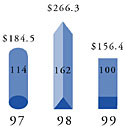
During 1999, our company again faced changes — in industry conditions and consumer preferences — which are again creating opportunities for us to grow stronger. The 1990s were a time of consolidation in the death care industry, during which our company achieved its position as third largest in North America. As the decade closed, however, this environment shifted. The demand for acquisitions decreased as several of our largest competitors greatly reduced or terminated their acquisition activities. While we continued to make acquisitions, bringing on board 100 new businesses during the fiscal year, we decreased our acquisition activity in the third quarter. At the same time, we began to see that consumers were becoming more price-conscious and were expressing a growing preference for cremation. We are meeting these changes with our time-proven ability to create opportunities. During 2000, we plan to modify our business strategies to focus on internal growth and operations rather than acquisitions, with added emphasis on cash flow. Top - History - Positioned to Change - Existing Strategies - New Strategies - Need for Service Positioned
to Change An example is the growing consumer interest in cremation. About 24% of U.S. deaths in 1998 resulted in cremations. By 2010, the number of cremations is expected to rise to 38% of deaths, according to industry estimates. Because we own the largest cremation society in America — Sentinel Cremation Societies, Inc., which we purchased in 1997 — we are well positioned to expand this area of our business. In fact, we have already begun to open new Sentinel offices. Nevertheless, while we are increasing our ability to provide cremation products and services, it remains true that the majority of today's consumers still choose traditional services. While we believe we understand our markets and what families want, we recognize that consumer attitudes are ever changing. As a result, in 1999 we commissioned one of the country's leading consulting firms to undertake a comprehensive national study of consumer preferences related to the death care industry. The results of this study, Project 2000, will begin to be implemented in February 2000. The knowledge gained — regarding changing trends in consumer preferences relative to pricing, merchandising and services — will better enable us to evaluate existing internal growth strategies and to implement new ones. Top - History - Positioned to Change - Existing Strategies - New Strategies - Need for Service Opportunities
for Existing Strategies
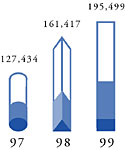
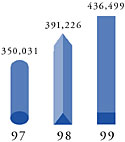
Selling prearranged death care products and services builds tomorrow's market share today. Stewart has had more than a half-century of experience in helping families make prearrangements. The Company employs over 3,500 dedicated sales professionals and utilizes well-developed, field-tested professional marketing programs. New marketing programs are tested continually and implemented when appropriate. At the close of fiscal year 1999, our backlog of prearranged funeral services exceeded 436,000, representing more than $1.5 billion in anticipated future revenue. Investing in the training of our sales force and cemetery and funeral home employees is always important, but it becomes even more vital during times of change. The responsibility for training is now being centralized, and a formal training policy will be developed in the course of the year. In 1979, we developed the Company's first combination operation (and the first in Louisiana) when we constructed Lake Lawn Metairie Funeral Home in Metairie Cemetery (acquired in 1969). We recently completed an addition to that funeral home to better serve the many families it assists annually — the largest number of any funeral home in the state. Today, 44% of our cemeteries operate in conjunction with funeral homes. The Company's experience has demonstrated that the combination of a funeral home with a cemetery can significantly increase the market share and profitability of both. We have developed two internal growth strategies that employ the use of combination operations. Not only have we constructed funeral homes on the grounds of our own cemeteries, but we have also entered into alliances to construct and operate funeral homes on the grounds of others' cemeteries. During fiscal 1999, construction was under way on four funeral homes being built by Stewart on cemeteries owned by the Archdiocese of Los Angeles. The first of these facilities opened and began serving families in January 2000. The same month saw the completion and opening of Wyuka Funeral Home in Wyuka Cemetery, a state-chartered cemetery in Lincoln, Nebraska. Entering into such partnerships enables us to obtain market share at a substantially lower cost than we could through acquisitions or cemetery development. As we grew our business through acquisitions, we selected funeral homes and cemeteries that were among the most highly regarded in the area, with outstanding reputations. Our acquisition strategy also took into account the potential for market clustering (operation of multiple businesses in close geographic proximity), which enables us to achieve economies of scale. We plan to expand on our cluster concept and leverage goodwill through market-wide regional branding. This will involve, in selected areas, associating the name of a leading firm in a cluster with the names of other firms in that cluster. Because customer service and loyalty remain keys to success in our industry, using the goodwill of our market leader in selected areas is expected to increase market share. In fact, we are experiencing success in several of our larger markets — Orlando and Tampa, Florida, and San Diego, California — where we have already positioned ourselves as a regional brand. We added alternative-services firms to our business in fiscal year 1997 with the acquisition of Sentinel Cremation Societies, Inc. of California. Sentinel serves families through the brand names Neptune Society of Northern California and Telophase Society. The following year, the Company acquired Desert Memorial Cremation in Las Vegas, Nevada, a state with one of the highest cremation rates in the United States. Because a typical cremation society office is located in leased space of 1,000 to 2,000 square feet and is staffed by two employees handling 500 families annually, the alternative-services-firm concept represents a cost-effective method of entering new markets and growing in existing markets. We are developing a business plan for expanding this part of our business in upcoming years and expect to integrate results of the Project 2000 study into the plan this year and beyond. During 2000, the Company plans to automate all of its funeral businesses with real-time and standardized information. We took the first step toward this goal in 1996 with the establishment of our Shared Services Center. The Center, located in New Orleans, performs all of the accounting and administrative functions for Stewart's U.S. and Puerto Rican operations and has been effective in controlling costs and improving customer service. In 1997, we began development of two major software packages: Cemetery and Funeral Home Enabler (CAFE) and Key Information for Sales (KIS). CAFE is a PC-based data-capture system that automates the process of arranging for funerals and burials, eliminates duplicate data entry, delivers the latest information to the desktop at all our locations, and generates reports. KIS tracks, processes and presents key sales data, and provides management with real-time access to the data. Rollout of these two technologies will be completed by June 2000. Improved service to client families through decreased errors in contracts is already evident in areas that have been fully automated. Top - History - Positioned to Change - Existing Strategies - New Strategies - Need for Service Opportunities
in New Strategies
A number of cash flow initiatives have been implemented since the close of fiscal year 1999. We have suspended acquisition activity unless an acquisition candidate is unusually attractive. To even be considered, it must meet strict criteria. Spending on internal growth initiatives in fiscal year 2000 is to be limited to $25 million, approximately $15 million of which is earmarked for the construction of funeral homes for the Archdiocese of Los Angeles. The balance of the funds is expected to be used for construction of funeral homes on some of the Company's cemeteries, further development of third-party partnerships, and the opening of additional alternative-services firms. Control over all capital expenditures has been centralized at the corporate office. Also, any expenditure over $25,000 - whether related to maintenance or growth - must now be approved at the corporate office instead of at the divisional level. Additionally, we are developing a program to analyze and possibly redeploy excess cemetery property, underperforming assets and real estate that would be more valuable if converted to another use. Of course, we plan to continue obtaining volume discounts from suppliers and to review and manage all costs. The Company will also continue to review the terms and conditions of sales, including third-party financing of at-need funeral services in selected areas. Currently, financing relationships are in place in several markets for at-need funerals. Top - History - Positioned to Change - Existing Strategies - New Strategies - Need for Service Need
for Service Never Changes
Each of our more than 11,200 employees realizes that we are undergoing another period of change. But change brings opportunities, and we are well positioned to seize those opportunities so that the shareholders and families we serve will be rewarded by our success. Top - History - Positioned to Change - Existing Strategies - New Strategies - Need for Service
|


 1910
1910