
|
|
|
|
Analysis
|
|
Page One | Page Two | Page Three | Page Four | Page Five |
ANALYSIS
- OVERVIEW
|

|
In the future, the primary emphasis in the marketplace is likely to be on the implementation of partial lab automation, with the main focus on automation of front-end sample handling. Diagnostics Update, August 1999
|
|||
| Jim
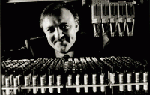
Marks, Ph.D. Associate Research Fellow Parke-Davis, A Warner-Lambert Division Ann Arbor, Michigan, USA 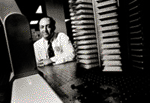 |
Integrated Systems Parke-Davis
purchased its first SAGIANTM Core System to automate steps in the pharmaceutical
discovery process about three years ago. The system integrated modular
“plug and play” workstations around a single robotic arm, which gave the
pharmaceutical company a new way to complete routine laboratory tasks.
Parke-Davis liked the results so much that it has since installed two
more systems. “The SAGIAN Core System’s robotic arm is, to us, like an
automated pair of hands, moving candidate compounds from one station to
another. Because our researchers can focus on bench work while the system
runs, we have nearly doubled our workflow,” says Marks. |
|||
|
Ralph
Dadoun, BSC, MBA
|
Sample Preparation St. Mary’s Hospital Center revamped its entire laboratory to help manage a 232 percent increase in specimen volume coming from in-patient collection, outpatient clinics and outreach programs. By purchasing a Beckman Coulter Power Processor for sample preparation automation, Dadoun significantly reduced turnaround time on test results, while improving consistency and reliability. Says Dadoun, “The doctors waiting for results are getting them much faster. We are the only laboratory in Quebec to be accredited by the College of American Pathologists. In overall efficiency, we are within the top 5 percent of labs in the North America system.” |
|||
| George
Krempel Administrative Director of Clinical Laboratories and Pathology Loyola University Medical Center Chicago, Illinois, USA 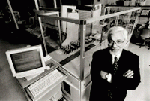 |
Workcells “Our core lab processes 2,500 to 3,000 specimens every day,” says Krempel. “Since we implemented automation with robotics and workstation consolidation in our core laboratory, we have reduced sample turn- around times by 11 percent and saved $100,000 in staff salaries in less than a year.” The centerpiece to Loyola’s Core Laboratory is Beckman Coulter’s AccelNet™ Laboratory Automation Network, an automated workcell table with robotics. The AccelNet system sorts tubes, then those requiring chemistry analysis are centrifuged and loaded directly onto two SYNCHRON CX®7 Analyzers. This system processes the majority of tests flowing through the lab. |
|||
| Elkin
Simson, M.D. Medical Director of Clinical Laboratories The Mt. Sinai Hospital New York, New York, USA 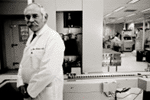 |
Total Lab Automation The Mt. Sinai Hospital of Mt. Sinai NYU Health has created one of the largest, most comprehensive automated core laboratories in the world. From the time the bar-coded specimen tubes are placed on the tracks, all processes and procedures are entirely automated. Specimens are kept on the move, thanks to the IDS automated track system from Beckman Coulter. Along the track, some samples are processed on Coulter® Hematology Systems, some on SYNCHRON CX®3 Analyzers; other samples go to various test-specific systems. Says Simson, “The automated core lab provides enhanced accuracy of analysis, reduces the possibility of specimen identification errors and increases lab worker safety, all at reduced cost. We’ve accomplished what we set out to do.” |
|||
|
Annual
Report 1999
|
|
©
1999 Beckman Coulter, Inc. - www.beckmancoulter.com
|