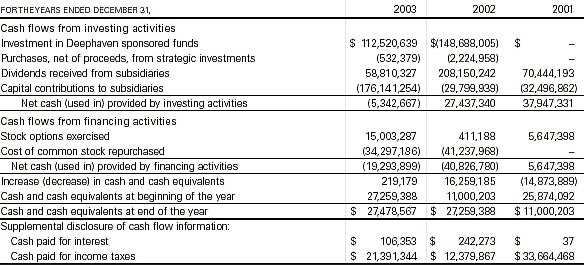
|
Note 1. ORGANIZATION AND DESCRIPTION OF THE BUSINESS
Knight Trading Group, Inc. and its subsidiaries (the "Company") operate
in Equity Markets, Derivative Markets and Asset Management segments.
The Company's business segments are comprised of the following operating
subsidiaries:
Equity Markets
- Knight Equity Markets, L.P. ("KEM;" formerly Knight Securities, L.P.)
operates as a market maker in over-the-counter equity securities ("OTC
securities"), primarily those traded in the Nasdaq stock market and
on the OTC Bulletin Board ("OTCBB"). Additionally, in December 2003,
KEM acquired the business of Donaldson & Co., Incorporated ("Donaldson"),
a firm that offers soft dollar and commission recapture services. KEM
is a broker-dealer registered with the Securities and Exchange Commission
("SEC"), is a member of the National Association of Securities Dealers
("NASD"), the National Stock Exchange and the Pacific Stock Exchange.
- Knight Capital Markets LLC ("KCM") operates as a market maker in the
Nasdaq Intermarket™, the over-the-counter market for New York Stock
Exchange ("NYSE") and American Stock Exchange ("AMEX") listed securities.
KCM is a broker-dealer registered with the SEC and is a member of
the NASD.
- Knight Roundtable Europe Limited ("KREL") owns Knight Securities International,
Ltd. ("KSIL"), a U.K. registered broker-dealer that provides agency
execution services for European clients in European and U.S. equities.
KSIL also provided market-making services in European securities,
however, these services were discontinued in 2002. At December 31,
2003, the Company owned an approximate 85% interest in KREL. KSIL
is regulated by the Financial Services Authority in the U.K. and
is a member of the London Stock Exchange.
- Knight Securities Japan Ltd. ("KSJ") operated as a market maker in
Japanese equity securities until it ceased its trading operations and
was subsequently liquidated in 2003. The Company owned 60% of KSJ through
a joint venture with Nikko Cordial Group. See Footnote 10 "Discontinued
Operations" for a further discussion on KSJ.
Derivative Markets
- Knight Financial Products LLC ("KFP") operates as a market maker and
specialist in options on individual equities, equity indices and
fixed income and commodity futures instruments in the U.S. KFP, through
its affiliate Knight Execution Partners LLC ("KEP"), also manages a professional
option and equity execution services business. KFP and KEP are broker-dealers
registered with the SEC and are members of the Chicago Board Options
Exchange, American Stock Exchange, Philadelphia Stock Exchange, Pacific
Stock Exchange and the International Securities Exchange ("ISE").
KFP is also a member of the Chicago Board of Trade, the Chicago
Mercantile Exchange, the New York Mercantile Exchange and the Philadelphia
Board of Trade.
Asset Management
- Deephaven Capital Management LLC ("Deephaven") is
the investment manager and sponsor of the Deephaven investment funds
(the "Deephaven Funds"). Also included
in the segment is the Company's investment in the Deephaven Funds.
back to top
Note 2. SIGNIFICANT ACCOUNTING POLICIES
Basis of consolidation and form of presentation
The accompanying consolidated financial statements include the
accounts of the Company and its majority and wholly-owned subsidiaries.
All significant intercompany transactions and balances have been
eliminated.
Certain prior year amounts have been reclassified to conform to the
current year presentation.
Cash and cash equivalents
Cash and cash equivalents include money market accounts, which
are payable on demand, or short-term investments with an original
maturity of less than 30 days. The carrying amount of such cash
equivalents approximates their fair value due to the short-term
nature of these instruments.
Market-making activities
Securities owned and securities sold, not yet purchased, which primarily
consist of listed and OTC equities and listed options contracts,
are carried at market value and are recorded on a trade date basis.
Net trading revenue (trading gains, net of trading losses) and commissions
and related expenses are also recorded on a trade date basis. Payments
for order flow represent payments to certain clients for directing
their order executions to the Company and payments to institutions
in connection with commission recapture programs. The Company's clearing
agreements call for payment of or receipt of interest income, net
of interest expense for facilitating the settlement and financing
of securities transactions.
Asset management fees
The Company earns asset management fees for sponsoring and managing
the Deephaven Funds. Such fees are recorded monthly as earned and
are calculated as a percentage of the Deephaven Funds' monthly net
assets, plus a percentage of a new high net asset value (the "Incentive Allocation
Fee"), as defined, for any six month period ended June 30th or
December 31st. A new high net asset value is generally defined
as the amount by which the net asset value of the Deephaven Funds
exceeds the greater of either the highest previous net asset
value in the Deephaven Funds, or the net asset value at the time
each investor made a purchase. If the Deephaven Funds recognizes
a loss in the second half of a calendar year, the Incentive Allocation
Fee is recalculated on an annual rather than a semi-annual basis.
Estimated fair value of financial instruments
The Company's securities owned and securities sold, not yet
purchased are carried at market value, which is estimated using
market quotations available from major securities exchanges,
clearing brokers and dealers. Management estimates that
the fair values of other financial instruments recognized on the
Consolidated Statements of Financial Condition (including receivables,
payables and accrued expenses) approximate their carrying values,
as such financial instruments are short-term in nature, bear interest
at current market rates or are subject to frequent repricing.
Accounting for derivatives
The Company's derivative financial instruments, primarily comprised
of listed options and futures, are all held for trading purposes
and are carried at market value.
Goodwill and intangible assets
The Company applies the provisions of Statement of Financial Accounting
Standards ("SFAS") No. 142 Goodwill and Other Intangible Assets,
which requires that goodwill and intangible assets with an indefinite
useful life no longer be amortized, but instead, be tested for impairment
annually or when an event occurs or circumstances change that
signify the existence of impairment. Other intangible assets are
amortized over their useful lives.
Strategic investments
Strategic investments include equity ownership interests of less
than 20% in financial services-related businesses and are accounted
for under the equity method or at fair value. The equity method of
accounting is used for investments in limited partnerships and limited
liability corporations. The fair value
of other investments, for which a quoted market or dealer price is
not available for the size of our investment, is based
on management's estimate. Among the factors considered by management
in determining the fair value of investments are the cost of the
investment, terms and liquidity, developments since the acquisition
of the investment, the sales price of recently issued securities,
the financial condition and operating results of the issuer, earnings
trends and consistency of operating cash flows, the long-term business
potential of the issuer, the quoted market price of securities with
similar quality and yield that are publicly traded, and other factors
generally pertinent to the valuation of investments. The fair value
of these investments is subject to a high degree of volatility and
may be susceptible to significant fluctuations in the near term.
The valuations of strategic investments are reviewed by management
on an ongoing basis.
Minority interest
Minority interest represented minority owners' share of net income
or losses and equity in the Company's majority-owned consolidated
subsidiaries.
Treasury stock
The Company records its purchases of treasury stock at cost as a
separate component of Stockholders' equity. The Company obtains treasury
stock through purchases in the open market or through privately negotiated
transactions.
Foreign currencies
The functional currency of the Company's consolidated foreign subsidiaries
is the U.S. dollar. Assets and liabilities in
foreign currencies are translated into U.S. dollars using current
exchange rates at the date of the Consolidated Statements of Financial
Condition. Revenues and expenses are translated at average rates
during the periods. Gains or losses resulting from foreign currency
transactions are included in Investment income and other on the Company's
Consolidated Statements of Operations. Prior to its liquidation,
KSJ's functional currency was the Japanese yen. The foreign exchange
gains and losses resulting from the translation of the financial
statements of KSJ were included within a separate component of Stockholders'
equity as of December 31, 2002. As discussed in Note 10 "Discontinued
Operations," in
the second quarter of 2003, KSJ ceased its operations, and its
results, including the effects of translation, are included with Loss
from discontinued
operations on the Consolidated Statements of Operations.
Depreciation, amortization and occupancy
Fixed assets are being depreciated on a straight-line basis over
their estimated useful lives of three to seven years. Leasehold improvements
are being amortized on a straight-line basis over the shorter of
the life of the related office lease or the expected useful life
of the assets. The Company records rent expense on a straight-line
basis over the lives of the leases. The Company capitalizes certain
costs associated with the acquisition or development of internal-use
software and amortizes the software over its estimated useful life
of three years, commencing at the time the software is placed in
service.
Writedown of fixed assets
Writedowns of fixed assets are recognized when it is
determined that the fixed assets are no longer actively used and
are determined to be impaired. The amount of the impairment writedown
is determined by the difference between the carrying amount and
the fair value of the fixed asset. In determining the impairment, an
estimated fair value is obtained through research and inquiry of
the market. Fixed assets are reviewed for impairment on a quarterly
basis.
Lease loss accrual
It is the Company's policy to identify excess real estate capacity
and where applicable, accrue for such future costs. In determining
the accrual, a nominal cash flow analysis is performed for lease
losses initiated prior to December 31, 2002, the effective date of
SFAS No. 146 Accounting for Costs Associated with Exit or Disposal
Activities (which requires the accrual of future costs to be made
using a discounted cash flow analysis for lease losses initiated
after such date), and costs related to the excess capacity are accrued.
Income taxes
The Company records deferred tax assets and liabilities for the expected
future tax consequences of temporary differences between the financial
reporting and tax bases of assets and liabilities and are measured
using the enacted tax rates
and laws that will be in effect when such differences
are expected to reverse. Deferred tax assets and liabilities are
included in Other assets and Accounts payable, accrued expenses and
other liabilities, respectively.
Stock-based compensation
The Company applies Accounting Principles Board Opinion
No. 25, Accounting for Stock Issued to Employees ("APB 25") and related
interpretations in accounting for its stock option
plans. As options are granted at the then market value, no
compensation expense has been recognized for the fair values
of the options granted to employees.
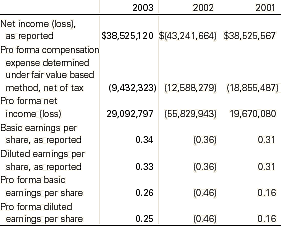
Had compensation expense for the Company's options been determined
based on the fair value at the grant dates in
accordance with SFAS No. 123, Accounting for Stock-Based Compensation,
the Company's net income and earnings per share amounts for the years
ended December 31, 2003, 2002 and 2001 would have been as follows:
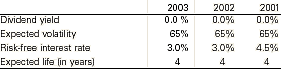
The fair value of each option granted is estimated as of its respective
grant date using the Black-Scholes option-pricing model with the
following assumptions:
The Company records the fair market value of restricted awards on
the date of grant as unamortized stock-based compensation in Stockholders'
equity and amortizes the balance to compensation expense ratably
over the vesting period.
Other
The preparation of financial statements in conformity with generally
accepted accounting principles requires management to make estimates
and assumptions that affect the reported amounts of assets and liabilities
and disclosure of contingent assets and liabilities at the date of
the financial statements and the reported amounts of revenues and
expenses during the reporting period. Actual results could differ
from those estimates.
back to top
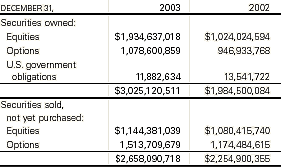
Note 3: SECURITIES OWNED AND SECURITIES SOLD, NOT YET PURCHASED
Securities owned and securities sold, not yet purchased are carried
at market value and consist of the following:
back to top
Note 4: RECEIVABLE FROM/PAYABLE TO BROKERS AND DEALERS
At December 31, 2003, amounts receivable from and payable to brokers
and dealers consist of the following:

back to top
Note 5: GOODWILL AND INTANGIBLE ASSETS
The Company adopted the provisions of SFAS No. 142 Goodwill and Other
Intangible Assets as of January 1, 2002. This statement established
new standards for accounting for goodwill and intangible assets acquired
outside of, and subsequent to, a business combination. Under the
new standards, goodwill and intangible assets with indefinite useful
lives are no longer being amortized, but are tested for impairment
annually or when an event occurs or circumstances change that signify
the existence of impairment. As part of our test for impairment,
we consider the profitability of the respective segment or reporting
unit, an assessment of the fair value of the respective segment or
reporting unit as well as the overall market value of the Company
compared to its net book value.
In June 2003, we tested for the impairment of goodwill and concluded
that there was no impairment. The goodwill balance of $21.1 million
at December 31, 2003, consists of $16.7 million related to the Equity
Markets segment and $4.4 million related to the Derivative Markets
segment. Goodwill is net of accumulated amortization of $22.5 million
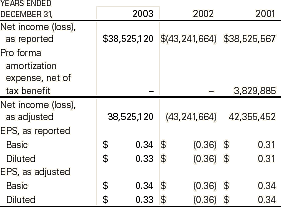
through December 31, 2001. The following table sets forth reported
net earnings and EPS adjusted to exclude goodwill amortization expense
recorded in 2001:
At December 31, 2003, the Company had intangible assets, net
of accumulated amortization, of $14.7 million. Intangible assets,
net of accumulated amortization, of $12.0 million, which resulted
from the purchase of the business of Donaldson, primarily represent
customer relationships, are included within the Equity Markets
business segment. The carrying value of these intangible assets
is being amortized over the remaining useful lives, which have
been determined to range from five to thirty years.
Intangible assets, net of accumulated amortization, of $2.7 million,
which primarily resulted from the purchase of various options related
specialists posts, are included within the Derivative Markets business
segment. These intangible assets are being amortized over the remaining
useful lives, the majority of which are within one year, with the
remainder having lives of up to fourteen years.
The Company evaluates the remaining useful lives and evidence of
permanent impairment of its intangible assets at least annually.
As part of the test for impairment of intangible assets in 2003,
it was determined that the fair value of the intangible assets within
our Derivative Markets business segment were permanently impaired.
Consequently, the intangible assets were written down to fair value,
resulting in a $29.5 million impairment charge.
In 2003, the Company recorded amortization expense relating to all
of its intangible assets of $2.7 million. The estimated amortization
expense relating to the intangible assets for each of the five succeeding
years approximates $1.8 million in 2004 and $670,000 per year in
the subsequent four years.
The chart below summarizes the activity of the Company's Goodwill
and Intangible assets, net of accumulated amortization for 2002 and
2003:

back to top
Note 6: INVESTMENT IN DEEPHAVEN SPOSORED FUNDS AND STRATEGIC INVESTMENTS
The Company's wholly-owned subsidiary, Deephaven, is the investment
manager and sponsor of the Deephaven Funds, which engage in various
trading strategies involving equities, debt instruments and derivatives.
The underlying investments in the Deephaven Funds are carried at
market value. Of the $1.6 billion of assets under management in the
Deephaven Funds as of December 31, 2003, the Company had an investment
of $201.1 million. Of the $201.1 million investment held by the Company,
$197.6 million represented the Company's strategic investment, while
$3.5 million represented investments related to employee deferred
compensation plans. In addition, certain officers, directors and
employees of the Company have invested approximately $15.9 million
in the Deephaven Funds, in the aggregate, as of December 31, 2003.
Strategic investments, which primarily include the Company's investments
in Nasdaq and the ISE, are reviewed on an
ongoing basis to ensure that the fair value of the investment has
not been impaired. In accordance with this policy, the Company wrote
down its investment in Nasdaq, to fair value, resulting in a charge
of $6.8 million in 2003.
back to top
Note 7: SIGNIFICANT CUSTOMERS
The Company considers significant customers to be customers who account
for 10% or more of the total U.S. equity dollar value traded, the
total U.S. equity shares traded or the total
U.S. options contracts traded by the Company during the period. One
customer accounted for approximately 12.0% of the Company's U.S.
equity dollar value traded and 31.2% of the Company's U.S. equity
shares traded during 2003. Payments for order flow to this firm for
U.S. equity and U.S. options contract order flow amounted to $19.1
million during 2003.
Additionally, the Company's investment in the Deephaven Funds is
$201.1 million, which accounted for 12.3% of total assets under management.
In addition to the Company,
there were two institutional investors that accounted for 15.4% and
10.8%, respectively, of the Deephaven Funds' assets
under management.
back to top
Note 8: INTERNATIONAL CHARGES
No charges related to continuing international operations were incurred
during 2003. During 2002, the Company incurred charges of $32.1 million
related to its continuing international businesses primarily due
to the reduction of
its European operations including the discontinuation of its European
market-making operations. The charges consisted of
$13.1 million related to the writedown of our investments in Nasdaq
Europe, $7.4 million related to the writedown of fixed assets that
are no longer actively used, $6.4 million related to contract settlements
and terminations, $4.2 million related to the writedown of excess
real estate capacity and $1.0 million related to other charges.
back to top
Note 9: WRITEDOWN OF ASSETS AND LEASE LOSS ACCRUAL
Writedowns of assets and lease loss accrual were $46.9 million, $16.2
million and $20.5 million for 2003, 2002 and 2001, respectively.
The charges in 2003 consist of $29.6 million related to the impairment
of intangible assets in our Derivative Markets business segment,
$10.3 million of lease loss accruals related to costs associated
with excess real estate capacity, primarily in Jersey City, NJ, $6.8
million related to the writedown of our strategic investment in Nasdaq
to fair value and $260,000 related to the writedown of fixed assets
that are no longer actively used.
The charges in 2002 consist of $8.9 million related to costs associated
with excess real estate capacity, $3.6 million related to the writedown
of fixed assets that are no longer actively used, $3.0 million related
to the writedown of impaired strategic investments to fair value,
and $700,000 related to a writedown of exchange seats to fair value.
The charges in 2001 primarily consisted of $10.7 million related
to the writedown of impaired strategic investments to fair value,
$6.8 million related to the writedown of fixed assets that are no
longer actively used, $1.6 million related to the writedown of exchange
seats to fair value and $1.4 million related to costs associated
with excess real estate capacity.
back to top
Note 10: DISCONTINUED OPERATIONS
The losses from discontinued operations for 2003, 2002 and 2001 include
the results of operations of KSJ and charges resulting from the liquidation
of the business. KSJ was fully liquidated in 2003 and all charges
related to this liquidation were incurred during 2003.
On March 31, 2003 the Company and its joint venture partner, Nikko
Cordial Group, announced that KSJ would cease its operations. KSJ's
business plan was significantly impaired due to changes in market
structure, the withdrawal of Nasdaq Japan, poor market conditions
and limited market-making opportunities in Japan. As a result, trading
operations ceased at KSJ on May 2, 2003. After the cessation of trading,
the parties liquidated KSJ. The losses, included in Loss from discontinued
operations on the Consolidated Statements of Operations were $2.1
million, $5.9 million and $4.7 million in 2003, 2002 and 2001, respectively.
Included in these results were revenues, income tax benefits and
pre-tax losses as follows:
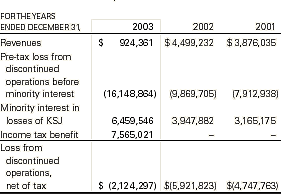
The Loss from discontinued operations, net of tax for 2003 includes
$7.6 million in income tax benefits related to cumulative losses
at KSJ. As tax benefits could not be recognized until there were
offsetting profits or the commencement of the liquidation process,
no tax benefit had previously been accrued.
back to top
Note 11: FIXED ASSETS AND LEASEHOLD IMPROVEMENTS
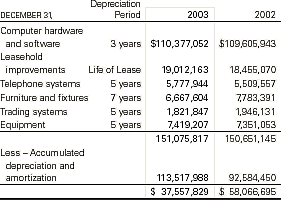
Fixed assets and leasehold improvements comprise
the following:
back to top
Note 12: COMMITMENTS AND CONTINGENT LIABILITIES
The Company leases office space under noncancelable
operating leases. The office leases contain certain escalation clauses
whereby the rental commitments may be increased if certain conditions
are satisfied and specify yearly adjustments to the lease amounts
based on annual adjustments to the Consumer Price Index. Rental expense
under the office leases was as follows:
| For the year ended December 31, 2001 | $ | 11,275,328 |
| For the year ended December 31, 2002 |
|
15,480,044 |
| For the year ended December 31, 2003 |
|
11,295,174 |
The Company leases certain computer and other equipment under noncancelable
operating leases. In addition, the Company has entered into guaranteed
employment contracts with certain of its employees. As of December
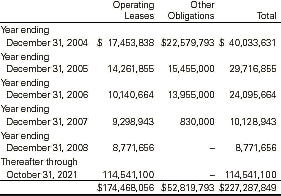
31, 2003, future minimum rental commitments under all noncancelable
office, computer and equipment leases ("Operating Leases"), and obligations on
clearing contracts and guaranteed employment contracts longer than one
year ("Other Obligations") were as follows:
During the normal course of business, the Company collaterizes
certain leases, employment agreements or other contractual obligations
through letters of credit or segregated funds held
in escrow accounts. As of December 31, 2003, the Company has provided
a $9.0 million letter of credit, collateralized by
U.S. Treasury Bills, as a guarantee for one of the Company's lease
obligations.
The Company has agreements with the ISE to purchase Class A and Class
B membership interests of ISE with a total purchase price of approximately
$28.5 million. The ISE demutualized on May 31, 2002 and as a result,
the Company received shares of the ISE representing both equity interest
and trading rights. In accordance with the purchase agreement, the
Company made an initial payment at the time of the closing with further
periodic payments to be made in the future based on a fixed dollar
amount per contract traded. The Company capitalizes the exchange
memberships at a fixed dollar amount per contract traded. As of December
31, 2003, the Company
had capitalized $7.3 million of Equity Interest (Class A) and $15.4
million of Trading Rights (Class B). These amounts are included in
Strategic investments and Other assets, respectively, on the Consolidated
Statements of Financial Condition. The Company is not obligated to
make future payments; however, the Company would forfeit its equity
interest and
its trading rights if it failed to meet its minimum payment
obligations under the contract.
On October 22, 2003, the Company announced that it had entered into
new long-term employment contracts with the senior management team
of Deephaven (the "Deephaven managers"). These employment agreements,
which became effective on January 1, 2004, are for three-year terms
and include an option for renewal by the Deephaven managers through
2009 under certain circumstances. In addition, the agreements provide
that, in the event of a change of control of the Company, the Deephaven
managers would have the option to obtain a 51% interest in Deephaven
in exchange for the termination of their employment contracts and associated
profit-sharing bonuses. If a change of control were to occur, and if
the Deephaven managers exercised this option, the Company would retain
a 49% interest in Deephaven.
In the ordinary course of business, the nature of the Company's business
subjects it to claims, lawsuits, regulatory examinations and other
proceedings. The results of these matters cannot be predicted with
certainty.
In March 2004, Knight Securities, L.P. ("KSLP," now known as KEM)
and its former CEO, Kenneth D. Pasternak, received Wells Notices
from the staff of the SEC's Division of Enforcement and from NASD's
Department of Market Regulation. The Wells Notices from the SEC's
Division of Enforcement indicate that the Division is considering
recommending that the SEC bring civil and administrative enforcement
actions against KSLP and Mr. Pasternak for possible violations of
securities laws. These Wells Notices pertain to investigations into
specific trade activity, conduct, supervision and record-keeping
that occurred in 1999 through 2001. The Wells Notices from NASD's
Department of Market Regulation indicate that NASD intends to bring
formal disciplinary proceedings against both parties relating to
similar trade activity and conduct that occurred in 1999 and 2000.
We understand that three former KSLP employees have also received
Wells Notices.
Since receiving the Wells Notices, the Company has not yet presented
its response or met with the SEC or NASD to discuss the proposed
charges. As a result, it is premature to fully assess the potential
impact of these Wells Notices to the Company, the outcome of the
investigations or the timing of their resolution. There can be no
assurance that these matters will not have a material adverse effect
on the Company's results of operations in any future period and a
substantial judgment or other resolution could have a material adverse
impact on the Company's financial condition and results of operations.
However, it is the opinion of management, based on information currently
available, that it is not probable that the ultimate outcome of these
matters will have a material adverse effect on the consolidated financial
condition of the Company, although they might be material to the
operating results for any particular period, depending, in part,
upon the operating results for that period.
back to top
Note 13: EARNINGS PER SHARE
Basic earnings per common share ("EPS") have been calculated by dividing
net income (loss) by the weighted average shares of Class A Common
Stock outstanding during each respective period. Diluted EPS
reflects the potential reduction in EPS using the treasury stock
method to reflect the impact of common share equivalents if stock
awards such as stock options and restricted stock were exercised
or converted into common stock.
The following is a reconciliation of the numerators and denominators
of the basic and diluted earnings per share computations for the
years ended December 31, 2003, 2002 and 2001:
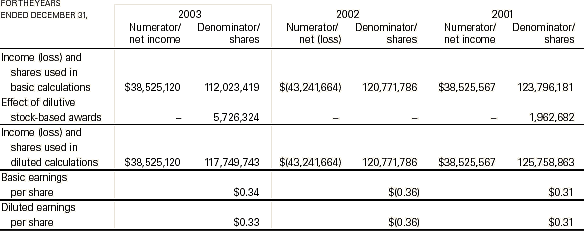
For the year ended December 31, 2002, 1,374,689 shares of common stock
equivalents were not included in the calculation of weighted average
shares for diluted EPS because the Company incurred losses during the
period and the effect of their inclusion would be anti-dilutive.
back to top
Note 14: EMPLOYEE BENEFIT PLAN
The Company sponsors 401(k) profit sharing plans (the "Plans") in which
substantially all of its employees are eligible to participate. Under
the terms of the Plans, the Company
is required to make annual contributions to the Plans equal
to 100% of the contributions made by its employees, up to certain limits.
The total expense recognized with respect to the Plans was as follows:
| For the year ended December 31, 2001 | $ | 5,377,539 | | For the year ended December 31, 2002 | | 5,631,808 | | For the year ended December 31, 2003 | | 3,842,556 |
back to top
Note 15: INCOME TAXES
The Company and its subsidiaries file a consolidated federal income
tax return as well as combined state income tax returns in certain jurisdictions.
In other jurisdictions, the Company and its subsidiaries file separate
company state income tax returns.
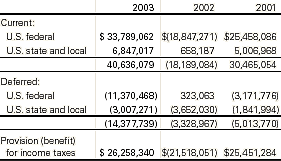
The provision (benefit) for income taxes consists of:
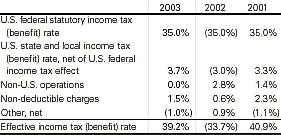
The following table reconciles the provision to the U.S. federal statutory
income tax (benefit) rate:
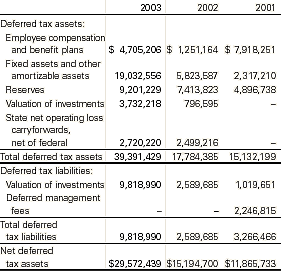
Deferred income taxes reflect the net tax effects of temporary differences
between the financial reporting and tax bases of assets and liabilities
and are measured using the enacted tax rates and laws that will be in
effect when such differences are expected to reverse. Significant components
of the Company's deferred tax assets and liabilities at December 31,
2003, 2002 and 2001 are as follows:
At December 31, 2003, the Company had net operating
loss carryforwards for state income tax purposes. The estimated amount
of such carryforwards ranged by jurisdiction up to approximately $62
million. These state net operating loss carryforwards expire between
2007 and 2022.
back to top
Note 16: LONG-TERM INCENTIVE PLANS
The Company established the Knight Trading Group, Inc. 1998 Long-Term
Incentive Plan and the Knight Trading Group, Inc. 1998 Nonemployee Director
Stock Option Plan. Additionally, in May 2003, the Company established,
and the stockholders approved, the Knight Trading Group, Inc. 2003 Equity
Incentive Plan (the "2003 Plan") (collectively, the "Plans"). The purpose
of the Plans is to provide long-term incentive compensation to employees
and directors of the Company. The Plans are administered by the Compensation
Committee of the Company's Board of Directors, and allow for the grant
of options, restricted stock and restricted stock units (collectively,
the "awards"), as defined by the Plans. The number of shares reserved
under
the 2003 Plan was 10,000,000. Including the 2003 Plan, the
maximum number of shares of Class A Common Stock reserved for the grant
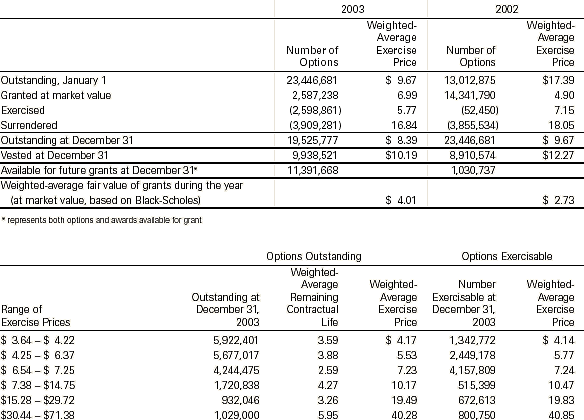
of options and awards under the Plans is now 37,819,000, of which, 11,391,668
are available for grant at December 31, 2003. In addition, the Plans
limit the number of options or shares that may be granted to a single
individual, and the Plans also limit the number of shares of restricted
stock that may be awarded. See the following table for a reconciliation
of activity of the Plans and awards available for future grants.
The Company's policy is to grant options for the purchase of shares
of Class A Common Stock at not less than market value, which the Plans
define as the average of the high and low sales prices on the date prior
to the grant date. Options and awards generally vest over a three- or
four-year period and expire on the fifth or tenth anniversary of the
grant date, pursuant to the terms of the agreements. Restricted stock
awards generally vest over three years. In July 2003, the Company's Board
of Directors approved a change in the vesting schedule for restricted
stock awards issued under the 2003 Plan to include a one-year minimum
vesting period for performance-based awards and a three-year vesting
period for time-based awards. The Company has the right to fully vest
employees in their option grants and awards upon retirement. The following
is a reconciliation of option activity for the Plans for 2003 and 2002,
and a summary of options outstanding and exercisable at December 31,
2003:
The Company applies APB 25 and related interpretations in accounting
for its stock option plans. As options are granted at the then market
value, no compensation expense has been recognized for the fair values
of the options granted to employees.
The Company granted a total of 971,577 restricted shares of Class A
Common Stock to certain current employees of the Company under the 1998
Long-Term Incentive Plan (the "1998 Plan") in 2003. In addition, 211,283
restricted shares of Class A Common Stock were granted to certain current
employees of the Company outside of the 1998 Plan in 2003. At December
31, 2003, the Company had 2,138,944 restricted shares outstanding, in
aggregate, both under and outside of the 1998 Plan. Such grants were
made at fair market value and with terms consistent with the 1998 Plan.
The Company recognizes compensation expense for the fair values of the
restricted shares of Class A Common Stock granted to employees ratably
over the vesting period. In 2003, the Company recorded compensation expense
of $3.7 million for all of its outstanding restricted shares, which has
been included in Employee compensation and benefits in the Consolidated
Statements of Operations. The restricted stock requires future service
as a condition of the vesting of the underlying shares of common stock.
On December 11, 2002, the Company filed with the SEC a Tender Offer
Statement on Schedule TO and associated documents relating to an offer
to exchange certain outstanding vested and unvested options granted under
the Plans (the "Exchange Program"). To be eligible for the Exchange Program
the options had to have an exercise price of at least $14.00 and be held
by current employees who had not received an option grant since June
1, 2002. Members of the Company's Board
of Directors and executive officers were excluded from
participating in the Exchange Program.
The offering under the Exchange Program expired on January 17, 2003.
A total of 1,436,750 options to purchase one share were cancelled. Approximately
1.8 million options were eligible to
be exchanged. In accordance with the Exchange Program, 524,380 options
to purchase one share were granted to current employees on July 21, 2003,
a date that was over six months and one day after the Company cancelled
the options. Under the Exchange Program, for every two-and-a-half options
to purchase one share tendered for exchange, a new option
to purchase one share was issued. The new options were issued at a price
not less than the market value on the issuance date and have a two-year
vesting period. The Exchange Program was structured to comply with FASB
Interpretation
("FIN") 44 Accounting for Certain Transactions Involving
Stock Compensation an Interpretation of APB 25 in order to achieve the
same accounting treatment as the original option grants that were tendered
for exchange.
back to top
Note 17: FINANCIAL INSTRUMENTS WITH OFF-BALANCE SHEET RISK AND CONCENTRATIONS OF CREDIT RISK
As a market maker of equities and options, the majority of the Company's
securities transactions are conducted as principal or riskless principal
with broker-dealer and institutional counterparties primarily located
in the United States. The Company clears all of its securities transactions
through clearing brokers. Accordingly, a substantial portion of the Company's
credit exposures are concentrated with its clearing brokers. The clearing
brokers can rehypothecate the securities held on behalf of the Company.
Additionally, pursuant to the terms of the agreement between the Company
and the clearing brokers, the clearing brokers have the right to charge
the Company for all losses that result from a counterparty's failure
to fulfill its contractual obligations. At December 31, 2003, the Company
has recorded liabilities of approximately $2.1 million with regard to
this right. The Company has the ability to pursue collection from or
performance with regard to this right. The Company's policy is to monitor
the credit standing of the clearing brokers and all counterparties with
which it conducts business.
Securities sold, not yet purchased represent obligations to purchase
such securities (or underlying securities) at a future date. The Company
may incur a loss if the market value of the securities subsequently increases.
Derivative contracts are financial instruments whose value is based
upon the value of the underlying asset, index, reference rate or a combination
of these factors. The Company uses derivative financial instruments as
part of its options market-making and trading business and its overall
risk management process. These financial instruments, which generally
include exchange-traded options, options on futures and futures contracts,
expose the Company to varying degrees of market and credit risk. The
Company records its derivative-trading
activities at market value, and unrealized gains and losses are recognized
currently.
In November 2002, the FASB issued FIN 45 Guarantor's Accounting and
Disclosure Requirements for Guarantees, Including Indirect Guarantees
of Indebtedness of Others, which requires the Company to disclose information
about obligations under certain guarantee arrangements. FIN 45 defines
a guarantee as a contract that contingently requires the Company to pay
a guaranteed party based on: (a) changes in an underlying asset, liability,
or equity security of the guaranteed party, or
(b) a third party's failure to perform under a specified agreement.
The Company considers written put options to be guarantees under FIN
45.
In addition to the contracts described above, there are certain derivative
contracts to which the Company is a counterparty that meet the characteristics
of a guarantee under FIN 45. These derivatives are recorded on the Statements
of Financial Condition at fair value. These contracts include written
put options that may require the Company to purchase assets from the
option holder at a specified price by a specified date in the future.
The total theoretical exposure of these derivatives that the Company
deems to be guarantees, assuming the underlying positions have zero value,
was approximately $9.6 billion at December 31, 2003. The Company reduces
its exposures to these contracts by entering into offsetting transactions,
or by entering into contracts that hedge the market risk related to these
contracts.
Upon the retirement of Mr. Irvin Kessler, the former chief
executive officer of Deephaven, as of December 31, 2001, the Company
entered into a consulting agreement with
Mr. Kessler. In order to maintain Mr. Kessler's relationships
with the Deephaven Funds' investors and maintain
Mr. Kessler's continued investment in the Deephaven Funds, the Company
agreed to provide Mr. Kessler with a full recourse collateralized loan
of $25 million. On June 13, 2002, the Company entered into loan and security
documents with
Mr. Kessler providing for such a loan. The loan matured on March 31,
2003 and was fully repaid.
The Company currently has no loans to any former or current executive
officers or directors.
back to top
Note 18: NET CAPITAL REQUIREMENTS
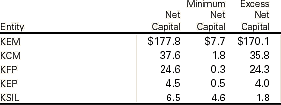
As registered broker-dealers, KEM, KCM, KFP and KEP are subject to the
SEC's Uniform Net Capital Rule (the "Rule"), which requires the maintenance
of minimum net capital. Additionally, KSIL is subject to regulatory requirements
of the Financial Services Authority in the United Kingdom. As of December
31, 2003, the Company was in compliance with its capital adequacy requirements.
The following table sets forth the net capital levels and
requirements for the following broker-dealer subsidiaries at December
31, 2003 (in millions):
back to top
Note 19: BUSINESS SEGMENTS
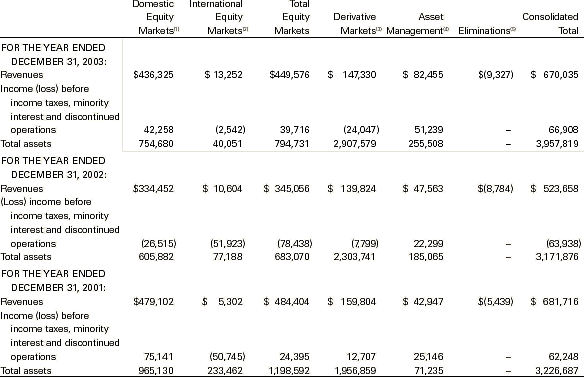
Effective in the fourth quarter of 2003, the Company instituted a new
segment reporting format to include three reportable business segments:
Equity Markets, Derivative Markets and Asset Management. Prior to this
change, the Company reported two business segments: Equity Markets, which
included equity and derivatives business activities, and Asset Management.
This segment reporting change was made to better reflect management's
approach to operating and directing the businesses and to more closely
align financial and managerial reporting. Prior period segment data has
been restated to conform to the 2003 presentation. Equity Markets includes
two geographic classifications, domestic and international. Domestic
Equity Markets primarily represents market making in U.S. equities. International
Equity Markets represents the Company's European equities business. Market
making in Europe was discontinued during 2002. Derivative Markets primarily
represents market-making and specialist operations in U.S. options. The
Asset Management segment consists of investment management and sponsorship
of the Deephaven Funds and the Company's investment in the Deephaven
Funds.
The Company's net revenues, income before income taxes, minority interest
and discontinued operations and assets by segment are summarized below
(amounts in $000's). Other revenues and expenses that are not directly
attributable to a particular
segment are allocated based upon the Company's allocation methodologies,
generally based on each segment's respective resource usage or other
appropriate measures.
|