Management's Discussion and Analysis of Financial Conditions and Results of Operations
This section should be read in conjunction with the Selected Consolidated Financial and Operating Data and OneSource's Consolidated Financial Statements and the Notes thereto appearing elsewhere in this Annual Report.
The following discussion contains forward-looking statements that involve risks and uncertainties. OneSource makes such forward-looking statements under the provision of the "Safe Harbor" section of the Private Securities Litigation Reform Act of 1995. Any forward-
looking statements should be considered in light of the factors described below under "Certain Factors that May Affect Future Results." Actual results may vary materially from those projected, anticipated or indicated in any forward-looking statements. In this Annual Report, the words "anticipates," "believes," "expects," "intends," "future," "could," and similar words or expressions (as well as other words or expressions referencing future events, conditions or circumstances) identify forward-looking statements.
Overview
OneSource provides Web-based business and financial information to professionals who need quick access to reliable corporate, industry and market intelligence. OneSource was formed as a division of Lotus Development Corporation in 1987 and became an independent company when it was purchased in a management buy-out in 1993. Until December 1996, our business was to provide business
information to the financial community using CD Rom technology as the primary method of distribution. The introduction of Business Browser in December 1996 marked a fundamental shift in our business as we began a transition away from our legacy CD Rom
business and toward Web-based products.
On October 1, 1999, OneSource acquired Corporate Technology, a Delaware corporation located in Woburn, Massachusetts. Corporate Technology is a provider of high technology company profiles with a focus on emerging private companies. Pursuant to the terms of an Agreement and Plan of Merger, the consideration paid by OneSource was $7.6 million in cash. A portion of the cash consideration is being held in escrow to be released in accordance with the Agreement and Plan of Merger and an Escrow Agreement. For financial
statement purposes, this acquisition was accounted for as a purchase and, accordingly, the results of operations of Corporate Technology subsequent to October 1, 1999, have been included in OneSource's consolidated statements of operations. Prior to being acquired, Corporate Technology had revenues of $4.4 million and $4.9 million in the nine months ended September 30, 1999, and the year ended December 31, 1998, respectively.
In May 1998, we sold our CD-Insurance division to allow us to focus more completely on our new Web-based product line. We recognized a gain of $12.8 million on this sale during 1998. In addition, in connection with the disposition, we licensed certain of our CD Rom
software to the acquirer in exchange for $4.0 million of license fees. These license fees will be paid in eight equal quarterly installments beginning January 1, 1999, and running through December 31, 2000, and will be recognized ratably as other income. For the year ended December 31, 1999, OneSource recorded $2.0 million of other income related to the software license agreement.
Our revenues for both CD Rom and Web-based products consist of monthly subscription fees from customer contracts. Customer
contracts span varying periods of time but are generally for one year, are renewable for like periods, and are payable in advance. Subscription fees generally are quoted to clients on an annual basis but are earned as revenues on a monthly basis over the subscription period. Invoices are recorded as accounts receivable until paid and as deferred revenues until earned. Deferred revenues attributable to Web-based products increased 43% to $22.8 million as of December 31, 1999, from $15.9 million as of December 31, 1998, and increased 375% from $4.8 million as of December 31, 1997.
Cost of revenues consists primarily of royalties to information providers and, to a lesser extent, employee salaries and benefits, facilities allocation and related expenses, depreciation associated with computers for data processing and on-line requirements and Web hosting expenses. We enter into contracts with our information providers which are generally for a term of at least one-year and are automatically renewable if not canceled with advance notice. These contracts may be terminated under certain circumstances. Under these arrangements, royalties are generally paid on a quarterly basis to information providers. Royalties generally are calculated either as a flat
percentage of our revenues or as a per-user fee that declines as the number of authorized users of the product increases. In limited cases, we pay a fixed fee per period.
Selling and marketing expense consists primarily of employee salaries and benefits and sales commissions paid to our sales force,
customer support organization and marketing personnel, as well as facilities allocation and related expenses, direct marketing
promotional materials, trade show exhibitions and advertising. Sales commissions are paid when customers are invoiced and are recorded as deferred subscription costs, which are amortized ratably over the term of the contract, typically 12 months, as the associated revenues are recognized. All other selling and marketing costs are expensed as incurred.
Platform and product development expense consists primarily of employee salaries and benefits, facilities allocation and related expenses, as well as outside contractor expenses, relating to the development of our "platform" of core software supporting our products and the development of new products based upon that platform. Platform and product development expense includes expenses relating to the
editorial staff that implements our KeyID technology to integrate disparate information sources into our Web-based products.
General and administrative expense consists primarily of employee salaries and benefits, facilities allocation and related expenses
associated with OneSource's management, finance, human resources, management information systems and administrative groups.
Results of Operations
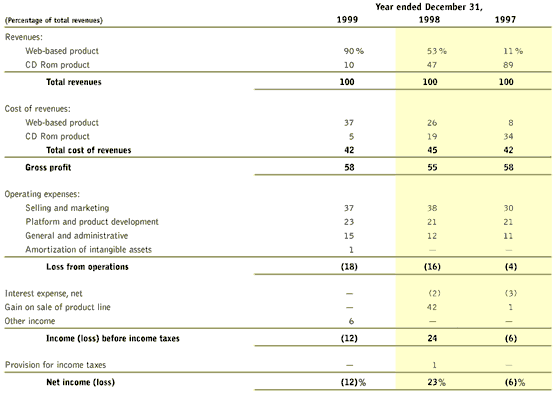
The following table sets forth, for the periods indicated, the percentage of total revenues represented by each line item in OneSource's
consolidated statement of operations. We can give no assurance that the indicated trends in revenues or operating results will continue
in the future.
Comparison of Results for the Years Ended December 31, 1999 and 1998
Revenues. Total revenues increased 17% to $35.5 million for the year ended December 31, 1999, from $30.4 million for the year ended December 31, 1998. In May 1998, OneSource sold its CD-Insurance division. Revenues from this product line were $2.6 million for the
year ended December 31, 1998. On October 1, 1999, OneSource acquired Corporate Technology; thereafter, revenues for the year ended December 31, 1999, include $1.0 million of revenue recognized from products and customers related to the acquired Corporate Technology business. Excluding the CD-Insurance division and Corporate Technology revenues, total revenues for the year ended December 31, 1999, increased by 24%.
Web-based product revenues increased by 98% to $31.8 million for the year ended December 31, 1999, from $16.1 million for the year ended December 31, 1998. The increase was attributable to new customers, an increase in the number of user seats purchased by existing customers and the sale of new products to existing customers. At the same time, CD Rom product revenues decreased by 74% to $3.7
million in 1999 from $14.4 million in 1998 as OneSource continued its transition away from its legacy CD Rom business.
Cost of Revenues. Total cost of revenues increased 8% to $14.8 million for the year ended December 31, 1999, from $13.7 million for the year ended December 31, 1998. As a percentage of total revenues, total cost of revenues decreased to 42% in 1999 from 45% in 1998. The decrease in total cost of revenues percentage was principally due to a decreased effective royalty rate for our Web-based
products, which resulted from the renegotiation of some information provider agreements to lower royalty rates and contracts where effective royalty rates decline as the number of seats sold to a customer increase.
Cost of Web-based product revenues increased 67% to $13.1 million for the year ended December 31, 1999, from $7.9 million for the year ended December 31, 1998. As a percentage of Web-based product revenues, cost of Web-based product revenues decreased to 41% in 1999 from 49% in 1998, due to an increase in our customer base as well as more favorable royalty rates.
Cost of CD Rom product revenues decreased 71% to $1.7 million for the year ended December 31, 1999, from $5.8 million for the
year ended December 31, 1998. This decrease was due to lower revenues reflecting our shift away from the CD Rom product line.
As a percentage of CD Rom product revenues, cost of CD Rom product revenues increased to 45% in 1999, from 40% in 1998.
Selling and Marketing Expense. Selling and marketing expense increased 14% to $13.3 million for the year ended December 31, 1999, from $11.6 million for the year ended December 31, 1998, principally due to increased headcount and expenses incurred to hire and train new sales personnel in connection with our Business Browser product line. Selling and marketing expense decreased as a percentage of total revenues to 37% in 1999 from 38% in 1998. We expect sales and marketing expenses to increase as we continue to hire additional sales personnel.
Platform and Product Development Expense. Platform and product development expense increased 27% to $8.0 million for the year ended December 31, 1999, from $6.3 million for the year ended December 31, 1998. As a percentage of total revenues, platform
and product development expense increased from 21% to 22%. The increase was due principally to additional headcount to meet
new product demands.
General and Administrative Expense. General and administrative expense increased 42% to $5.5 million for the year ended December 31, 1999, from $3.8 million for the year ended December 31, 1998. The increase primarily relates to payments to terminate certain arrangements upon the completion of our initial public offering in May 1999. These expenses included termination fees of $0.5 million to each of William Blair Venture Partners III Limited Partnership and an affiliate of Information Partners Capital Fund, L.P. in connection with our public offering, financial advisory fees of $0.2 million and relocation expenses of our headquarters of $0.1 million. General and administrative expense increased as a percentage of total revenues to 15% in 1999, from 12% in 1998.
Amortization of Intangible Assets. Amortization of intangible assets expense for the year ended December 31, 1999, was $0.4 million. The increase is the result of the acquisition of Corporate Technology in October 1999 and the associated amortization of intangible assets acquired as part of that transaction.
Interest Income, Net. Interest income, net of interest expense, was $47,000 for the year ended December 31, 1999, compared to $595,000 of net interest expense for the year ended December 31, 1998. This increase is primarily due to an increase in interest income related to the invested cash balance from the initial public offering proceeds and the sale of the CD-Insurance division, as well as a
reduction in interest expense following the payoff of long-term debt in May 1999. OneSource recognized a one-time expense of
$0.3 million relating to the unamortized portion of the original issue discount when we paid the outstanding balance on long-term debt
in the principal amount of $6.3 million from the proceeds of our initial public offering.
Other Income. Other income increased $2.0 million for the year ended December 31, 1999, and was attributable to revenues from a
software license agreement entered in connection with the sale of our CD-Insurance division.
Gain on Sale of Product Line. As the result of the sale of the CD-Insurance division, we recorded a gain of $12.8 million for the
year ended December 31, 1998.
Provision for Income Taxes. The provision for income taxes for the year ended December 31, 1999, was $133,000 and related to amounts due for state and franchise taxes. The provision for income taxes for the year ended December 31, 1998, was $250,000 and related to the gain on the sale of the CD-Insurance division.
Comparison of Results for the Years Ended December 31, 1998 and 1997
Revenues. Total revenues remained at approximately the same level of $30.4 million for each of the years ended December 31, 1998,
and 1997. In May 1998, OneSource sold its CD-Insurance division. Revenues from this product line were $2.6 million for the year ended December 31, 1998, compared to $6.6 million for the year ended December 31, 1997. Excluding these revenues from total revenues
for each period, total revenues for the year ended December 31, 1998, increased by 17%.
Web-based product revenues increased by 385% to $16.1 million for the year ended December 31, 1998, from $3.3 million for the year ended December 31, 1997. The increase was attributable to new customers, an increase in the number of user seats purchased by existing customers and the sale of new products to existing customers. At the same time, CD Rom product revenues decreased by 47% to $14.4 million in 1998, from $27.1 million in 1997 as OneSource continued its transition away from its legacy CD Rom business.
Cost of Revenues. Total cost of revenues increased 6% to $13.7 million for the year ended December 31, 1998, from $12.8 million for the year ended December 31, 1997. As a percentage of total revenues, total cost of revenues increased to 45% in 1998, from 42% in 1997. The increase in total cost of revenues was principally due to increased royalty expense for our Web-based products. It was offset partially by a decrease in our costs of revenues relating to the CD Rom product line.
Cost of Web-based product revenues increased 227% to $7.9 million for the year ended December 31, 1998, from $2.4 million for the year ended December 31, 1997. As a percentage of Web-based product revenues, cost of Web-based product revenues decreased to 49% in 1998 from 72% in 1997, due to an increase in our customer base. Royalty expense increased as a result of growth in Business Browser product line revenues and number of user seats sold.
Cost of CD Rom product revenues decreased 45% to $5.8 million for the year ended December 31, 1998, from $10.4 million for the
year ended December 31, 1997. This decrease was due to decreased revenues reflecting our shift away from the CD Rom product line.
As a percentage of CD Rom product revenues, cost of CD Rom product revenues increased to 40% in 1998, from 39% in 1997.
Selling and Marketing Expense. Selling and marketing expense increased 26% to $11.6 million for the year ended December 31, 1998, from $9.2 million for the year ended December 31, 1997, principally due to increased expenses incurred to hire new sales personnel and to train new and existing personnel in connection with our transition to our new Business Browser product line. Selling and marketing expense increased as a percentage of total revenues to 38% in 1998 from 30% in 1997.
Platform and Product Development Expense. Platform and product development expense decreased 1% to $6.3 million for the year ended December 31, 1998, from $6.4 million for the year ended December 31, 1997, although as a percentage of total revenues it remained constant at 21%. The decrease was due principally to the decrease in salary expense resulting from the elimination of CD-Insurance product development staff in May 1998 upon the sale of that division and the elimination of several CD Rom product management positions. This decrease in salary expense was offset by increased headcount in the Global Strategic Web Applications Team to meet new product demands.
General and Administrative Expense. General and administrative expense increased 13% to $3.8 million for the year ended December 31, 1998, from $3.4 million for the year ended December 31, 1997, principally due to increased headcount in management information systems and human resources for infrastructure required to accommodate the growth in our business. General and administrative expense increased as a percentage of total revenues to 12% in 1998, from 11% in 1997.
Interest Expense, Net. Interest expense, net of interest income, decreased 36% to $0.6 million for the year ended December 31, 1998, from $0.9 million for the year ended December 31, 1997, due to an increase in interest income related to invested cash balances from
the sale of the CD-Insurance division line in May 1998.
Gain on Sale of Product Line. As a result of the sale of the CD-Insurance division, we recorded a gain of $12.8 million. This gain reflects cash proceeds received of $11.0 million together with recognition of deferred revenues of $3.1 million and $0.6 million of deferred
subscription costs due to the transfer of related service obligations, net of transaction related expenses.
Provision for Income Taxes. The provision for income taxes for the year ended December 31, 1998, was $0.3 million and is directly related to the gain on the sale of the CD-Insurance division. Although the gain on the sale created significant taxable income for 1998, such gain was largely offset by utilizing our net operating loss carryforwards.
Quarterly Results of Operations (Unaudited)
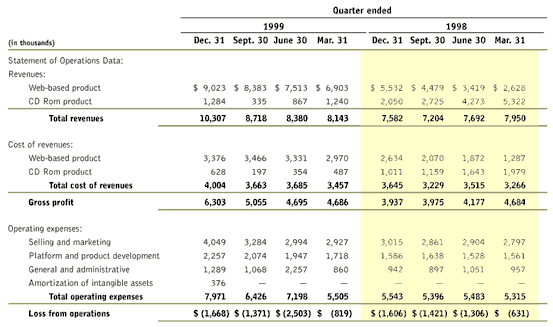
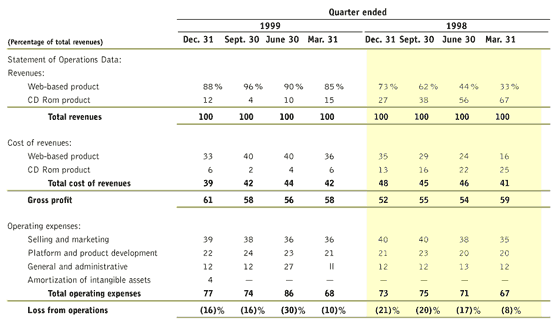
The following tables set forth a summary of OneSource's unaudited quarterly operating results for each of the eight quarters in the
two-year period ended December 31, 1999. This information has been derived from unaudited interim consolidated financial statements that, in the opinion of management, have been prepared on a basis consistent with the Consolidated Financial Statements appearing
elsewhere in this Annual Report and include all adjustments, consisting of only normal recurring adjustments, necessary for a fair
statement of such information when read in conjunction with OneSource's Consolidated Financial Statements and the Notes thereto.
Our operating results for any quarter are not necessarily indicative of results for any future period.
Annualized Contract Value
One measure of the performance of our business is "annualized contract value." This is a measurement we use for normalized
period-to-period comparisons to indicate business volume and growth, both in terms of new customers and upgrades and expansions at
existing customers. Our presentation and calculation of annualized contract value may not be comparable to similarly titled measures
used by other companies. It is not an absolute indicator, and we cannot guarantee that any annualized contract value will be ultimately
realized as revenues.
We use annualized contract value as a measure of our business because it shows the growth or decline in our customer base in a way that revenues cannot. Since our business is a subscription business, revenues are recognized not when a sale is made, but in ratable portions
over the term of the subscription (which is usually twelve months). As a result, from a revenue viewpoint the addition or loss of even a major customer contract may not have a dramatic impact on a quarter-to-quarter basis. On the other hand, by looking at the value of
customer contracts in hand at the end of each quarter, we can more readily see trends in our business. For example, the addition of a
one-year subscription contract with total payments of $1.0 million may only increase revenues by approximately $250,000 ($1.0 million divided by four) in the quarter in which the sale is made, but would increase annualized contract value by $1.0 million. Similarly, if the
customer did not renew that contract, revenues in the next quarter would only decrease by $250,000, while annualized contract value
would decrease by $1.0 million.
In calculating annualized contract value, we include only those contracts where the customer has actually been invoiced. Since amounts invoiced are included in deferred revenues on our balance sheet for all customer contracts with terms extending beyond the month of invoice, this demonstrates that annualized contract value is based on actual customer contracts reflected in our historical financial
statements. To compute annualized contract value, we multiply by twelve the total amount of fees invoiced for one month and included
in deferred revenues. Annualized contract value is not intended to be an absolute indicator of future revenues. We only annualize existing, invoiced contracts, but we do so without regard to the remaining term of those contracts. Most of our contracts are for 12 months,
but as of the date that we calculate annualized contract value the remaining term of nearly all of our contracts will be less than
12 months. If a customer fails to pay its invoiced fees or terminates the contract or if we are unable to renew a contract, our revenues
in subsequent periods may be less than expected based solely on annualized contract values. Conversely, if we add additional customers
or renew existing contracts at higher rates, our revenues in future periods may exceed expectations based solely on annualized
contract value.
The calculation of annualized contract value for our Web-based products is illustrated below:

We have increased annualized contract value attributable to Web-based products 49% to $38.7 million as of December 31, 1999, from $25.9 million as of December 31, 1998. The number of Web-based customers has increased 31% to 583 at December 31, 1999,
from 445 at December 31, 1998. At the same time, the average annualized contract value of all Web-based product customers has increased 14% to $66,500 per customer at December 31, 1999, from $58,200 per customer at December 31, 1998. This growth
was attributable to an increase in the number of user seats purchased by customers and the addition of new products.
Liquidity and Capital Resources
Since acquiring our business from Lotus Development Corporation in 1993, we have funded our operations through a combination of seller financing, proceeds received from the sale of Class P common stock and common stock in connection with the purchase of the business from Lotus Development Corporation, bank debt, proceeds received from the sale of non-strategic lines of business, capitalized equipment leases, cash flows from operations and our initial public offering which closed in May 1999.
Our cash and cash equivalents totaled $13.6 million at December 31, 1999, compared to $8.7 million at December 31, 1998, an increase of $4.9 million primarily due to the receipt of net proceeds of $26.9 million from our initial public offering in May 1999, less funds used to acquire Corporate Technology and to retire outstanding long-term debt.
Net cash used in operating activities was $0.6 million for the year ended December 31, 1999, as compared to net cash provided by
operating activities of $1.2 million for the year ended December 31, 1998.
Net cash used in investing activities was $11.1 million for the year ended December 31, 1999, as compared to net cash provided by investing activities of $9.0 million for the year ended December 31, 1998. Cash used in investing activities was primarily from the
acquisition of Corporate Technology for $7.6 million and purchases of property and equipment for $2.8 million during the year ended December 31, 1999. Cash generated in investing activities for the year ended December 31, 1998, reflects net cash proceeds from the
sale of our CD-Insurance division.
Net cash provided by financing activities was $16.7 million for the year ended December 31, 1999, as compared to net cash used by financing activities of $2.0 million for the year ended December 31, 1998. Net cash provided by financing activities in 1999 primarily consisted of net proceeds from the sale of common stock in our initial public offering, offset in part by the repurchase and retirement
of common stock, repayments of debt and capital lease obligations. Net cash used in financing activities in 1998 reflected primarily repayments of our line of credit and capital lease obligations.
We do not currently have a line of credit but intend to enter into a revolving line of credit for letters of credit and general working capital.
We believe that the net proceeds from our initial public offering, together with our current cash and cash equivalents and funds
anticipated to be generated from operations, will be sufficient to satisfy working capital and capital expenditure requirements for
at least the next twelve months.
Recently Issued Accounting Pronouncements
In June 1998, the Financial Accounting Standards Board ("FASB") issued Statement of Financial Accounting Standards ("SFAS")
No. 133, "Accounting for Derivative Instruments and Hedging Activities." This standard establishes accounting and reporting standards
for derivative instruments, including certain derivative instruments embedded in other contracts (collectively referred to as derivatives),
and for hedging activities. SFAS No.133 requires companies to recognize all derivatives as either assets or liabilities, with the instruments measured at fair value. The accounting for changes in fair value, gains or losses depends on the intended use of the derivative and its
resulting designation. In June 1999, the FASB issued SFAS No. 137 that defers the effective date of adoption of SFAS No. 133 to fiscal years beginning after June 15, 2000. Management believes the effect of adoption SFAS No. 133 will not have a significant impact on
its financial statements.
In December 1999, the Securities and Exchange Commission issued Staff Accounting Bulletin No. 101 ("SAB No. 101"), "Revenue Recognition in Financial Statements". SAB No. 101 provides guidance on applying generally accepted accounting principles to revenue recognition issues in financial statements. OneSource will adopt SAB No. 101 as required in the first quarter of 2000 and is evaluating the effect that such adoption may have on its consolidated results of operations and financial position.
Certain Factors that May Affect Future Results
This Annual Report contains forward-looking statements which involve risks and uncertainties. OneSource's actual results could differ materially from those anticipated in these forward-looking statements as a result of certain factors, including without limitation, those
set forth in the following risk factors and elsewhere in this Annual Report. In addition to the other information included or incorporated
by reference in this Annual Report the following risk factors should be considered carefully in evaluating OneSource and its business.
OneSource may not be able to retain key employees of corporate technology. Key founders and some employees of Corporate Technology, several of whom were large stockholders, received a substantial cash payment upon closing of the acquisition. In certain cases, these
individuals may be financially independent. Additionally, start-up and other companies will seek out these individuals due to the financial result they have achieved for Corporate Technology. Under the circumstances, OneSource faces a difficult and significant task of retaining and motivating the key personnel of Corporate Technology to stay committed to OneSource.
We will incur substantial charges against earnings in connection with the acquisition of Corporate Technology. Significant merger-related charges against earnings increased OneSource's losses in the fourth quarter of fiscal year 1999 and during the post-merger integration period. We expect to incur charges of approximately $0.5 million in connection with the acquisition that relate to other integration costs. These costs may be higher than we anticipate. In addition, we may incur other unanticipated acquisition costs. These costs may delay the anticipated benefits of the acquisition. Nonrecurring expenses will be recorded in the period incurred.
Subscribers of OneSource and Corporate Technology may not renew their subscriptions as a result of concerns over the acquisition.
The closing of the acquisition could cause subscribers of OneSource and Corporate Technology to allow their subscriptions to lapse as
a result of concerns over product evolution, integration and support of the combined company's products. These non-renewals could have a material adverse effect on the business, operating results and financial condition of OneSource or Corporate Technology.
We have a limited operating history with Business Browser on which to evaluate our prospects. We began operations as an independent company in 1993. We began to migrate our business to the Web from CD Rom-based products in early 1996, and launched the Web-based Business Browser product line in December 1996. Our prospects must be considered in light of the risks, expenses and difficulties frequently encountered by companies transitioning to a new product line, particularly companies in the new and rapidly evolving market for Internet and Web-based business information products.
Our Business Browser products have not been profitable and may not become profitable in the future. We incurred losses from operations of approximately $1.6 million in 1996, $1.4 million in 1997, $5.0 million in 1998 and $6.4 million for the year ended December 31, 1999. In addition, we have not reached the critical mass of users of Web-based products, which we believe is necessary to leverage effectively our royalty payments and infrastructure expenses to become profitable. As of December 31, 1999, we had an accumulated deficit of $14.9 million.
We rely on our Business Browser product line, and we will not succeed unless demand for our Business Browser products continues
to grow. Subscription revenues from our Business Browser product line accounted for 90% of total revenues in 1999, 53% of total
revenues in 1998 and 11% in 1997. These subscription revenues accounted for 97% of our total annualized contract value at the end of 1999, 83% at the end of 1998 and 29% at the end of 1997. We have phased out CD Rom products that are not part of the Business Browser product line. As a result, our future financial condition will depend heavily on the success or failure of our Business Browser product line. Business Browser products were introduced in December 1996, and it is difficult to predict demand and market acceptance for these products in the new and rapidly evolving Web-based business information services market. If the demand for Business Browser products does not grow, whether due to competition, lack of market acceptance, failure of Internet or Web use to grow in general,
technological change or other factors, our business would suffer significantly.
Annualized contract value may not be an accurate indication of our performance. We use "annualized contract value" as a measurement for normalized period-to-period comparisons to indicate business volume and growth. Our presentation and calculation of annualized
contract value may not be comparable to similarly titled measures used by other companies. It is not an absolute indicator, and we cannot guarantee that any annualized contract value will be ultimately realized as revenues.
Competition in our industry is intense, and many of our competitors have greater resources than we do; this competition may adversely affect our financial results. The business information services industry is intensely competitive. We face direct or indirect competition from the following types of companies:
- large, well-established business and financial information providers such as Dow Jones, Dialog, Lexis-Nexis, Pearson, Reuters,
Factiva, Thomson, Primark and McGraw-Hill
- on-line information services or Websites targeted to specific markets or applications, such as NewsEdge, Factset and Bloomberg
- providers of sales, marketing and credit information such as Dun & Bradstreet
- Web retrieval, Web "portal" companies and other free or low-cost mass market on-line services such as Excite, Infoseek, Lycos,
Yahoo! and AOL/Netscape
- free or low-cost specialized business and financial information Websites such as Hoovers.com, Marketwatch.com, Multex.com
and TheStreet.com
Based on reported operating results, industry reports and other publicly available information, we believe that many of our existing
competitors, as well as a number of prospective competitors, have longer operating histories, greater name recognition, larger customer bases and significantly greater financial, technical and marketing resources than we do. As a result, they may be able to respond more quickly to new or emerging technologies and changes in user requirements, or to devote greater resources to the development, promotion and sale of their products than we can. These competitors may be able to undertake more extensive marketing campaigns, adopt more aggressive pricing policies and make more attractive offers to potential employees, customers and information providers. Our competitors also may develop products that are equal or superior to our products or that achieve greater market acceptance than our products.
If our information providers stopped doing business with us, we could not continue to sell Business Browser. We do not own or create
all of the original content distributed through our products. We depend significantly on information providers to supply information and data feeds to us on a timely basis. Our products could experience interruptions due to any failure or delay in the transmission or receipt of this information.
If our software is defective, it might be costly to correct; we could get sued and our reputation could be harmed. Complex software like the software we develop for our products may contain errors or defects, especially when first implemented, that may be very costly to correct. Defects or errors also could result in downtime, and our business could suffer significantly from potential adverse customer
reaction, negative publicity and harm to our reputation.
We may have difficulty in identifying and competing for acquisition opportunities. Our business strategy includes the pursuit of strategic acquisitions. From time to time we may engage in discussions with third parties concerning potential acquisitions of niche expertise,
business and proprietary rights. In executing our acquisition strategy, we may be unable to identify suitable companies as acquisition
candidates, making it more difficult to acquire suitable companies on favorable terms.
Pursuing and completing potential acquisitions could divert management attention and financial resources and may not produce the desired business results. If we pursue any acquisition, our management could spend a significant amount of time and management and financial resources in the acquisition process and to integrate the acquired business with our existing business. To pay for an acquisition, we may use capital stock, or cash or a combination of both. Alternatively, we may borrow money from a bank or other lender. If we use cash or debt financing, our financial liquidity will be reduced. In addition, from an accounting perspective, an acquisition may involve
nonrecurring charges or involve amortization of significant amounts of goodwill that could adversely affect our results of operations.
Despite the investment of these management and financial resources and completion of due diligence with respect to these efforts, an acquisition may not produce the revenue, earnings or business synergies that we anticipated, and an acquired technology or proprietary right may not perform as expected for a variety of reasons, including:
- difficulty in the assimilation of the operations, technologies, rights, products and personnel of the acquired company
- risks of entering markets in which we have no or limited prior experience
- expenses of any undisclosed or potential legal liabilities of the acquired company
- the potential loss of key employees of the acquired company
We may experience significant fluctuations in our quarterly results, which makes it difficult for investors to make reliable
period-to-period comparisons and contributes to volatility in the market price for our common stock. Our quarterly revenues,
gross profits and results of operations have fluctuated significantly in the past, and we expect them to continue to fluctuate
significantly in the future. In addition, we believe that an important measure of our business is the annualized contract value at
the end of each period, which also may fluctuate. Causes of such fluctuations have included and may include, among other factors:
- changes in demand for our products
- the dollar value and timing of both new and renewal subscriptions
- competition (particularly price competition)
- increases in selling and marketing expenses, as well as other operating expenses
- technical difficulties or system downtime affecting our products on the Web generally
- economic conditions specific to the Web, as well as general economic conditions
- consolidation of our customers
In addition, a substantial portion of our expenses, including most product development and selling and marketing expenses, must be incurred in advance of revenue generation. If our projected revenue does not meet our expectations, then we are likely to experience
an even larger shortfall in our operating profit (loss) relative to our expectations.
Any one or more of these factors could affect our business, financial condition and results of operations, and this makes the prediction of results of operations on a quarterly basis unreliable. As a result, we believe that period-to-period comparisons of our historical results of operations and annualized contract values are not necessarily meaningful and that you should not rely on them as an indication for future performance. Also, due to these and other factors, it is possible that our quarterly results of operations (including the annualized contract value) may be below expectations. If this happens, the price of our common stock would likely decrease.
Quantitative and Qualitative Disclosure About Market Risk
OneSource is exposed to various market risks, including changes in foreign currency exchange rates and interest rates. However, our
exposure to currency exchange rate fluctuations has been and is expected to continue to be modest due to the fact that the operations
of our United Kingdom subsidiary are almost exclusively conducted in local currency. Operating results are translated into United States dollars and consolidated for reporting purposes. The impact of currency exchange rate movements on intercompany transactions was immaterial for the years ended December 31, 1999 and 1998.
OneSource also owns financial instruments that are sensitive to market risks as part of its investment portfolio. The investment portfolio is used to preserve OneSource's capital until it is required to fund operations, including the Company's marketing and product
development activities. None of these market-risk sensitive instruments are held for trading purposes. The investment portfolio contains instruments that are subject to the risk of a decline in interest rates. We do not enter into derivatives or any other financial instruments for trading or speculative purposes.