1. Nature of Business
OneSource Information Services, Inc. and its wholly-owned subsidiaries provide Web-based business and financial information to
professionals in corporations and other enterprises and publishes information on private technology companies. OneSource primarily
sells its products through a direct sales force located throughout the United States and United Kingdom. OneSource manages its
business as a single segment.
2. Summary of Significant Accounting Policies
Principles of Consolidation
The consolidated financial statements include the accounts of OneSource Information Services, Inc. and its wholly-owned subsidiaries: Corporate Technology Information Services, Inc. and OneSource Information Services Limited, (collectively, "OneSource"). All significant intercompany transactions and balances have been eliminated.
Revenue Recognition
OneSource's products are sold on a subscription basis pursuant to customer contracts that span varying periods of time but are generally for a period of one year. In accordance with its customer agreements, OneSource initially records receivables and defers the related revenue at the time amounts are billed to customers. Revenues are recognized ratably over the related subscription period.
OneSource also produces print directories on an annual basis. The related revenue is recognized upon shipment, provided that fees are fixed or determinable and collection of the related receivable is probable.
Subscription Costs
Subscription costs represent sales commissions and royalty costs that are directly associated with securing a subscription and procuring information to be delivered over the subscription period, respectively. These costs are deferred and amortized ratably over the associated subscription period as a component of selling and marketing expense and cost of revenues, respectively. At December 31, 1999, and 1998, deferred subscription costs consisted of $1.7 million and $1.3 million, respectively, related to sales commissions and $5.5 million and $5.4 million, respectively, related to royalties.
Cash and Cash Equivalents
Cash equivalents consist of money market funds with original maturities of three months or less and are stated at cost which approximates fair market value. These funds are managed by a financial institution with a strong credit rating. Accordingly, the investments are subject to minimal credit and market risks.
Property and Equipment
Property and equipment are recorded at cost and depreciated over their estimated useful lives, generally three to five years, using the straight-line method. Equipment held under capital leases is stated at the fair value of the equipment at inception of the leases and is amortized on a straight-line basis over the term of the leases.
Intangible Assets
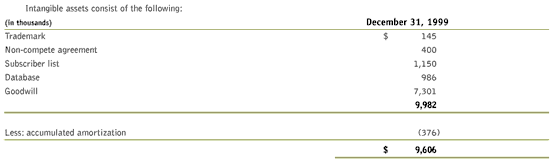
Intangible assets consist primarily of a trademark, non-compete agreement, subscriber list, database and goodwill. Intangible assets are amortized using the straight-line method over a period of three to seven years, based on the estimated useful life. The carrying value of the intangible assets is reviewed on a quarterly basis for the existence of facts or circumstances both internally and externally that may suggest impairment. To date, no such impairment has occurred. OneSource determines whether an impairment has occurred based on gross expected future cash flows and measures the amount of the impairment based on the related future estimated discounted cash flows. The cash flow estimates used to determine the impairment, if any, contain management's best estimates, using appropriate and customary assumptions and projections at the time.
Platform and Product Development and Software Development Costs
Platform and product development costs, other than certain software development costs, are charged to expense as incurred. Software development costs incurred subsequent to the establishment of technological feasibility (as defined by Statement of Financial Accounting Standards ("SFAS") No. 86, "Accounting for the Costs of Computer Software to be Sold, Leased or Otherwise Marketed"), and prior to general release of the product, are capitalized and amortized on a straight-line basis over the estimated useful lives of the related products, generally twenty-four to thirty-six months. The Company also adopted in 1999 Statement of Position ("SOP") 98-1, "Accounting for the Costs of Computer Software Developed or Obtained for Internal Use," which requires computer software costs associated with internal use to be charged to operations as incurred until certain capitalization criteria are met. At December 31, 1999 and 1998, OneSource had capitalized software development costs pursuant to the above of $306,000 and $310,000, respectively. For the years ended December 31, 1999, 1998 and 1997, amortization of capitalized software development costs amounted to $229,000, $198,000 and $413,000, respectively.
Financial Instruments
Fair values of OneSource's financial instruments, which include cash and cash equivalents, restricted time deposits, accounts receivable, long-term debt and capital lease obligations are based on quoted market prices and assumptions concerning the amount and timing of estimated future cash flows and assumed discount rates reflecting varying degrees of perceived risk. The carrying value of these financial instruments approximated their fair value at December 31, 1999 and 1998.
Concentration of Credit Risk
Concentration of credit risk with respect to accounts receivable is limited due to the large number of companies comprising OneSource's client base. Ongoing credit evaluations of customers' financial condition are performed and collateral is generally not required. OneSource maintains reserves for potential credit losses and such losses, in the aggregate, have not exceeded management's expectations.
Accounting for Stock-Based Compensation
OneSource accounts for stock-based compensation to employees in accordance with Accounting Principles Board Opinion ("APB")
No. 25, "Accounting for Stock Issued to Employees," and related interpretation. Accordingly, compensation expense is recorded for options issued to employees in fixed amounts to the extent that the fixed exercise prices are less than the fair market value of OneSource's common stock at the date of grant. OneSource follows the disclosure requirements of SFAS No. 123, "Accounting for Stock-Based
Compensation" (Note 9). All stock-based awards to non-employees are accounted for at their fair value in accordance with
SFAS No. 123.
Earnings Per Share and Pro Forma Earnings Per Share
Earnings per share is computed in accordance with SFAS No. 128, "Earnings Per Share." SFAS No. 128 requires the presentation of two amounts, basic earnings per share and diluted earnings per share. The two-class method of computing earnings per share has been used since the Class P common stock and the common stock share ratably in earnings remaining subsequent to the 12% yield on the Class P common stock.
Earnings per share of Class P common stock is calculated by dividing the yield earned and income (loss) attributable to Class P common stock by the weighted average number of shares of Class P common stock outstanding during the period. Diluted earnings per share is the same for all periods presented as there are no securities outstanding that would result in dilution for Class P common stock.
Earnings per share of common stock is calculated by dividing income (loss) attributable to common stock by the weighted average
number of shares of common stock outstanding during the period. Diluted earnings per share is calculated by considering the impact of potential common stock as if they were converted into common stock at the beginning of the period. Potential common stock equivalents are not included in loss periods as they are anti-dilutive.
Pro forma basic and diluted earnings per share of common stock for the year ended December 31, 1999, has been calculated based on net income applicable to all classes of common stock and assuming the reclassification of OneSource's Class P common stock prior to the completion of OneSource's public offering, as if such reclassification had occurred at January 1, 1999, for the year ended December 31, 1999. Each share of Class P common stock was reclassified into one share of common stock plus an additional number of shares of common stock (determined by dividing the preference amount for such share by the initial public offering price of $12.00 per share).
Foreign Currency Translation
Assets and liabilities of OneSource's United Kingdom operations, where the local currency is the functional currency, are translated into US dollars at the exchange rate in effect as of the balance sheet date, while revenues and expenses are translated at average exchange rates during the period. The resultant translation adjustment is reflected as a separate component of stockholders' equity (deficit). Transaction gains and losses, which are not material in amount, are reflected in the consolidated statement of operations.
Use of Estimates
The preparation of financial statements in conformity with generally accepted accounting principles requires OneSource management to make estimates and assumptions that affect the reported amounts of assets and liabilities and disclosure of contingent assets and liabilities at the date of the financial statements and the reported amounts of revenues and expenses during the reporting period. Actual results could differ from those estimates.
Recently Issued Accounting Pronouncements
In June 1998, the Financial Accounting Standards Board ("FASB") issued SFAS No. 133, "Accounting for Derivative Instruments and Hedging Activities." The new standard establishes accounting and reporting standards for derivative instruments, including certain derivative instruments embedded in other contracts (collectively referred to as derivatives), and for hedging activities. SFAS No.133 requires
companies to recognize all derivatives as either assets or liabilities, with the instruments measured at fair value. The accounting for changes in fair value, gains or losses, depends on the intended use of the derivative and its resulting designation. In June 1999, the
FASB issued SFAS No. 137 that defers the effective date of adoption of SFAS No. 133 to fiscal years beginning after June 15, 2000. Management believes the effect of adoption SFAS No. 133 will not have a significant impact on its financial statements.
In December 1999, the Securities and Exchange Commission issued Staff Accounting Bulletin No. 101 ("SAB No. 101"), "Revenue Recognition in Financial Statements." SAB No. 101 provides guidance on applying generally accepted accounting principles to revenue recognition issues in financial statements. OneSource will adopt SAB No. 101 as required in the first quarter of 2000 and is evaluating the effect that such adoption may have on its consolidated results of operations and financial position.
3. Acquisition
On October 1, 1999, OneSource acquired Corporate Technology Information Services, Inc. ("Corporate Technology"), a Delaware
corporation located in Woburn, Massachusetts (the "Acquisition"). Corporate Technology is a provider of high technology company
profiles with a focus on emerging private companies. Pursuant to the terms of an Agreement and Plan of Merger, the consideration paid by OneSource was $7.6 million in cash. A portion of the cash consideration is being held in escrow to be released in accordance with
the Agreement and Plan of Merger and an Escrow Agreement. The Corporate Technology acquisition has been accounted for under the purchase method of accounting. Accordingly, the purchase price was allocated based upon an independent professional appraisal of the fair value of assets acquired and liabilities assumed. The excess of the purchase price over the fair value of the tangible assets acquired
of $1.0 million and liabilities assumed of $2.5 million totaled $9,982,000. This amount has been included in intangible assets (Note 4), which are being amortized using the straight-line method over applicable periods ranging from three to seven years; related amortization expense totaled $376,000 for the year ended December 31, 1999. The operating results of Corporate Technology have been included in the financial statements since the date of the Acquisition. The following unaudited pro forma condensed financial information presents
the combined results of operations of OneSource and Corporate Technology, including the amortization of intangible assets, as if the Acquisition had occurred at the beginning of each year presented:
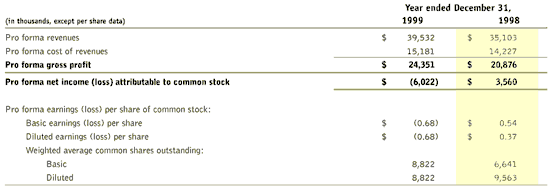
The pro forma results of operations are not necassarily indicative of the results that would have occurred had the Aquistion occurred at the beginning of each year presented, and are not intended to be indicative of future results of operations.
4. Intangible Assets
Intangible assets consist of the following:
5. Property And Equipment
Property and equipment consists of the following:
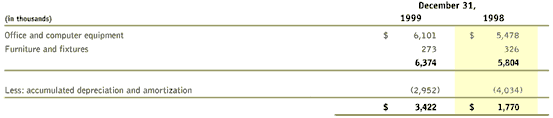
At December 31, 1999 and 1998, office and computer equipment under capital leases totaled $837,000 and $1,304,000, respectively. Related accumulated amortization of assets under capital leases totaled $651,000 and $702,000 at December 31, 1999 and 1998, respectively. During the years ended December 31, 1998 and 1997, OneSource sold and leased back certain computer equipment with net book values of $237,000, and $788,000, respectively, for cash proceeds of $228,000 and $753,000. During 1999 and 1998, OneSource retired $3,124,000 and $525,000, respectively, of fully depreciated property and equipment.
6. Borrowings
Notes Payable
OneSource entered into a credit agreement (the "Agreement") with a bank, as amended, which provided for a line of credit (the "Line") of up to $2.5 million through April 1, 1998 and a term loan (the "Term Loan") of $750,000 to be used for financing equipment
purchases. During 1998, the Line and the Term Loan expired and were repaid in full.
Long-Term Debt
In connection with the acquisition of the business in 1993, OneSource entered into a subordinated note agreement with the seller with
a face amount of $5.0 million (the "Note"). The Note accrued interest at 8% per annum, payable annually commencing March 31, 1995 and was discounted to reflect the market rate of 12% at the time of issuance. The initial discount totaling $938,000 was being amortized to interest expense over the life of the Note using the effective interest method. Interest payments were added to the unpaid principal of the Note annually if OneSource's cash flow, as defined in the Note agreement, was less than a specified amount.
As of December 31, 1998, the carrying value of the Note was $6,232,000. In accordance with the terms of the Note agreement, OneSource added $1,523,000 to the principal of the Note for interest which accrued through the end of December 31, 1997. As of December 31, 1998, the unamortized discount was $291,000. Accrued interest related to the Note was $524,000 for the year ended December 31, 1998 and, since OneSource met the cash flow requirements set forth in the Note agreement, such amount was paid in March 1999.
Upon the completion of the Company's public offering and in accordance with the Note agreement, OneSource repaid the Note in May 1999 for $6.8 million of principal and interest. In conjunction with the repayment, OneSource recognized $272,000 of interest expense, which represented the remaining unamortized discount on the Note.
7. Earnings Per Share
The following tables set forth the computation of earnings per share of common stock and Class P common stock
from net income (loss):
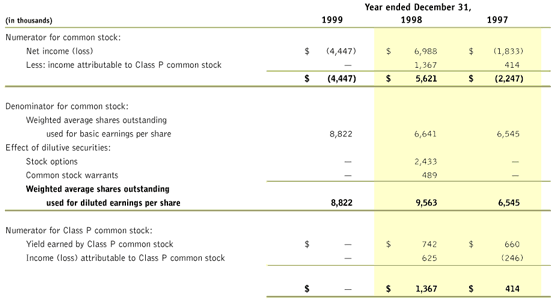
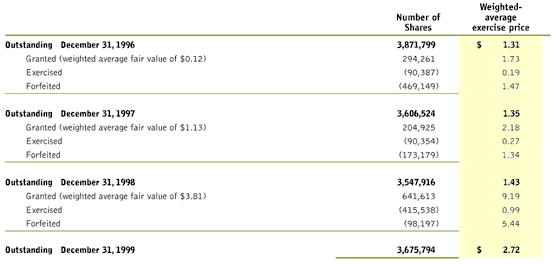
At December 31, 1999, total potential common equivalent shares consist of 3,675,794 stock options outstanding with a weighted average exercise price of $2.72 per share and 407,000 common stock warrants exercisable at $0.06 per share. At December 31, 1997, total potential common equivalent shares consist of 3,606,524 stock options outstanding with a weighted average exercise price of $1.35
per share and 490,029 common stock warrants exercisable at $0.06 per share.
Basic and diluted earnings per share of Class P common stock are the same for all periods presented since there are no potentially
dilutive securities.
8. Stockholders' Equity
In connection with its initial capitalization, OneSource issued 725,274 shares of Class P common stock and 6,527,466 shares of common stock at $4.91 per share and $0.06 per share, respectively. The holders of the Class P common stock, as a separate class, were entitled to receive first all or a portion of any distribution, as defined, until the "preference amount" and the original issuance cost had been paid in full. The preference amount was 12% compounded quarterly. After all such payments were made, the holders of the Class P common stock and of the common stock were entitled to share pro rata in the remaining portion of the distribution, as a single class. No dividends on either the Class P common stock or the common stock have been declared or paid, and no payments of the aggregate yield have been made to the Class P common stockholders. As a result, the Class P common stock was stated at its original issuance cost of $4.91 per share. On May 24, 1999, the liquidation preference of these shares was $6,911,000, consisting of its original issuance cost of $3,524,000 and accumulated "preference amount" of $3,387,000.
Authorized Shares
The authorized capital stock of the Company consists of 20,000,000 shares of common stock, $0.01 par value, and 1,000,000 shares of undesignated preferred stock, $0.01 par value. Prior to the closing of OneSource's public offering, OneSource's capital stock consisted of 20,000,000 shares of common stock, $0.01 par value, and 1,250,000 shares of Class P common stock, $0.01 par value.
Voting Rights
All holders of common stock are entitled to one vote per share on all matters to be voted upon by OneSource's stockholders.
Stock Split
On April 13, 1999, OneSource authorized a 2.035 for one stock split on common stock and Class P common stock. As a result, all
common stock and Class P common stock share data included in the accompanying consolidated financial statements, and notes have been retroactively restated for this split.
Warrants
In connection with the Note agreement (Note 6), OneSource issued a warrant exercisable at $0.06 per share for 407,000 shares of OneSource's common stock. This warrant was fully exercised in January 2000.
Public Offering
In May 1999, OneSource completed an initial public offering of 3,636,000 shares of its common stock, of which 2,500,000 shares
were issued and sold by OneSource, for net proceeds of $27.0 million. As a result, all outstanding shares of Class P common stock
were automatically converted into 717,119 shares of OneSource's common stock.
In conjunction with the initial public offering, OneSource converted the accumulated "preference amount" on Class P common stock
of $3,387,000 into 282,209 shares of common stock based on the public offering price of $12.00 per share. Subsequently, OneSource repurchased and retired the equivalent number of common stock shares issued for the preference amount at $12.00 per share.
Reserved Shares
At December 31, 1999, OneSource had reserved 4,655,015 shares of common stock for issuance upon exercise of common stock options and warrants.
9. Stock Plans
The 1993 Stock Purchase and Option Plan (the "1993 Plan") provides for the grant of incentive stock options and non-qualified stock options for the purchase of up to an aggregate of 4,273,500 shares of OneSource's common stock by employees, directors, consultants and advisors of OneSource. The Board of Directors determines the term of each option, option price, number of shares for which each option is granted, whether restrictions will be imposed on the shares subject to options, and the vesting schedule of each option. The exercise price for incentive stock options granted may not be less than the fair value per share of the underlying common stock on the date granted as determined by the Board of Directors (not less than 110% of the fair value for options granted to holders of more than 10% of the voting stock of OneSource). Additionally, the term of the options cannot exceed ten years (five years for options granted to holders of more than 10% of the voting stock of OneSource). The options generally vest over a four-year period. In February 1999, there were no shares of common stock available for grant under the 1993 Plan.
In February 1999, the Board of Directors of OneSource approved the 1999 Stock Option and Incentive Plan (the "1999 Plan") to be effective upon OneSource's initial public offering. The 1999 Plan provides for the grant of stock-based awards to employees, officers and directors of, and consultants or advisors to, OneSource. A total of 800,000 shares of common stock are authorized for issuance upon the exercise of options or other awards granted under the 1999 Plan.
In February 1999, the Board of Directors of OneSource approved the 1999 Employee Stock Purchase Plan (the "1999 Purchase Plan"), to be effective upon OneSource's initial public offering. The 1999 Purchase Plan provides for the issuance of a maximum of 100,000 shares of common stock.
Transactions under the 1993 Plan and 1999 Plan during the years ended December 31, 1997, 1998 and 1999 are summarized
as follows:
The following table summarizes information about stock options outstanding and exercisable at December 21, 1999:
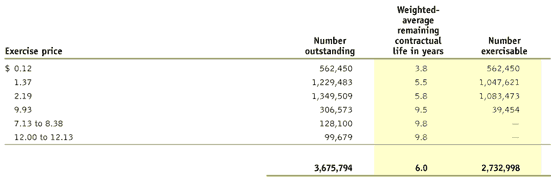
As of December 31, 1998 and 1997, 2,730,457 and 2,472,240 options were exercisable, respectively, under the 1993 Plan. As of December 31, 1999, there were 572,221 shares of common stock available for grant under the 1999 Plan.
Fair Value
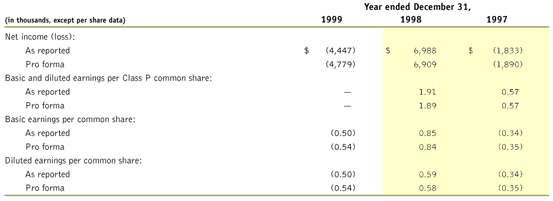
Compensation expense has been recognized for OneSource's stock option plans under APB No. 25. Had compensation cost been determined based on the fair value of the options at the grant date consistent with the provisions of SFAS No. 123, OneSource's net income (loss) and earnings (loss) per share on a pro forma basis would be as follows:
The fair value of each option grant is estimated on the date of grant using the Black-Scholes option pricing model with the following weighted-average assumptions:

Because options vest over several years and additional option grants are expected to be made in future years, results of operations for future years may be materially different if the provisions of SFAS No. 123 are applied.
Compensation Expense
In conjunction with the sale of the CD-Insurance division, OneSource modified the terms of 226,601 stock options held by terminated employees. In accordance with APB No. 25, compensation expense of $295,000 was recorded as a reduction of the gain on the sale of the insurance division in the year ended December 31, 1998.
During 1998, 203,093 stock options were granted with an exercise price of $2.19 per share and 1,832 stock options were granted with an exercise price of $1.37 per share; these exercise prices were below the estimated fair market value of the common stock at the date of grant. Unearned compensation of $45,000 was recorded, in accordance with APB No. 25, and will be amortized over the related vesting period. Options issued during 1997 were granted with exercise prices above the estimated fair market value of the common stock at the date of grant.
During 1999, 40,700 stock options were granted with an exercise price of $2.19 per share and 30,525 stock options were granted with an exercise price of $5.90 per share; these exercise prices were below the estimated fair market value of the common stock at the date of grant. Unearned compensation of $438,000, less $92,000 subsequently forfeited by a terminated employee, was recorded in accordance with APB No. 25 and will be amortized over the related vesting period of four years. Related compensation expense of $114,000 and $6,000 was recorded during the years ended December 31, 1999 and 1998, respectively.
10. Income Taxes
Components of the income (loss) before income taxes and of the current provision for income taxes are as follows:
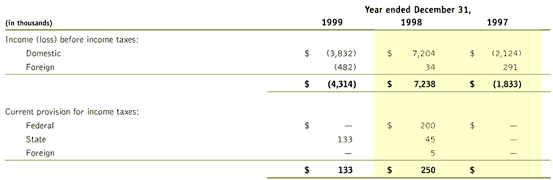
OneSource had no deferred provision for income taxes in each of the years ended December 31, 1999, 1998 and 1997 due to the offsetting effects of the valuation allowance on its net deferred tax assets. Provision has not been made for the United States or additional foreign taxes on undistributed earnings of foreign subsidiaries as those earnings have been permanently reinvested. Such taxes, if any,
are not expected to be significant.
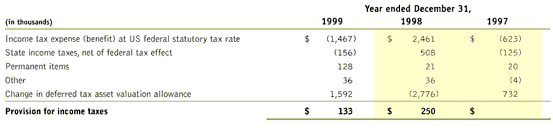
Income taxes computed using the federal statutory income tax rate differ from OneSource's effective tax rate primarily due to
the following:
Components of OneSource's deferred tax assets and liabilities are as follows:
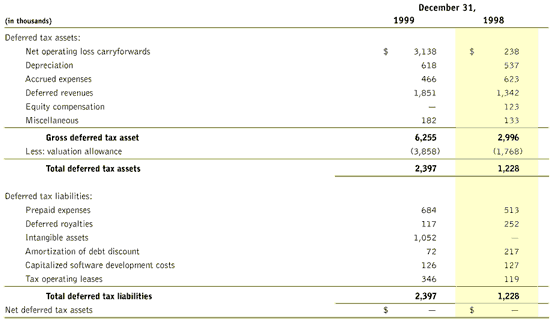
A portion of the net operating loss carryforwards totaling approximately $1.0 million relates to deductions for the exercise of non-qualified stock options and will be credited to additional paid-in capital upon realization. Approximately $533,000 of the valuation allowance at December 31, 1999 relates to deferred tax assets acquired from Corporate Technology.
Realization of OneSource's net deferred tax assets is contingent upon the generation of future taxable income. Due to the uncertainty
of realization of these tax benefits, OneSource has provided a valuation allowance for the full amount of its net deferred tax assets.
As of December 31, 1999, OneSource has federal and state net operating loss carryforwards of approximately $7.5 million that begin
to expire in 2019 and 2004, respectively. During 1998, OneSource utilized $8.0 million of net operating loss carryforwards. As of December 31, 1998, OneSource had net operating loss carryforwards of $575,000 for foreign tax purposes which do not expire. Under the provisions of the Internal Revenue Code, if certain substantial changes in OneSource's ownership should occur, the amount of net operating loss carryforwards which could be utilized annually to offset future taxable income and income tax liability may be limited.
The amount of any annual limitation is determined based upon OneSource's value prior to an ownership change.
11. Sale of Product Lines
In June 1997, OneSource sold its CD Rom banking product line for $650,000 in cash. In connection with the sale, OneSource entered
a non-compete agreement for five years. As a result of the sale, OneSource recorded a gain of $501,000 which is net of expenses of $149,000 incurred in conjunction with the sale. No assets or liabilities with recorded net book values were transferred in connection with this product line sale.
In May 1998, OneSource sold its CD-Insurance division for $11.0 million in cash and entered a software license agreement for $4.0 million to be received in equal quarterly installments for two years commencing January 1, 1999. In connection with the sale, OneSource also entered a non-compete agreement for five years. As a result of the sale, OneSource recorded a gain of $12,797,000 which includes:
(i) the recognition of $3,124,000 of deferred revenues and $595,000 of deferred subscription costs based upon the assumption by the buyer of all obligations to service the existing subscriber base of the insurance division, (ii) $530,000 of employee severance costs and (iii) $202,000 of expenses associated with the sale. Payments pertaining to the software license agreement will be recognized in other income as support services are performed and payments become due in accordance with the agreement. During 1999, OneSource recorded $2.0 million of other income related to the software license agreement.
12. Employee Benefit Plans
After three months of service, OneSource employees are eligible to participate in a tax deferred savings plan (the "Savings Plan") under Section 401(k) of the Internal Revenue Code. OneSource matches 25% of the first 6% contributed by the employee, and the employee becomes fully vested in OneSource's matching contribution after three years of service. OneSource's contributions to the Savings Plan totaled $133,000, $120,000 and $116,000 for the years ended December 31, 1999, 1998 and 1997, respectively.
13. Related Party Transactions
At December 31, 1999 and 1998, OneSource had accounts receivable of $373,000 and $335,000, respectively, due from two stockholders. OneSource recognized revenue of $558,000, $318,000 and $292,000 in the years ended December 31, 1999, 1998 and 1997, respectively, from these parties.
Management fees paid to a stockholder and an affiliate of another stockholder for the years ended December 31, 1999, 1998 and 1997 were $68,000, $200,000 and $200,000, respectively, and are included in general and administrative expenses.
In addition, OneSource paid a termination fee of $500,000 to both a shareholder and an affiliate of another shareholder in conjunction with the initial public offering.
14. Commitments
Leases
OneSource leases facilities and certain equipment under various noncancelable operating lease agreements. Total rent expense under
such leases was $1.6 million, $1.1 million and $1.2 million for the years ended December 31, 1999, 1998, and 1997, respectively. Future minimum lease commitments under all noncancelable capital and operating leases at December 31, 1999 are as follows:
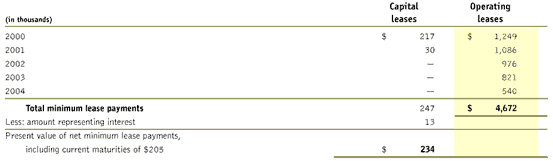
In January 1999, OneSource entered into a five-year noncancelable operating lease for a new operating facility. Minimum yearly rental payments will be $655,000, commencing in June 1999. Pursuant to the lease, OneSource entered into a $415,000 irrevocable letter
of credit collateralized by a certificate of deposit.
Restricted Time Deposits
In connection with several facility leases, OneSource is required to maintain, on behalf of the landlord, irrevocable letters of credit with
a bank in the total amount of $703,000 over the term of the leases. In addition, OneSource was required to maintain certificates of deposit in equal amounts as security for the letters of credit.
15. Geographic Information
Revenue was distributed geographically as follows:

Substantially all of OneSource's identifiable assets are located in the United States.
16. Supplemental Disclosure of Cash Flow Information
The following is the supplemental cash flow information for all periods presented: