|
 |
 |
 |
 |
 |
 |
 |
 |
 |
 |
 |
 |
 |
 |
 |
 |
 |
 |
 |
 |

 |
 |
|
|||||||||||
 |
 |
||||||||||
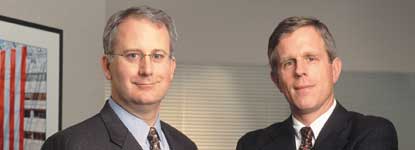
| Thomas A. Carr Philip L. Hawkins | |||||||||||
Facing a difficult climate, the company executed well in property operations, investments, and development. We maintained financial flexibility and dividend coverage for our shareholders. Finally, we took important steps for the future. These actions reflect the extraordinary efforts and talents of CarrAmerica’s people, and for that we thank them. Moving into 2004, we will continue to improve and optimize every aspect of our company. We believe the results can be seen in the quality of our assets, the way we do business, and the way we serve our customers. Maintaining Financial StrengthThroughout 2003, the company demonstrated strength in its financial performance. Diluted earnings per share for 2003 were $0.89 on net income of $72.9 million, compared to diluted earnings per share of $1.39 on net income of $109.3 million for 2002. Diluted Funds from Operations available to common shareholders (Diluted FFO) for 2003 were $178.5 million or $3.07 per share compared to $189.8 million or $3.20 per share for 2002. Excluding the impact of the HQ Global Workplaces, Inc. (HQ Global) lease guarantee charges, impairment losses on real estate and the impact of preferred stock redemptions, Diluted FFO per share for 2003 would have been $3.34 versus $3.45 in 2002. We have maintained our investment-grade ratings and a strong balance sheet through conservative management. This has afforded the company financial flexibility in the past year, and that philosophy will continue to guide us in the future. During 2003 we addressed three core financial objectives—strengthening the balance sheet, lowering the overall cost of capital, and covering dividends and fixed charges. We completed the redemption of Series B, C, and D preferred shares at rates of approximately 8.5% and issued new 7.5% cumulative redeemable Series E preferred shares to favorably adjust our capital structure going forward. In keeping with our existing financial strategy, leverage remains comfortable for the company and will not be increased materially to grow assets. In fulfilling our responsibilities as a REIT, we believe it’s important to focus on the basics, and dividend coverage is chief among them. In spite of the continuing challenges in 2003, the company maintained dividend coverage for the year and a relatively low dividend payout ratio. Challenging Office Market ConditionsIn the last year, the country has begun to see growth in the GNP, but growth in the employment figures has been slow to follow. Because jobs fuel the office market, its recovery continues to lag behind the overall economy. We expect the office market to remain soft this year, and our operating conditions to continue to be difficult. That the national office market direct vacancy rate went from 15.6% in 2002 to 16.7% in the last year supports our cautious projections going forward. There is, however, good news to report. Vacancies have stabilized or improved in most of our markets, new speculative deliveries have all but stopped, and there was positive demand for office space in most of our markets for the year. Some of the strongest demand continues to come from Southern California and the Washington, D.C. region, while Northern California continues to lag our other markets in terms of recovery. Specifically, San Diego, Orange County and Northern Virginia all recognized net absorption for the year of 2.5% or greater of the office space inventory in each market. Strong Operating ExecutionStrong operating performance remains paramount in every aspect of the way we do business. This year’s operational accomplishments were realized through the intense focus and market knowledge of our local teams. Focusing on Leasing PerformanceWe remain in a recovering economy where tenants will defer office space decisions until the effects of the overall economic recovery are clear. By the close of 2003, market vacancy rates, including sublease space, appeared to have bottomed out nationally, running between 14% and 26% across all of our markets with the exception of Washington, D.C., which is now at 8.4%. Tenant demand in our markets increased modestly and rental rates began to stabilize. Overall, our average 2003 portfolio vacancy rate was 11.1%, compared to a direct vacancy rate of 17.4% for the industry as a whole in our markets. This was accomplished in an environment of lease economics where rental rates were often lower than the ones they replaced and were often attended by tenant improvement incentives. Portfolio occupancy rates fell this year, largely due to early lease terminations caused by tenant credit issues. Although tenant demand remains well below historical averages, we leased 3.7 million square feet, exceeding our average volume of 2.4 million square feet over the last four years. Our focus on local relationships and responsive decision making has been crucial in our successfully outperforming the overall markets. Looking back on 2003, several leasing transactions illustrate that point. We were particularly proud to announce the 15-year lease of 417,000 square feet at International Square to Dickstein Shapiro Morin & Oshinsky LLP. Our Washington, D.C. market office team responded to the law firm’s needs in all aspects of this transaction. Meeting their requirements—including timing, size, location, retail and office amenities, and commuter access—was a challenge we were uniquely positioned to address. In our Northern California market, Ross Stores signed one of the largest deals completed in that market, a headquarters lease, occupying 150,000 square feet at CarrAmerica Corporate Center in Pleasanton. In another noteworthy transaction, Covad Communications Company signed an 86,196 square foot headquarters lease in San Jose’s Rio Robles Technology Center. In our Southern California market, the company landed one of Orange County’s most important new leases for 2003. The campus expansion of the University of Phoenix resulted in a 65,000 square foot lease in Costa Mesa. This transaction brought the occupancy at South Coast Executive Centre to 95%. Investing in QualityIn 2003, we increased the quality of the portfolio through four exciting new investments with an aggregate value of $429.0 million, in which CarrAmerica’s investment was $169.0 million, including our share of assumed debt. Three of the four acquisitions were done off-market, capitalizing on the strength of our local presence and longstanding relationships. We also disposed of five non-strategic properties in Atlanta, San Diego and Orange County for $46.5 million, resulting in an aggregate gain of $11.2 million net of impairment charges. A key investment in 2003 involved the buyout of our joint venture partner in 1717 Pennsylvania Avenue. Strategically located in the first block west of the White House, the building is a 13-story, 184,446 square foot Class-A office property. The company paid $34.0 million, including the assumption of $12.0 million in existing mortgage debt, to bring our ownership in this fully leased trophy address to 100%. We are proud to strengthen further our position as the predominant landlord for the 1700 block of “America’s Main Street,” with interests in 1717, 1730, 1747 and 1775 Pennsylvania Avenue. Two important investments in Los Angeles served to increase our investment profile in the Southern California market. 10 Universal City Plaza is a 775,000 square foot, 35-story, Class-A, trophy-quality office building adjacent to the Burbank Media District submarket. The property was purchased for $190.0 million through a joint venture with Beacon Capital Partners, LLC. In addition to our 20% ownership position, the company will also provide leasing and property management services. Our second Los Angeles investment, 1888 Century Park East, was purchased for $119.0 million, again through a joint venture with Beacon Capital. In addition to our 35% ownership position, we will provide property management services to this 475,000 square foot, 21-story Century City building.
Finally, the company acquired 500 Forbes Boulevard, a two-story, 155,685 square foot office and biotech building in South San Francisco, for $51.0 million. Built in 2003, the building features state-of-the-art lab and office space. It is 100% occupied by Cell Genesys under a long-term lease. Each of these investment transactions shows how the company strives to influence positively the quality of assets and cash flow in the portfolio by recycling and upgrading, and by identifying transactions where we bring an advantage to the discussion. Developing Exceptional ProjectsOur overall development activity remained level in 2003, with $9.9 million in 2003 service fees compared to $9.8 million in 2002. Nonetheless, our development group continues to be one of the leaders in their field nationally. We are completing several projects awarded in the last few years and the new engagements awarded this year demonstrate we are making the best of a difficult development market. Given the challenging economy, we believe it has been prudent to shift the company’s focus away from speculative development in favor of build-to-suit and fee-based services. Following that strategy, the development group continued to win some of the country’s most prestigious engagements. We completed Network Associates, Inc.’s 180,000 square foot, three-story office building in suburban Dallas at the beginning of the year. Delivered ahead of schedule and under budget, we received an incentive fee in addition to the base fee for this engagement. In Washington, D.C., the International Monetary Fund’s second headquarters building is moving towards completion, and The Atlantic Building, The Newseum, and Kennedy Center Plaza are among the development projects now underway. Serving our CustomersProperty management is an area where our commitment to customer service is most evident. We see it in our positive customer surveys and in the recognition of our peers. This year we were honored that our industry colleagues chose properties in our Dallas and D.C. markets as The Office Building of the Year in their respective categories. Among the property management contracts won by the company in 2003 were four properties in Northern Virginia totaling more than 500,000 square feet and The Lincoln at Legacy contract in Dallas. The Lincoln at Legacy is a two-building, 300,000 square foot office property for which we also handle leasing activity. Taking Strategic StepsBy the close of the year, we undertook a careful evaluation of our business. Analyzing our relative strength in the company’s markets, we decided to exit the Atlanta and Portland markets. In both markets, we felt our assets would have an under-performing return on invested capital compared to the long-term projections for the rest of our portfolio. In spite of the hard work and best efforts of our market offices there, neither Atlanta nor Portland was likely to be an appropriate venue for the leadership position we try to achieve in all our markets. While our investments in these two markets represent only 6.2% of property operating income, this decision clearly demonstrates our commitment to refining and improving our operational performance and investment strategy over time. Going forward, we believe a more concentrated focus will make us more profitable— both by reducing overhead and by increasing our market participation. Following this strategy will not adversely effect either our commitment to growing the size of the portfolio or our commitment to wide diversification in our tenant base. Reporting and GovernanceThis has been a year of great challenges and even greater accomplishments in the areas of reporting and governance. Never before in our memory has there been so much turmoil in the world of accounting. Specifically, the regulatory bodies overseeing public companies called for changes to accounting standards and definitions that had a direct impact on our reporting. Implementing these changes may have made it more difficult for investors to follow financial results in 2003. We thank our shareholders for their patience in light of these short-term reporting challenges, and hope to experience more settled conditions in 2004. As a result of our multi-year commitment to infrastructure enhancements we successfully launched our new J.D. Edwards/ERP 8.0 finance and accounting system. The ERP 8.0 investment provides us more streamlined access to quality information, resulting in real operational savings. Going forward, these kinds of significant operational investments will continue to be made as needed. Because of our ongoing commitment to funding operational improvements such as ERP 8.0, we were able to incorporate more efficiently the requirements arising from the Sarbanes-Oxley Act of 2002. Many thanks to the company team that devoted significant time and energy to this implementation. They made the transition to ERP 8.0 go smoothly for our employees and without disruption to our customers. We are proud to maintain our standard of strong corporate governance in a highly entrepreneurial environment. The corporate governance initiatives the company put in place over the last two years have had the positive and ongoing impact we intended. At the 2003 Annual Meeting, Jim Clark, an inside director, retired after 10 years of extremely effective service and, in July 2003, an outside director, Joan Carter, was elected. Consequently, the majority of our Board members are now independent directors. In addition all our Board committees have been reconstituted, including the representation of only independent directors on the Audit, Nominating and Corporate Governance and Executive Compensation committees. Following a shareholder resolution unanimously accepted by the Board and approved by the stockholders, all Board seats now carry a one-year term beginning in 2004, thus eliminating the staggered composition previously in place. This change in governance exemplifies the shareholder responsiveness we strive to achieve. April 29, 2004 marks the last board meeting for our founder and one of CarrAmerica’s original directors, Oliver T. Carr, Jr. Although we will no longer benefit from his Board involvement, his entrepreneurial vision and commitment to quality will remain hallmarks of CarrAmerica’s corporate culture. We rely on the fact that our entire Board of Directors is composed of tremendously skilled individuals. We sincerely thank them for their time and attention. Looking to 2004We expect office market conditions will experience a slow, gradual recovery as the overall economy improves. However, because of the lagging relationship between the overall economic recovery and the office market recovery, the operating environment will remain difficult. Going forward, we remain focused on retaining customers and increasing occupancy. With regard to our investments, we plan to execute the sale of non-strategic assets and sharpen our acquisition focus. In doing so, we will continue to reposition positively the company’s portfolio. As in 2003, we anticipate that these strategies will make the company a modest net buyer while upgrading our portfolio overall. We continue to focus on maintaining financial flexibility, a strong balance sheet, covering dividends and fixed charges, and improving the quality of our portfolio and its cash flow. Finally, looking to 2004 and beyond, we continue our commitment to superior customer service and the positive impact it has on operating performance and long-term profitability.
|
|||||||||||
 s 2003
began, we were cautiously optimistic about the pace of the economic recovery.
Now, as we look back over the last year, it is
clear our caution was justified. Despite tough conditions, the company’s
financial performance met our expectations for the year.
s 2003
began, we were cautiously optimistic about the pace of the economic recovery.
Now, as we look back over the last year, it is
clear our caution was justified. Despite tough conditions, the company’s
financial performance met our expectations for the year.