Derivative
activities:
In fiscal 2001, the Company adopted Statement of Financial
Accounting Standards No. 133, “Accounting for Derivative
Instruments and Hedging Activities,” as amended in June
2000 (“SFAS 133”) and Statement of Financial Accounting
Standards No. 138, “Accounting for Derivative Instruments
and Certain Hedging Activities, an amendment of FASB Statement
No. 133” (“SFAS 138”). SFAS 133 and 138
established accounting and reporting standards for derivative
and hedging activities, and requires companies to record derivative
instruments as assets or liabilities, measured at fair value.
The recognition of gains or losses resulting from changes
in the values of those derivative instruments is based on
the use of each derivative instrument and whether it qualifies
for hedge accounting. The Company has identified derivative
instruments related to certain of its commitments to originate
residential mortgage loans. The Company had no embedded derivative
instruments requiring separate accounting treatment.
The Company
originates residential mortgage loans with the intention of
selling these loans. These commitments to fund loans are freestanding
derivative instruments and do not qualify for hedge accounting
treatment and, therefore, the fair value adjustments are recorded
in the consolidated statement of earnings. The commitments
that qualify as derivative instruments totaled $252,593 at
April 30, 2001. The transition adjustment for adoption of
SFAS 133 and SFAS 138 of $4,414, net of taxes, is shown as
the cumulative effect of a change in accounting principle
in the consolidated statement of earnings for the year ended
April 30, 2001.
New
accounting standards:
In May 2001, the Company elected early adoption of SFAS 141
and 142, as noted above. SFAS 141 addresses financial accounting
and reporting for business combinations and replaces APB Opinion
No. 16, “Business Combinations” (“APB 16”).
SFAS 141 no longer allows the pooling of interests method
of accounting for acquisitions, provides new recognition criteria
for intangible assets and carries forward without reconsideration
the guidance in APB 16 related to the application of the purchase
method of accounting. SFAS 142 addresses financial accounting
and reporting for acquired goodwill and other intangible assets
and replaces APB Opinion No. 17, “Intangible Assets.”
SFAS 142 addresses how intangible assets should be accounted
for upon their acquisition and after they have been initially
recognized in the financial statements. Additionally, the
new standard provides specific guidance on measuring goodwill
for impairment annually using a two-step process.
In the
year of adoption, SFAS 142 requires the first step of the
goodwill impairment test to be completed within the first
six months and the final step to be completed within twelve
months of adoption. The first step of the test was completed
during the quarter ended October 31, 2001 and no indications
of goodwill impairment were found; therefore, step two of
the goodwill impairment test is not applicable.
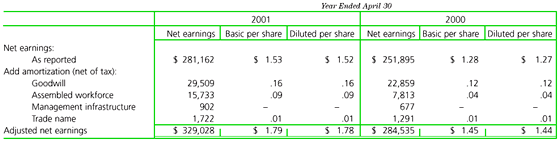
The adoption
of SFAS 141 and 142 has had a significant effect on the consolidated
statement of earnings for fiscal year 2002, due to the cessation
of goodwill amortization beginning May 1, 2001. Had the provisions
of SFAS 141 and 142 been applied for the years ended April
30, 2001 and 2000, the Company’s net earnings and net
earnings per basic and diluted share would have been as follows:
In May
2001, the Company adopted Emerging Issues Task Force Issue
99-20, “Recognition of Interest Income and Impairment
on Purchased and Retained Beneficial Interests in Securitized
Financial Assets” (“EITF 99-20”). EITF 99-20
addresses how the holder of beneficial interests should recognize
cash flows on the date of the transaction, how interest income
is recognized over the life of the interests and when securities
must be written down to fair value due to other than temporary
impairments. EITF 99-20 requires adverse changes in the timing
of cash flows to be treated as impairments when the carrying
value of the residual interest exceeds the fair value and
requires positive changes to cash flows to be accreted into
earnings over the remaining life of the underlying loans using
the effective yield method. The adoption of EITF 99-20 did
not have a material impact on the consolidated financial statements.
On February
1, 2002, the Company adopted Emerging Issues Task Force Issue
No. 01-9, “Accounting for Consideration Given by a Vendor
to a Customer (Including a Reseller of the Vendor’s
Products)” (“EITF 01-9”). EITF 01-9 addresses
sales incentives such as discounts, coupons or rebates offered
to customers of retailers or other distributors and the income
statement classifications of these items. Based on EITF 01-9,
these items are recorded as a reduction of revenues. The Company
has historically recorded these items as expenses in its U.S.
and international tax operations. The adoption of EITF 01-9
had no impact on net earnings. All years presented have been
restated to reflect the adoption of this guidance. Revenues
and expenses were reduced by $43,528, $32,586 and $35,314
for fiscal years 2002, 2001 and 2000, respectively, due to
the adoption of EITF 01-9.
On February
1, 2002, the Company adopted Emerging Issues Task Force Issue
No. 01-14, “Income Statement Characterization of Reimbursements
Received for ‘Out-of-Pocket’ Expenses Incurred”
(“EITF 01-14”). EITF 01-14 establishes requirements
that must be met to record out-of-pocket expenses as either
net in revenues or as an expense. The Company has out-of-pocket
expenses associated with its Business services segment and
has historically recorded them net in revenues. Based on EITF
01-14, the Company now records these as gross revenues and
expenses. There is no impact to net earnings as a result of
adoption of EITF 01-14. All years presented have been restated
to reflect the adoption of this guidance. Revenues and expenses
were increased by $17,751, $12,348 and $9,056 for fiscal years
2002, 2001 and 2000, respectively, due to the adoption of
EITF 01-14.
In August
2001, the Financial Accounting Standards Board issued Statement
of Financial Accounting Standards No. 144, “Accounting
for the Impairment or Disposal of Long-Lived Assets”
(“SFAS 144”), effective for the Company’s
fiscal year beginning May 1, 2002. This statement supercedes
Statement of Financial Accounting Standards No. 121, “Accounting
for the Impairment of Long-Lived Assets and for Long-Lived
Assets to be Disposed Of,” (“SFAS 121”)
and the accounting and reporting provisions of Accounting
Principles Board Opinion No. 30, “Reporting the Results
of Operations - Reporting the Effects of Disposal of a Segment
of a Business, and Extraordinary, Unusual and Infrequently
Occurring Events and Transactions,” for the disposal
of a segment of a business. SFAS 144 establishes a single
accounting model, based on the framework established in SFAS
121, for long-lived assets to be disposed of by sale. The
adoption of SFAS 144 will not have a material effect on the
consolidated financial statements.
NOTE
2: NET EARNINGS PER SHARE
Basic net earnings per share is computed using the weighted
average number of common shares outstanding. The dilutive
effect of potential common shares outstanding is included
in diluted net earnings per share. The computations of basic
and diluted net earnings per share before change in accounting
principle are as follows (shares in thousands):
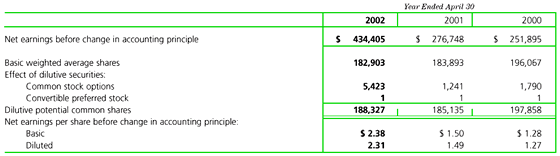
Diluted
net earnings per share excludes the impact of weighted average
shares issuable upon the exercise of stock options of 682,802,
13,906,602, and 6,078,390 shares for 2002, 2001 and 2000,
respectively, because the options’ exercise prices were
greater than the average market price of the common shares
and therefore, the effect would be antidilutive.
NOTE
3: CASH AND CASH EQUIVALENTS
Cash and cash equivalents is comprised of the following:

NOTE
4: MARKETABLE SECURITIES AVAILABLE-FOR-SALE
The amortized cost and market value of marketable securities
classified as available-for-sale at April 30, 2002 and 2001
are summarized below:
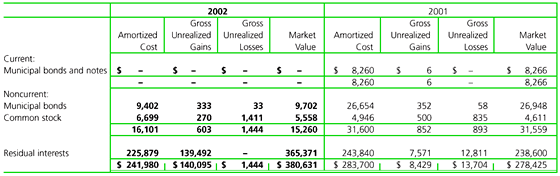
Proceeds
from the sales of available-for-sale securities were $23,173,
$356,192 and $211,836 during 2002, 2001 and 2000, respectively.
Gross realized gains on those sales during 2002, 2001 and
2000 were $635, $17,936 and $12,177, respectively; gross realized
losses were $212, $192 and $480, respectively.
Contractual
maturities of available-for-sale debt securities at April
30, 2002 are presented below. Since expected maturities differ
from contractual maturities due to the issuers’ rights
to prepay certain obligations or the seller’s rights
to call certain obligations, the first call date, put date
or auction date for municipal bonds and notes is considered
the contractual maturity date.

|




















 2
2



