The Company applies APB 25 in accounting for its
stock compensation plans, under which no compensation cost
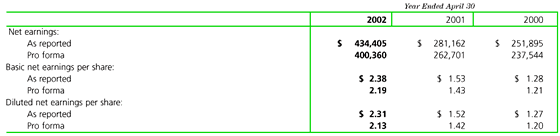
has been recognized. Had compensation cost for the stock compensation
plans been determined in accordance with the fair value accounting
method prescribed under SFAS 123, the Company’s net
earnings and net earnings per share would have been as follows:
For the
purposes of computing the pro forma effects of stock compensation
plans under the fair value accounting method, the fair value
of each stock option grant or purchase right grant was estimated
on the date of the grant using the Black-Scholes option pricing
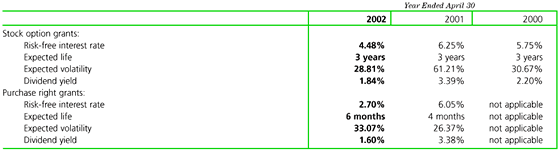
model. The weighted-average fair value of stock options granted
during 2002, 2001 and 2000 was $5.77, $9.34 and $9.09, respectively.
The weighted-average fair value of purchase rights granted
during 2002 and 2001 was $5.88 and $4.58, respectively. The
following weighted-average assumptions were used for stock
option grants and purchase right grants during the following
periods:
The Company has defined contribution plans
covering all employees following the completion of an eligibility
period. Expenses related to these plans were $15,547, $22,213
and $10,386 for fiscal 2002, 2001 and 2000, respectively.
NOTE
14: SHAREHOLDER RIGHTS PLAN
On July 25, 1998, the rights under the July 1988 shareholder
rights plan, as amended, expired and the rights under a shareholder
rights plan adopted by the Company’s Board of Directors
on March 25, 1998 became effective. Like the 1988 plan, the
1998 plan was adopted to deter coercive or unfair takeover
tactics and to prevent a potential acquirer from gaining control
of the Company without offering a fair price to all of the
Company’s stockholders. Under the 1998 plan, a dividend
of one right (a “Right”) per share was declared
and paid on each share of the Company’s Common Stock
outstanding on July 25, 1998. Rights automatically attach
to shares issued after such date.
Under
the 1998 plan, a Right becomes exercisable when a person or
group of persons acquires beneficial ownership of 15% or more
of the outstanding shares of the Company’s Common Stock
without the prior written approval of the Company’s
Board of Directors (an “Unapproved Stock Acquisition”),
and at the close of business on the tenth business day following
the commencement of, or the public announcement of an intent
to commence, a tender offer that would result in an Unapproved
Stock Acquisition. The Company may, prior to any Unapproved
Stock Acquisition, amend the plan to lower such 15% threshold
to not less than the greater of (1) any percentage greater
than the largest percentage of beneficial ownership by any
person or group of persons then known by the Company, and
(2) 10% (in which case the acquisition of such lower percentage
of beneficial ownership then constitutes an Unapproved Stock
Acquisition and the Rights become exercisable). When exercisable,
the registered holder of each Right may purchase from the
Company one two-hundredth of a share of a class of the Company’s
Participating Preferred Stock, without par value, at a price
of $107.50, subject to adjustment. The registered holder of
each Right then also has the right (the “Subscription
Right”) to purchase for the exercise price of the Right,
in lieu of shares of Participating Preferred Stock, a number
of shares of the Company’s Common Stock having a market
value equal to twice the exercise price of the Right. Following
an Unapproved Stock Acquisition, if the Company is involved
in a merger, or 50% or more of the Company’s assets
or earning power are sold, the registered holder of each Right
has the right (the “Merger Right”) to purchase
for the exercise price of the Right a number of shares of
the common stock of the surviving or purchasing company having
a market value equal to twice the exercise price of the Right.
After
an Unapproved Stock Acquisition, but before any person or
group of persons acquires 50% or more of the outstanding shares
of the Company’s Common Stock, the Board of Directors
may exchange all or part of the then outstanding and exercisable
Rights for Common Stock at an exchange ratio of one share
of Common Stock per Right (the “Exchange”). Upon
any such Exchange, the right of any holder to exercise a Right
terminates. Upon the occurrence of any of the events giving
rise to the exercisability of the Subscription Right or the
Merger Right or the ability of the Board of Directors to effect
the Exchange, the Rights held by the acquiring person or group
under the new plan will become void as they relate to the
Subscription Right, the Merger Right or the Exchange.
The Company
may redeem the Rights at a price of $.000625 per Right at
any time prior to the earlier of (i) an Unapproved Stock Acquisition,
or (ii) the expiration of the rights. The Rights under the
plan will expire on March 25, 2008, unless extended by the
Board of Directors. Until a Right is exercised, the holder
thereof, as such, will have no rights as a stockholder of
the Company, including the right to vote or to receive dividends.
The issuance of the Rights alone has no dilutive effect and
does not affect reported net earnings per share.
NOTE
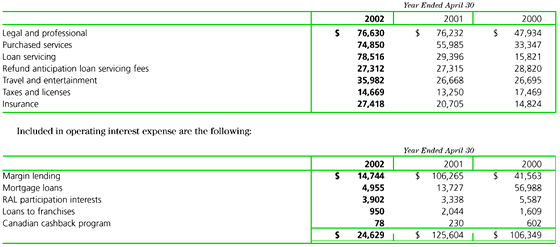
15: OTHER EXPENSES AND OPERATING INTEREST EXPENSE:
Included in other expenses are the following:
NOTE
16: TAXES ON EARNINGS
The components of earnings from continuing operations before
income taxes upon which domestic and foreign income taxes
have been provided are as follows:

Deferred
income tax provisions (benefits) reflect the impact of temporary
differences between amounts of assets and liabilities for
financial reporting purposes and such amounts as measured
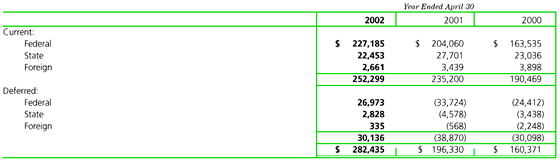
by tax laws. The current and deferred components of taxes
on earnings from continuing operations are comprised of the
following:
Unremitted
earnings of foreign subsidiaries aggregated $82,913 at April
30, 2002. Management intends to indefinitely reinvest foreign
earnings, therefore, a provision has not been made for income
taxes which might be payable upon remittance of such earnings.
Moreover, due to the availability of foreign income tax credits,
management believes the amount of federal income taxes would
be immaterial in the event foreign earnings were repatriated.
The following
table reconciles the U.S. Federal income tax rate to the Company’s
effective tax rate:

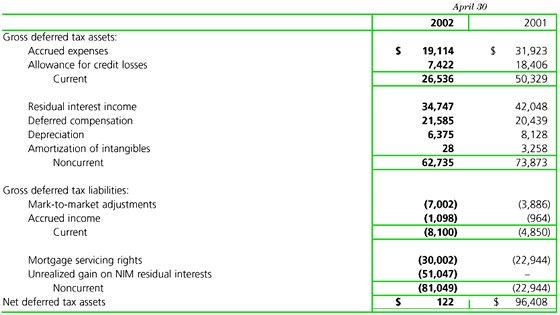
A summary
of deferred taxes follows:
|





















