NOTE 8: PROPERTY AND EQUIPMENT
A summary of property and equipment follows:
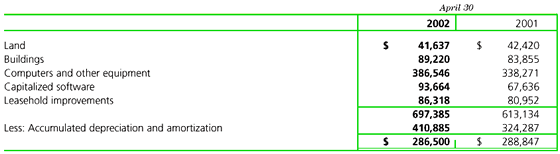
Depreciation and amortization expense for
2002, 2001 and 2000 amounted to $110,860, $101,332 and $80,872,
respectively. Included in depreciation and amortization expense
is amortization of capitalized software of $25,426, $16,122
and $6,006 for fiscal 2002, 2001 and 2000, respectively. As
of April 30, 2002 and 2001, the Company has property and equipment
under capital lease with a cost of $27,386 and $45,913, respectively,
and accumulated depreciation of $4,088 and $4,563, respectively.
The Company has an agreement to lease real estate and buildings
under a noncancelable capital lease for the next 18 years
with an option to purchase after five years. The real estate,
building and long-term debt of $14,075 related to this lease
were treated as a noncash investing activity on the consolidated
statement of cash flows for the year ended on April 30, 2000.
NOTE
9: LONG-TERM DEBT
On April 13, 2000, the Company issued $500,000 of 81/2 % Senior
Notes under a shelf registration statement. The Senior Notes
are due April 15, 2007, and are not redeemable prior to maturity.
The net proceeds of this transaction were used to repay a
portion of the short-term borrowings which initially funded
the acquisition of OLDE Financial Corporation and Financial
Marketing Services, Inc. (collectively, “OLDE”).
On October
21, 1997, the Company issued $250,000 of 63/4 % Senior Notes
under a shelf registration statement. The Senior Notes are
due November 1, 2004, and are not redeemable prior to maturity.
The net proceeds of this transaction were used to repay short-term
borrowings, which initially funded the acquisition of Option
One Mortgage Corporation (“Option One”).
The Company had obligations related to acquisitions of accounting
firms of $164,242 and $154,110 at April 30, 2002 and 2001,
respectively. The current portion of these amounts is included
in the current portion of long-term debt on the consolidated
balance sheet. The long-term portions are due from August
2003 to December 2006.
The Company
had mortgage notes and capitalized lease obligations of $16,901
at April 30, 2002 that are collateralized by land, buildings
and equipment. The obligations are due at varying dates for
up to 18 years.
The aggregate
payments required to retire long-term debt are $59,656, $51,735,
$276,254, $21,248, $508,109 and $11,041 in 2003, 2004, 2005,
2006, 2007 and beyond, respectively.
Based upon borrowing rates currently available to the Company
for indebtedness with similar terms, the fair value of the
long-term debt was approximately $938,920 and $907,115 at
April 30, 2002 and 2001, respectively.
NOTE
10: OTHER NONCURRENT LIABILITIES
The Company has deferred compensation plans which permit directors
and certain employees to defer portions of their compensation
and accrue earnings on the deferred amounts. The compensation,
together with Company matching of deferred amounts, has been
accrued, and the only expenses related to these plans are
the Company match and the earnings on the deferred amounts
which are not material to the financial statements. Included
in other noncurrent liabilities are $54,174 and $44,490 at
April 30, 2002 and 2001, respectively, to reflect the liability
under these plans. The Company purchases whole-life insurance
contracts on certain related directors and employees to recover
distributions made or to be made under the plans and records
the cash surrender value of the policies in other assets.
If all the assumptions regarding mortality, earnings, policy
dividends and other factors are realized, the Company will
ultimately realize its investment plus a factor for the use
of its money.
In connection
with the Company’s acquisition of the non-attest assets
of McGladrey & Pullen, LLP (“McGladrey”) in
August 1999, the Company assumed certain pension liabilities
related to McGladrey’s retired partners. The Company
makes payments in varying amounts on a monthly basis. Included
in other noncurrent liabilities at April 30, 2002 and 2001
are $25,655 and $31,360, respectively, related to this liability.
NOTE
11: STOCKHOLDERS’ EQUITY
On June 20, 2001, the Company’s Board of Directors declared
a two-for-one stock split of its Common Stock in the form
of a 100% stock distribution effective August 1, 2001, to
shareholders of record as of the close of business on July
10, 2001. All share and per share amounts have been adjusted
to reflect the retroactive effect of the stock split.
The Company
is authorized to issue 6,000,000 shares of Preferred Stock,
without par value. At April 30, 2002, the Company had 5,560,833
shares of authorized but unissued Preferred Stock. Of the
unissued shares, 600,000 shares have been designated as Participating
Preferred Stock in connection with the Company’s shareholder
rights plan.
On March
8, 1995, the Board of Directors authorized the issuance of
a series of 500,000 shares of nonvoting Preferred Stock designated
as Convertible Preferred Stock, without par value. In April
1995, 401,768 shares of Convertible Preferred Stock were issued
in connection with an acquisition. In addition, options to
purchase 51,828 shares of Convertible Preferred Stock were
issued as a part of the acquisition and 37,399 shares of Convertible
Preferred Stock were issued in connection with these options.
Each share of Convertible Preferred Stock became convertible
on April 5, 1998 into four shares of Common Stock of the Company
(eight shares after the August 1, 2001 stock split), subject
to adjustment upon certain events. The holders of the Convertible
Preferred Stock are not entitled to receive dividends paid
in cash, property or securities and, in the event of any dissolution,
liquidation or winding-up of the Company, will share ratably
with the holders of Common Stock then outstanding in the assets
of the Company after any distribution or payments are made
to the holders of Participating Preferred Stock or the holders
of any other class or series of stock of the Company with
preference over the Common Stock.
NOTE
12: COMPREHENSIVE INCOME
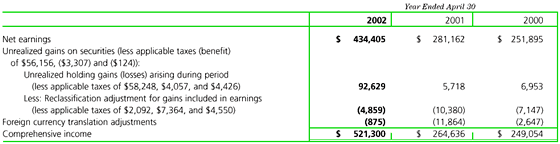
The Company’s comprehensive income is comprised of net
earnings, foreign currency translation adjustments and the
change in the net unrealized gain or loss on available-for-sale
marketable securities. Included in stockholders’ equity
at April 30, 2002 and 2001, the net unrealized holding gain
(loss) on available-for-sale securities was $85,682 and $(2,088),
respectively, and the foreign currency translation adjustment
was $(41,554) and $(40,679), respectively.
NOTE
13: EMPLOYEE BENEFIT PLANS
The Company has four stock compensation plans: the 1993 Long-Term
Executive Compensation Plan, the 1989 Stock Option Plan for
Outside Directors, the 1999n Stock Option Plan for Seasonal
Employees, and the 2000 Employee Stock Purchase Plan ("ESPP").
All of the Company's Stock compensation plans have been approved
by the shareholders.
The 1993 plan was approved by the shareholders
in September 1993 to replace the 1984 Long-Term Executive
Compensation Plan, which terminated at that time except with
respect to outstanding awards therunder. Under the 1993 and
1989 plans, options may be granted to selected employees and
outside directors to purchase the Company's Common Stock for
periods not exceeding 10 years at a price that is not less
than 100% of fair market value on the date of the grant. The
options are exercisable either (1) starting one year after
the date of the grant, (2) starting one year or three years
after the date of the grant on a cumulative basis at the annual
rate of 33 1/3% of the total number of options shares, or
(3) starting three years after the date of the grant on a
cumulative basis at the rate of 40%, 30%, and 30% over the
following three years. In addition, certain option grants
have accelerated vesting provisions based on the Company's
stock price reaching specified levels.
The 1999 Stock Option Plan for Seasonal Employees
provided for the grant of options on June 30, 2001, 2000 and
1999 at the market price on the date of the grant. The options
are exercisable during September through November in each
of the two years following the calendar year of the grant,
subject to certain conditions.
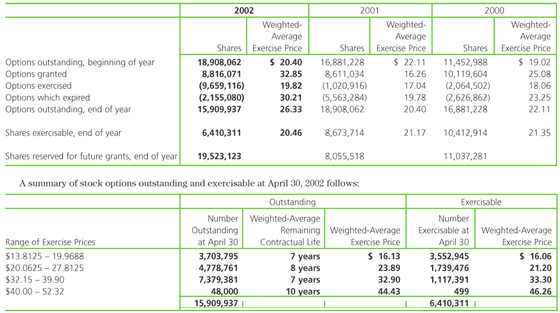
Changes
during the years ended April 30, 2002, 2001 and 2000 under
the stock option plans were as follows:
The 2000
ESPP provides the option to purchase shares of the Company’s
Common Stock through payroll deductions to a majority of the
employees of subsidiaries of the Company. The purchase price
of the stock is 90% of the lower of either the fair market
value of the Company’s Common Stock on the first trading
day within the Option Period or on the last trading day within
the Option Period. The Option Periods are six-month periods
beginning January 1 and July 1 each year. During fiscal 2002
and 2001, 97,052 and 27,345 shares, respectively, were purchased
under the ESPP out of a total authorized 6,000,000 shares.
|





















