NOTE 5: RESIDUAL INTERESTS IN SECURITIZATIONS AND MORTGAGE
SERVICING RIGHTS
Beginning in April 2000, the Company entered into off-balance
sheet arrangements under which the Company originates mortgage
loans and sells the mortgage loans the same day the loans
are funded to a third-party trust (“Trust”). As
a result of the whole-loan sale to the Trust, the Company
records a receivable from the Trust for a portion of the net
spread that the Trust has earned while holding the mortgage
loans. This receivable is included in prepaid and other current
assets on the consolidated balance sheet. The Companythen
pledges its receivable to a securitization trust (qualified
special purpose entity) and the Trust pledges the related
mortgage loans to the securitization trust to reconstitute
the loans. The securitization trust then securitizes the mortgage
loans. At this point, the Company’s receivable is recharacterized
as a residual interest from the securitized loans. The residual
interest is classified as either an available-for-sale security
or a trading security depending on certain criteria as established
by the Company. The Company then securitizes these residual
interests in net interest margin (“NIM”) transactions.
The Company securitized $809,226 and $380,267 of these residual
interests in NIM transactions during fiscal year 2002 and
2001, respectively. The receivable from whole-loan sales of
$26,057 and the pledge of this receivable of $19,960, were
treated as noncash investing activities in the consolidated
statement of cash flows for the year ended April 30, 2002.
The receivable from the whole-loan sales of $66,587 and the
pledge of this receivable of $14,206, were treated as noncash
investing activities in the consolidated statement of cash
flows for the year ended April 30, 2001. The Company received
proceeds from NIM securitizations of $783,171 and cash flows
from interest-only strips of $67,070 from the securitization
trusts in fiscal 2002. The Company received proceeds from
NIM securitizations of $319,620 and cash flows from interest-only
strips of $16,024 from the securitization trusts in fiscal
2001. Cash received on the interest-only strips is included
in maturities of available-for-sale securities on the consolidated
statements of cash flows.
In
connection with these off-balance sheet arrangements, the
Company entered into forward loan sale commitments whereby
the Company was obligated to sell, during fiscal 2001, a minimum
of $2,000,000 and a maximum of $6,000,000 in mortgage loans.
There was no commitment fee and the commitments are renewable
annually. For fiscal 2002, the forward loan sale commitments
were not renewed.
The
Company securitized $3,767,010 in mortgage loans during the
year ended April 30, 2000, resulting in residual interests
with an allocated carrying value of $245,801. The Company
securitized $248,555 of residual interests through NIM transactions.
The remaining residual interests from the securitizations
during 2000 of $28,042 were treated as noncash investing activities
in the consolidated statement of cash flows for the year ended
April 30, 2000.
The
Company estimates future cash flows from these residuals and
values them utilizing assumptions that it believes are consistent
with those that would be utilized by an unaffiliated third-party
purchaser.
The
fair value of residuals are determined by computing the present
value of the excess of the weighted average coupon on the
loans sold over the sum of (1) the coupon on the senior interests,
(2) a base servicing fee paid to the servicer of the loans
(which is usually the Company), (3) expected losses to be
incurred on the portfolio of the loans sold (as projected
to occur) over the lives of the loans, (4) fees payable to
the trustee and insurer, (5) estimated collections of prepayment
penalty fees, (6) other fees, and (7) payments made to investors
on NIM bonds. The weighted average coupon on the loans sold
and the coupon on the senior interests take into consideration
the current and expected interest rate environment, including
projected changes in future interest rates and the timing
of such changes. Prepayment and loss assumptions used in estimating
the cash flows are based on evaluation of the actual experience
of the Company’s servicing portfolio or on market rates
on new portfolios, also taking into consideration the current
and expected interest rate environment and its expected impact
on future prepayment and default rates. The estimated cash
flows expected to be received by the Company are discounted
at an interest rate the Company believes an unaffiliated third-party
purchaser would require as a rate of return on such a financial
instrument. To the extent that actual future excess cash flows
are different from estimated excess cash flows, the fair value
of the Company’s residual could increase or decrease.
Mortgage
servicing rights are included in other assets on the consolidated
balance sheet. Assumptions used in estimating the value of
MSRs includes market discount rates and anticipated prepayment
speeds. The prepayment speeds are estimated using the Company’s
historical experience and third party market sources for fixed-rated
mortgages with similar coupons and prepayment reports for
comparable adjustable rate mortgage loans. The fair value
of MSRs at April 30, 2002, 2001 and 2000 was $81,893, $61,796
and $42,282, respectively. Additions to and amortization of
MSRs for fiscal 2002 were $65,630 and $33,890, respectively.
An $11,643 write-down of MSRs was taken in the third quarter
of fiscal 2002 to reflect a change in the assumptions underlying
the related loan portfolio. Additions to and amortization
of MSRs for fiscal 2001 were $37,661 and $18,147, respectively.
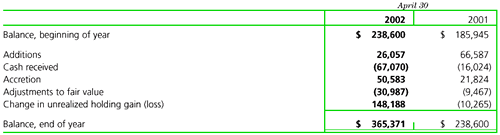
Activity
related to residual interests in securitizations consists
of the following:
The
key assumptions the Company utilizes to estimate the cash
flows of the residual interests and MSRs are as follows:

At
April 30, 2002, the sesitivity of the current fair value of
the residuals and MSRs to 10% and 20% adverse changes in the
above key assumptions are as follows:
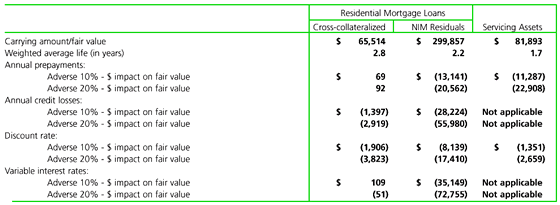
These
sensitivities are hypothetical and should be used with caution.
As the figures indicate, changes in fair value based on a
10% variation in assumptions generally cannot be extrapolated
because the relationship of the change in assumption to the
change in fair value may not be linear. Also in this table,
the effect of a variation of a particular assumption on the
fair value of the retained interest is calculated without
changing any other assumptions; in reality, changes in one
factor may result in changes in another, which might magnify
or counteract the sensitivities.
NOTE
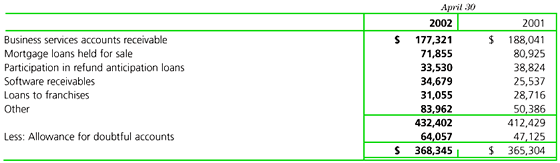
6: RECEIVABLES
Receivables consist of the following:
NOTE
7: INTANGIBLE ASSETS AND GOODWILL
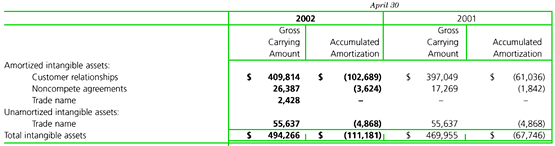
Intangible
assets consist of the following:
Changes
in the carrying amount of goodwill by segment for the year
ended April 30, 2002, are as follows:

|





















